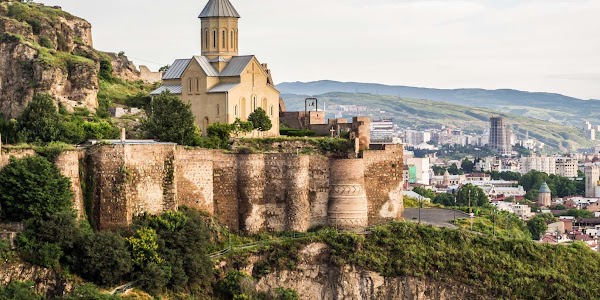
Nariqala Fortress is a fortress in Tbilisi, Georgia. Medieval fortress overlooking Tbilisi's Old Town, built in the 4th century and rebuilt multiple times through Georgian, Persian, and Ottoman rule. Most visitors spend 1–2 hours here. The free Lokali audio guide runs 9 minutes.
✓ Verified August 2026 · how we write these guides
Visitor facts
| Time needed | 1–2 hours |
|---|---|
| Lokali audio guide | 9 min · free |
| Type | Fortress |
| Best for | History |
| Location | Tbilisi, Georgia |
| Coordinates | 41.7168, 44.8071 |
| Languages | 45, in the Lokali app |
The story
The stone beneath your feet is warm from the sun, worn smooth by centuries of footsteps. Up here on the ridge, the wind carries the scent of pine and dust, and Tbilisi spreads below you in layers of terracotta roofs, green copper domes, and the silver curve of the Mtkvari River. Nariqala clings to this rocky spine like a natural outcrop, its honey-coloured walls following the contours of the hillside.
The fortress you are standing in has watched over this valley since at least the fourth century. Persians built the earliest walls, Byzantines reinforced them, Arabs expanded the complex, Mongols stormed it, Georgians reclaimed it, and finally an earthquake in 1827 brought down much of what you see today. What remains are fragments — thick curtain walls, ruined towers, the skeletal outline of a citadel that once enclosed barracks, cisterns, and a royal residence.
For photographers, the light here shifts dramatically through the day. Early morning delivers soft gold that wraps the old town in amber, perfect for wide shots across the rooftops toward the Sameba Cathedral. The shadows are long and gentle. By midday, the sun is harsh and flat — locals retreat indoors, and you should probably follow. Late afternoon is when the magic returns. The low sun rakes across the fortress walls, picking out every crack and repair in the stonework, and the city below begins to glow.
The best vantage points are along the upper ramparts on the western side, where you can frame the Mother of Georgia statue in the foreground with the modern city rising behind her. Move along the wall and you will find gaps where the stone frames the Metekhi Church perched on its own cliff across the river. These natural windows in the ruins make strong compositional anchors — use them to layer depth into your shots.
Just below the main fortress walls stands the Church of Saint Nicholas, rebuilt in 1996 on the foundations of a thirteenth-century chapel. Its pale stone and red tile dome catch the afternoon light beautifully, and the contrast between the crisp new masonry and the weathered fortress ruins behind it tells the whole story of this place in a single frame. Step inside briefly if the door is open — the interior is small and dim, painted with vivid frescoes that glow in the filtered daylight.
The cable car that brought many visitors up here is itself a subject worth shooting. The red gondolas glide silently over the Botanical Garden and the old town, their reflections catching in the glass and metal. If you ride it at dusk, you can shoot the city lights beginning to flicker on below, the river turning indigo, the fortress walls lit by warm floods.
Texture is everywhere up here. The fortress stones are a patchwork of repair — smooth medieval blocks next to rough Soviet-era concrete patches, all of it slowly weathering to the same dusty gold. Tufts of wild grass push through cracks in the battlements. Lizards sun themselves on the warm stone. These small details anchor the grandeur of the place in something tangible and immediate.
Tbilisi's layered history is visible from this height in a way it never is at street level. The winding lanes of the old town, the nineteenth-century mansions along Rustaveli Avenue, the brutal Soviet apartment blocks on the hills, the glittering new developments along the river — all of it compressed into a single panorama. The fortress has outlasted every regime, every architectural fashion, every conqueror.
If you are shooting at sunset, position yourself on the eastern wall facing the old town. The sun drops behind you, lighting the entire valley in warm pink and orange. The shadows deepen in the narrow streets below, and the domes and spires begin to stand out in silhouette. This is the golden hour stretched into forty minutes of perfect light.
The walk down through the Botanical Garden offers a completely different perspective — dense green canopy, a hidden waterfall, stone bridges over narrow streams. The light filters through the leaves in dappled patches, and the city noise fades to birdsong and running water. It is a quiet counterpoint to the fortress views above, and worth the descent if your knees can handle the steep stone steps.
When you leave, glance back at the fortress from the streets below. It changes character depending on where you stand — from some angles it looks like a ruin, from others a living monument. The walls are never quite the same colour twice, shifting with the light and the season and the hour. That restlessness, that refusal to settle into a single fixed image, is what keeps photographers coming back.
Key facts
What to look for
Practical tips
Common questions
How long do you need at Nariqala Fortress?
Plan 1–2 hours. That is the time most visitors spend at Nariqala Fortress. The free Lokali audio guide adds about 9 minutes of narration you can listen to as you walk, so it fits inside your visit rather than adding to it.
Is there a free audio guide to Nariqala Fortress?
Yes — the Lokali app narrates Nariqala Fortress free of charge in 50+ languages. It covers the history, what to look for on site and practical tips, and it works offline once downloaded.
Where is Nariqala Fortress?
Nariqala Fortress is in Tbilisi, Georgia, at 41.7168, 44.8071. Tap the map link on this page for directions from where you are.
What should you know before visiting Nariqala Fortress?
Shoot early morning or late afternoon for best light.
What is Nariqala Fortress known for?
Fortress foundations date to the fourth century.
What is the best time to visit Nariqala Fortress?
Climb at dusk when the stone glows amber and the city lights begin to twinkle.
On the map
Opens directions to Nariqala Fortress from your location.
More to see in Tbilisi

Hear Nariqala Fortress in your language
The full story, narrated, in 50+ languages. Download it before you go and it plays offline, at your own pace, with no ticket and no tour group.