
The King's Grave
55.6825° N · 14.2339° E · Archaeological Site
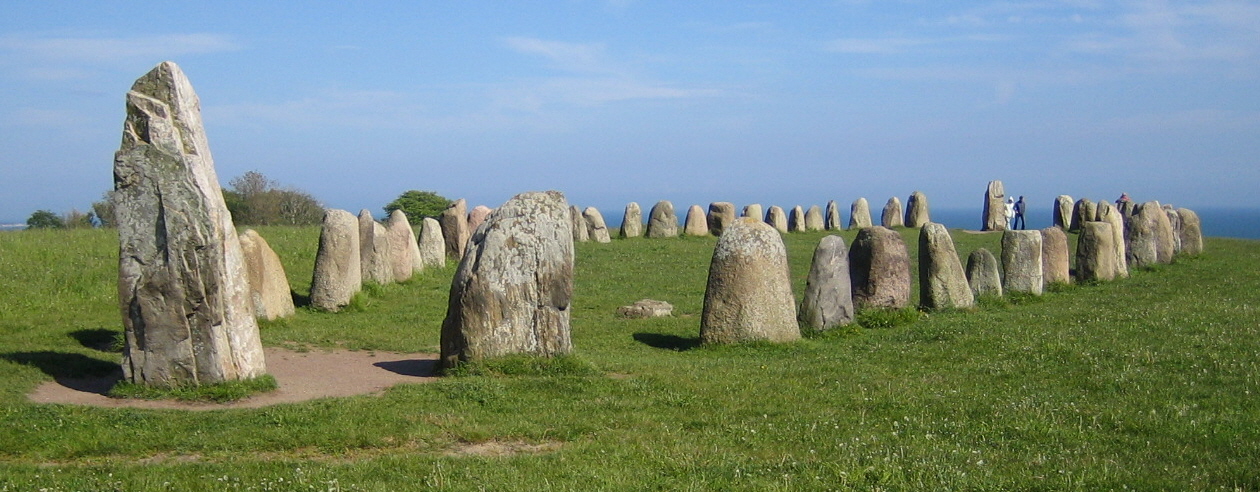
Photo: Abelson at English Wikipedia · CC BY 2.5 · Wikimedia Commons
The King's Grave is a nordic bronze age grave in Kivik, southern Sweden. Built during the Nordic Bronze Age, over three thousand years ago. The free Lokali audio guide runs 6 minutes.
✓ Published October 2026 · how we write these guides
Visitor facts
| Lokali audio guide | 6 min · free |
|---|---|
| Type | Archaeological Site |
| Location | Simrishamn, Sweden |
| Coordinates | 55.6825, 14.2339 |
| Languages | 50+, in the Lokali app |
The story
Listen first. Gravel shifts under your shoes. Wind comes in off the Baltic, carrying salt and the faint sweetness of apple orchards. In front of you rises a low, wide mound of grey stones. It is not a building and not a ruin in the usual sense. It is a pile of rocks, stacked by human hands more than three thousand years ago. Here, just outside the village of Kivik, you are standing beside the King's Grave.
The Swedes call it Kungagraven. It is a cairn, a burial mound built from loose stones rather than earth. Archaeologists date it to the Nordic Bronze Age, roughly the middle of the second millennium before Christ. That places it in the same broad era as the great kingdoms of Egypt. Far to the south, pharaohs were building temples. Here, on this coast, people gathered thousands of stones to honour someone they considered important.
Take a moment to judge the scale. The cairn is about seventy-five metres across, among the largest Bronze Age monuments in Scandinavia. Walk a few steps along its edge and you will feel how wide it is. Every stone was carried here. No machines, no draft animals of the kind we would recognise for heavy work. Just people, over a long period, building something meant to last. And it has lasted... though not quite untouched.
For centuries, the cairn was a convenient quarry. Local farmers took stones for walls, foundations, and fields. Nobody saw it as sacred anymore. In 1748, two farmers were digging stones out of the mound when they struck something unexpected. Under the rubble lay a long chamber built from flat stone slabs. They thought they might find treasure. What they found, in the end, was far more valuable to history than gold.
The chamber is a stone cist, a box-like grave made of upright slabs. Several of those slabs carry carvings on their inner faces. These are not random scratches. They are deliberate pictures, cut into hard stone with Bronze Age tools. Here is the first surprise. Rock carvings are common in southern Scandinavia, usually on open bedrock under the sky. Carvings inside a sealed grave, meant to be seen by no living person, are extremely rare.
What happened after the discovery is a story of loss. The farmers' digging disturbed the grave. Over the following decades, slabs were moved, damaged, or carried off. The original burial goods are largely unknown to us. Early drawings made by curious visitors became precious records. Much later, in the 1930s, archaeologists excavated the site properly and restored it. They rebuilt the cairn's shape and created the passage you can walk through today.
So when you step inside, remember what you are seeing. This is a careful reconstruction around an ancient core. The passage is modern. The chamber at its heart follows the original layout. Several slabs are ancient. Where pieces were lost, restorers used the old drawings as a guide. It is a meeting of two eras: Bronze Age builders and twentieth-century archaeologists, both trying to preserve something they believed mattered.
Now look closely at the carvings. You will see ships, simple curved hulls with lines for crew. You will see horses, and a figure standing on a two-wheeled chariot. There are axes, wavy lines, and circular shapes that may be sun symbols. On one slab, a row of figures appears to move in procession. Some seem to hold long curved instruments. Scholars often connect these to the lur, a Bronze Age horn made of cast bronze.
What do the pictures mean? Honestly, nobody knows for certain. Many researchers read them as a funeral ceremony, with music, sacrifice, and ritual. Others see religious scenes connected to the sun and its journey across the sky. Ships and the sun appear together often in Bronze Age art across Scandinavia. Be careful with any confident explanation you hear. These people left no writing. The images are their only voice.
And the king? That name is ours, not theirs. The title King's Grave came much later, from people who assumed such a large monument must hold a ruler. Locals have long told stories about who lay here, and legend has filled the gap that evidence cannot. The truth is quieter. Someone important was buried here, someone whose community spent enormous effort in their honour. Their name is gone.
Here is the second surprise. Look at where the cairn stands. It sits close to the shore of Hanö Bay, part of the Baltic Sea. In the Bronze Age, the sea was a highway. Bronze itself was not made from local ore. Copper and tin had to arrive through long trade routes from the south. A monument like this shows wealth, connections, and power on a coast that faced outward, toward other peoples.
When you come back outside, notice the landscape around you. The fields, the low hills, the orchards. Kivik is known across Sweden for its apples, and in late summer the air carries their scent. This gentle farmland once supported Bronze Age communities too. Other ancient mounds and stones are scattered across this corner of Skåne, the southern province of Sweden. The King's Grave is the largest voice in a much wider conversation.
Before you leave, stand still for a moment beside the stones. Feel how cold they are, even on a warm day. Notice the grey lichen on their surfaces, and the gaps where rain drains through. Somewhere beneath you, people once laid a body to rest with music and ceremony. As you walk back toward the road, glance over your shoulder. The mound will look smaller with each step... and older than almost anything else you will see today.
Key facts
What to look for
Practical tips
Common questions
Is there a free audio guide to The King's Grave?
Yes — the Lokali app narrates The King's Grave free of charge in 50+ languages. The guide runs about 6 minutes, covers the history, what to look for on site and practical tips, and works offline once downloaded.
Where is The King's Grave?
The King's Grave is near Simrishamn, Sweden, at 55.6825, 14.2339. Tap the map link on this page for directions from where you are.
What is The King's Grave known for?
Built during the Nordic Bronze Age, over three thousand years ago. Cairn measures roughly seventy-five metres across.
What should you look for at The King's Grave?
Ships with crew lines carved into the chamber slabs. A figure standing on a two-wheeled chariot. A procession of figures holding long curved horns.
What should you know before visiting The King's Grave?
Walk the full outer edge to grasp the cairn's scale. Bring a light or let eyes adjust inside the chamber.
When is the best time to visit The King's Grave?
Visit in late summer when Kivik's orchards fill the air.
On the map
Opens directions to The King's Grave from your location.
More to see near The King's Grave
Hear The King's Grave in your language
The full story, narrated, in 50+ languages. Download it before you go and it plays offline, at your own pace, with no ticket and no tour group.