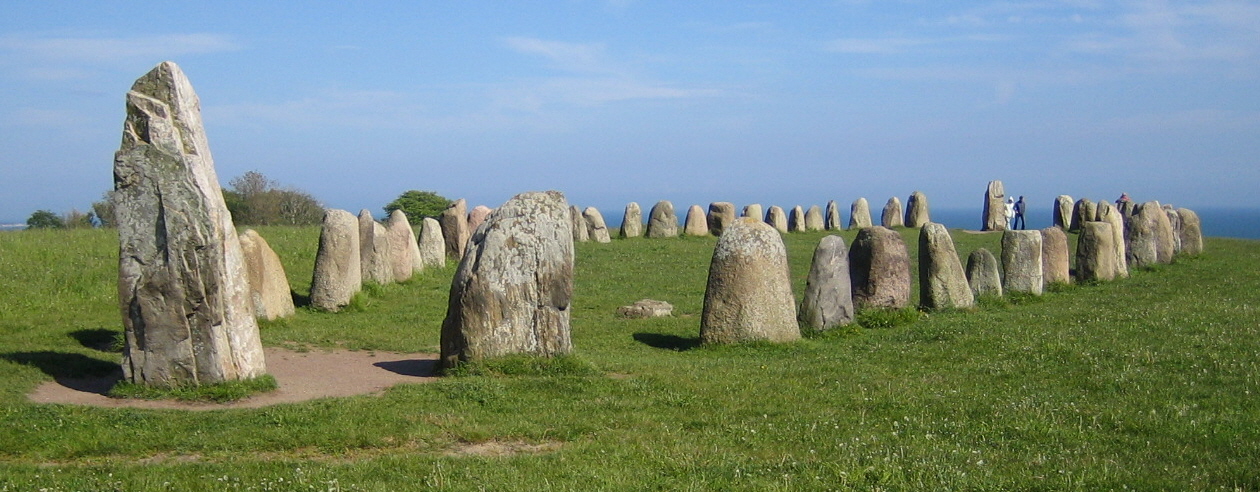
Ale's Stones
55.3827° N · 14.0544° E · Archaeological Site
Photo: Wikimedia Commons contributor · CC BY-SA 3.0 · Wikimedia Commons
Ale's Stones is a stone ship in Ystad, Sweden. Fifty-nine boulders form the outline of the stone ship. The free Lokali audio guide runs 7 minutes.
✓ Published October 2026 · how we write these guides
Visitor facts
| Lokali audio guide | 7 min · free |
|---|---|
| Type | Archaeological Site |
| Location | Ystad, Sweden |
| Coordinates | 55.3827, 14.0544 |
| Languages | 50+, in the Lokali app |
The story
Listen first. The wind comes in off the Baltic and moves through the grass on this ridge with a steady, dry hiss. Somewhere below, gulls call over the harbour. Under your feet the ground is springy turf, cropped short. Ahead of you, standing in a long oval against the sky, is a ring of grey boulders. They lean slightly, as if the wind has pushed on them for a very long time. This is Ale's Stones, known in Swedish as Ales stenar.
Take a moment to see the shape. The stones are not set in a circle. They form a long, pointed oval, wider in the middle and narrowing at each end. If you picture it from above, it looks like the outline of a boat. That is exactly what it is meant to be. Archaeologists call this kind of monument a ship setting. It is a ship made of stone, laid out on land, pointing toward the horizon.
Ship settings are found across Scandinavia and around the Baltic. Many of them are linked to burials. The idea, as far as scholars can tell, was connected to journeys and to death. A ship carried people across water in life. A stone ship may have marked a final crossing. This one is among the largest ship settings known in Sweden. Fifty-nine boulders make up the outline, and the whole ship runs for around sixty-seven metres from end to end.
Now look at the two ends. The stones at the bow and the stern are taller and heavier than the stones along the sides. They work like the raised prow and stern of a real Viking-style vessel. Walk toward one of them and stand beside it. Notice how much of the sky it blocks. Then notice the gap between the side stones, and how the line of the hull curves gently, not in a perfect geometric arc.
When was it built? This is where honesty matters. The most widely cited dating, based on radiocarbon analysis of material found at the site, places the ship in the late Iron Age, roughly fourteen hundred years ago. That would be before the Viking Age proper. But the debate is not completely closed. Some researchers have argued for an older origin, and the ridge itself shows signs of human activity from much earlier periods. So the safest answer is this: the stone ship is very old, and people have used this hilltop for thousands of years.
Here is something many visitors miss. The monument you see today was not always standing so neatly. Over the centuries, stones fell, sank, or were moved. In the early twentieth century, the site was restored and fallen stones were raised back into position. So when you look at the outline, you are looking at an ancient design, partly reconstructed in modern times. The stones are old. Their exact placement is a careful collaboration between the past and the people who repaired it.
There is also the question of the sun. A popular theory says the ship works as a kind of solar calendar. According to this idea, the sun sets over one end stone at midsummer and rises over the other end at midwinter. Other alignments with the seasons have been proposed too. The theory has many supporters among visitors and enthusiasts. Many professional archaeologists remain unconvinced and treat it as speculation. You are welcome to test it yourself. Stand at the centre and watch where the sun goes.
And the name? Nobody knows for certain who Ale was. Local folklore links the stones to a legendary king called Ale, said to be buried here. According to one tale, the ship marks his grave, facing the sea he once sailed. There is no historical record that confirms this king existed. Treat the story as what it is — a legend that has grown around the stones, the way stories gather around any place this old and this strange.
Turn around now and look at the setting. The ship sits on a high ridge above the fishing village of Kåseberga, on the southern coast of Skåne, Sweden's southernmost province. The land drops away steeply toward the water. On a clear day, the sea stretches out in bands of blue and grey. There are no trees to break the wind. Whoever chose this spot wanted the ship to be seen from far away, and to look out over open water.
The ridge itself is part of the experience. In some seasons, grazing animals keep the grass short, and you may share the hilltop with them. The soil is thin, and the slope toward the cliff edge is real. Keep children close near the edge. In the evening, the light turns low and golden, and the shadows of the stones stretch long across the turf. In summer, the hilltop fills with visitors at sunset. In winter, you may have it almost to yourself.
Look closely at the stones themselves. They are not identical. Some are rough and rounded, others flatter, with different colours and textures. Lichen grows on their surfaces in patches of pale green, yellow and orange. Rain and wind have worn them smooth in places. These boulders were moved and set upright by people without machines. That effort alone tells you this place mattered deeply to the community that built it.
Below you, Kåseberga harbour is worth a visit on your way back. It is a small working fishing village with a harbour, boats, and places that sell smoked fish — a long tradition along this coast. The walk between the harbour and the ridge is short but uphill. It gives you a chance to see how the monument sits above ordinary daily life. Fishing boats below, an ancient stone ship above. Both look out at the same sea.
Before you leave, stand once more inside the outline of the ship. Feel the wind on your face. Listen to the grass and the gulls. Look along the line of stones toward the far end, and then out to the horizon beyond it. Whoever raised these boulders stood on this same ridge, under this same sky, looking at this same water. As you walk away, glance back once. From a distance, the stones look small again — a quiet grey shape, still pointing out to sea.
Key facts
What to look for
Practical tips
Common questions
Is there a free audio guide to Ale's Stones?
Yes — the Lokali app narrates Ale's Stones free of charge in 50+ languages. The guide runs about 7 minutes, covers the history, what to look for on site and practical tips, and works offline once downloaded.
Where is Ale's Stones?
Ale's Stones is in Ystad, Sweden, at 55.3827, 14.0544. Tap the map link on this page for directions from where you are.
What is Ale's Stones known for?
Fifty-nine boulders form the outline of the stone ship. The ship setting runs around sixty-seven metres long.
What should you look for at Ale's Stones?
The taller stones marking the ship's bow and stern. Orange and yellow lichen patches on the boulder surfaces. The boat-shaped curve of the hull from one end.
What should you know before visiting Ale's Stones?
Wear sturdy shoes for the uphill walk from Kåseberga. Bring a windproof layer; the exposed ridge gets gusty.
When is the best time to visit Ale's Stones?
Come at sunset to watch the sun meet the stones.
On the map
Opens directions to Ale's Stones from your location.
More to see near Ale's Stones


Hear Ale's Stones in your language
The full story, narrated, in 50+ languages. Download it before you go and it plays offline, at your own pace, with no ticket and no tour group.