
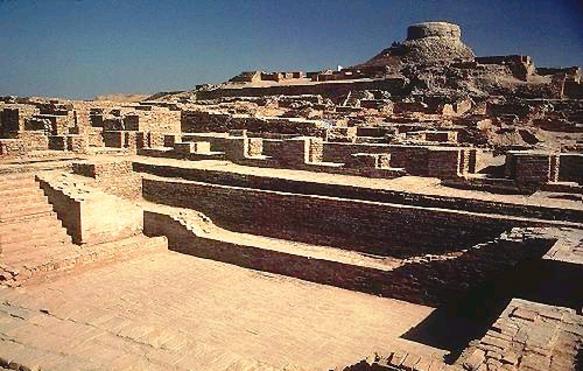
Great Bath
27.3292° N · 68.1389° E · Archaeological Site
Photo: Saqib Qayyum · CC BY-SA 3.0 · Wikimedia Commons
Great Bath is a structure at the ruins of Mohenjo-daro in Sindh, Pakistan. Built by the Indus Valley Civilisation over four thousand years ago. The free Lokali audio guide runs 7 minutes.
✓ Published October 2026 · how we write these guides
Visitor facts
| Lokali audio guide | 7 min · free |
|---|---|
| Type | Archaeological Site |
| Location | Sindh, Pakistan |
| Coordinates | 27.3292, 68.1389 |
| Languages | 50+, in the Lokali app |
The story
Start with your feet. The ground here is dry and pale, and the bricks under the dust are close and even. Many of them are the colour of weak tea. The air carries a faint smell of baked earth and salt. On a still morning you can hear birds over the plain and wind moving through the mound. In front of you is a rectangle sunk into the ground, lined with brick and edged with steps. It looks simple. It is one of the oldest public water tanks humans ever built.
You are standing on the ruins of Mohenjo-daro, in Pakistan's province of Sindh, not far from the Indus River. The city belonged to the Indus Valley Civilisation, also called the Harappan Civilisation. It is one of the earliest urban cultures on Earth, alongside ancient Egypt and Mesopotamia. Its cities rose in the third millennium before the common era. That means this tank was built more than four thousand years ago. When it was new, the pyramids of Giza were young.
The name Mohenjo-daro is not ancient. It is commonly translated from Sindhi as the Mound of the Dead. Nobody knows what the city's own people called it. Their writing survives on small carved seals, but no one has yet deciphered it. So every word you hear about this place comes from the bricks, the drains and the objects in the soil. The builders left no written explanation for any of it.
Now look closely at the tank itself. It is roughly twelve metres long and seven metres wide. It is a little under two and a half metres deep. Two staircases lead down into it, one at each narrow end. The steps once had wooden treads set into the brick. The floor slopes gently toward one corner. That slope was deliberate. It sent water toward an outlet, so the tank could be drained and cleaned.
Here is the first detail that surprises many visitors. The builders made this tank watertight with great care. They laid fired bricks on edge and set them tightly together with a gypsum mortar. Behind the brick lining, they added a layer of bitumen, a natural black tar. Then they built another wall of brick outside that. It was a careful, layered seal against leaks, made with materials and methods that engineers would still recognise today.
Water had to come from somewhere. Archaeologists found a well in a room close to the bath, and many scholars think it supplied the tank. When the water was let out, it ran into a large drain covered with a brick arch. That drain joined the wider system of the city. Mohenjo-daro had covered drains along many of its streets. Houses had bathing areas connected to them. Clean water and waste water were planned at the scale of a whole town.
Around the tank, the walls show the outline of a larger building. A corridor or colonnade seems to have run around the pool. Small rooms opened off it on several sides. Some scholars imagine people changing or preparing in those rooms before going down the steps. Others are more cautious. The plan is clear on the ground, but the way people used each room is a matter of interpretation, not record.
So what was the Great Bath for? The honest answer is that we do not know for certain. The most common view is that it served a ritual purpose, something to do with purity and washing. That idea draws on the importance of ritual bathing in later South Asian traditions, from temple tanks to river steps. It is a reasonable connection. But it is a theory, and you should hear it as one.
The excavation story belongs to the twentieth century. The ruins were identified as a major ancient city in the early 1920s. Large-scale digging followed under the Archaeological Survey of India, then led by Sir John Marshall. The bath was uncovered in the mid 1920s. The discovery changed how the world understood early history. It showed that a planned, sophisticated civilisation had flourished in this river valley long before anyone had expected.
Lift your eyes now to the higher ground nearby. This part of the site sits on a raised mound that archaeologists call the Citadel. Close by stands a dome-shaped brick ruin. That is a Buddhist stupa, a monument built to hold relics. It is far younger than the bath, by more than two thousand years. People returned to this mound long after the Indus city had emptied, and built their own sacred place above the older ruins.
Here is a second surprise, and it concerns the future. The greatest threat to these bricks is not people. It is salt. Groundwater in the area carries salts. When moisture rises through the brick and dries in the sun, salt crystals form and slowly break the surface apart. You may see white crusts or crumbling faces on some walls. Conservation teams have worked against this problem for decades. It is one reason Mohenjo-daro became a UNESCO World Heritage Site in 1980.
As you walk on, notice the shape of the city beyond the bath. In the lower town, streets run in fairly straight lines. Brick houses face onto narrow lanes. Wells sit inside private homes. The bricks follow consistent proportions across the site, which suggests shared building standards. There is a quiet order here. No grand palace dominates the view. Nobody has found a royal tomb. The most famous single structure is a place for water.
Take a final moment at the edge of the tank. Look down the worn steps toward the brick floor. Imagine it full, with the surface still and pale under the sky. Someone measured this, laid each brick, sealed each joint, and planned the slope toward the drain. Then the city faded, and the river plain kept the secret for thousands of years. When you leave, look again at the bricks beneath your feet. Many of them were laid more than four thousand years ago.
Key facts
What to look for
Practical tips
Common questions
Is there a free audio guide to Great Bath?
Yes — the Lokali app narrates Great Bath free of charge in 50+ languages. The guide runs about 7 minutes, covers the history, what to look for on site and practical tips, and works offline once downloaded.
Where is Great Bath?
Great Bath is in Sindh, Pakistan, at 27.3292, 68.1389. Tap the map link on this page for directions from where you are.
What is Great Bath known for?
Built by the Indus Valley Civilisation over four thousand years ago. Tank measures roughly twelve by seven metres.
What should you look for at Great Bath?
Two staircases descending at the narrow ends of the tank. Bricks laid on edge in tight, even rows. The corner outlet where the tank drained away.
What should you know before visiting Great Bath?
Visit early morning to avoid the strongest heat of the day. Carry plenty of water and a wide-brimmed hat.
When is the best time to visit Great Bath?
Visit early morning to avoid the strongest heat of the day.
On the map
Opens directions to Great Bath from your location.
More to see near Great Bath
Hear Great Bath in your language
The full story, narrated, in 50+ languages. Download it before you go and it plays offline, at your own pace, with no ticket and no tour group.