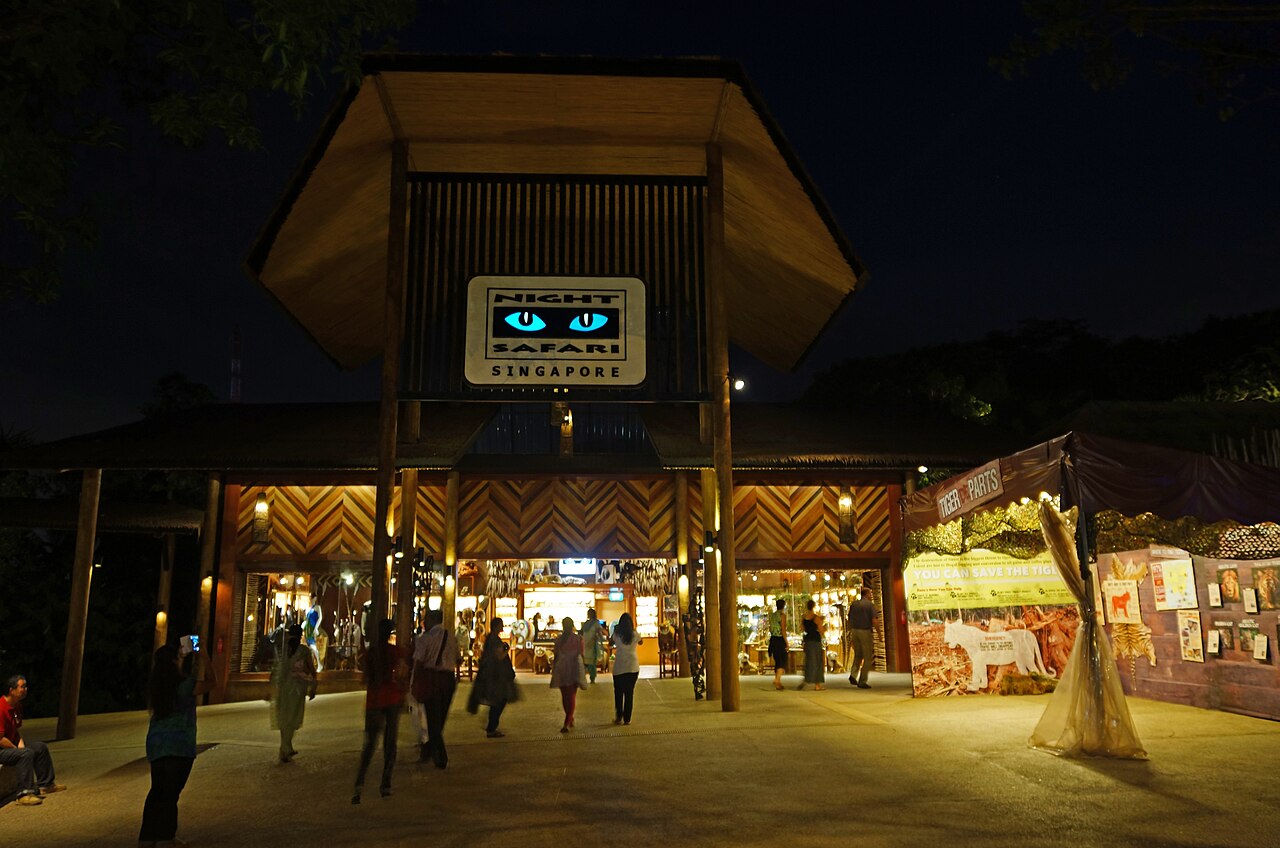
Night Safari is the world's first nocturnal zoo, featuring over 900 animals active after dark across 40 hectares. It is in Singapore. Most visitors spend 2–3 hours here. The free Lokali audio guide runs 6 minutes.
✓ Verified August 2026 · how we write these guides
Visitor facts
| Time needed | 2–3 hours |
|---|---|
| Lokali audio guide | 6 min · free |
| Type | Wildlife Park |
| Best for | Family |
| Location | Singapore, Singapore |
| Coordinates | 1.4054, 103.7878 |
| Languages | 45, in the Lokali app |
The story
Night falls early and fast near the equator. By the time you arrive, the sky over Mandai has gone dark, and the forest has changed its voice. Crickets and frogs fill the air. Somewhere ahead, a soft amber glow marks the entrance. This is the Night Safari, a wildlife park built for the hours when most zoos have already closed their gates and most animals are only beginning to wake.
The park opened in 1994, the first of its kind anywhere. The idea was simple but new at the time. A large share of the world's mammals are active at night, yet daytime zoos show them asleep. Here the schedule is turned around. The park opens in the evening and stays open late, and the animals you meet are the ones that hunt, browse, and move under cover of darkness.
The lighting is the heart of the design. Soft lamps, tuned to feel like moonlight, wash the enclosures in a pale glow that lets you see without startling the animals. There are no harsh floodlights. Your eyes adjust slowly as you walk, and shapes begin to separate from the shadows. A pair of eyes catches the light and shines back at you from across a clearing. The dimness asks you to slow down and pay attention.
Most visitors begin with the tram. It moves slowly along a winding route, its guide speaking in a low voice, carrying you through landscapes drawn from different parts of the world. You pass through scenes meant to suggest the Himalayan foothills, the river valleys of Asia, and the plains of Africa. Animals stand close to the track, separated from you by ditches and water rather than visible bars. The tram never rushes, and the darkness keeps every turn a small surprise.
For those who want to go on foot, walking trails branch off from the main route. These paths let you set your own pace and linger where you like. You move quietly between pools of light, past enclosures of smaller creatures, listening for rustles in the leaves. The trails reward patience. Stand still for a moment, and an animal that seemed absent may step forward into the light.
The park is home to animals from across Asia and beyond. Asian elephants move through their enclosure with slow, deliberate steps. Striped hyenas, sloth bears, and tapirs go about their night. Tigers pace at the water's edge. Smaller and stranger creatures appear along the trails, from giant flying squirrels to slow-moving pangolins. Each was chosen because the dark is its natural working time, and here it can behave more or less as it would in the wild.
The Night Safari covers a large area of secondary forest beside the reservoir, sharing the same green belt as the daytime zoo next door. The land was kept wooded on purpose, so the boundary between exhibit and forest often blurs. You may not always be sure where the planned enclosure ends and the surrounding jungle begins. That uncertainty is part of the effect the designers wanted.
Like its neighbor, the park frames itself around conservation and education. Many of the nocturnal species here are under pressure in the wild, hunted or squeezed out of shrinking forests. Signs and keeper talks explain how these animals live and why their night-time habits matter. By showing them awake and active, the park tries to build sympathy for creatures most people would otherwise never see in motion.
There is a particular mood to the place that daytime parks cannot match. Voices drop. Phone screens dim. Families that arrived noisy and restless grow quiet as they settle into the slow rhythm of the trams and trails. The warm night air, the smell of earth and leaves, and the steady background hum of insects all work together. You are a guest in someone else's waking hours.
Plan to spend two to three hours here. Lines for the tram can grow long soon after opening, so it can be worth walking a trail first and riding later, or the other way around. Wear shoes you can move in, and bring insect repellent. Photography with flash is not allowed, both to protect the animals' eyes and to keep the spell of the darkness intact for everyone around you.
When you finally walk back toward the gate, your eyes have grown so used to the dark that the lights of the exit feel almost too bright. Behind you, the forest carries on its night without you. The Night Safari leaves you with a quiet sense of how much life moves through the world while we sleep, unseen and unhurried, asking nothing of us but a little patience and a willingness to look.
Key facts
What to look for
Practical tips
Common questions
How long do you need at Night Safari?
Plan 2–3 hours. That is the time most visitors spend at Night Safari. The free Lokali audio guide adds about 6 minutes of narration you can listen to as you walk, so it fits inside your visit rather than adding to it.
Is there a free audio guide to Night Safari?
Yes — the Lokali app narrates Night Safari free of charge in 50+ languages. It covers the history, what to look for on site and practical tips, and it works offline once downloaded.
Where is Night Safari?
Night Safari is in Singapore, Singapore, at 1.4054, 103.7878. Tap the map link on this page for directions from where you are.
What should you know before visiting Night Safari?
Arrive near opening to ride the tram before lines grow.
What is Night Safari known for?
The Night Safari opened in 1994 in Mandai.
What is the best time to visit Night Safari?
The tram ride is essential for covering ground, but walking the Leopard Trail and Fishing Cat Trail on foot reveals patient observers to smaller nocturnal hunters.
On the map
Opens directions to Night Safari from your location.
More to see in Singapore



Hear Night Safari in your language
The full story, narrated, in 50+ languages. Download it before you go and it plays offline, at your own pace, with no ticket and no tour group.