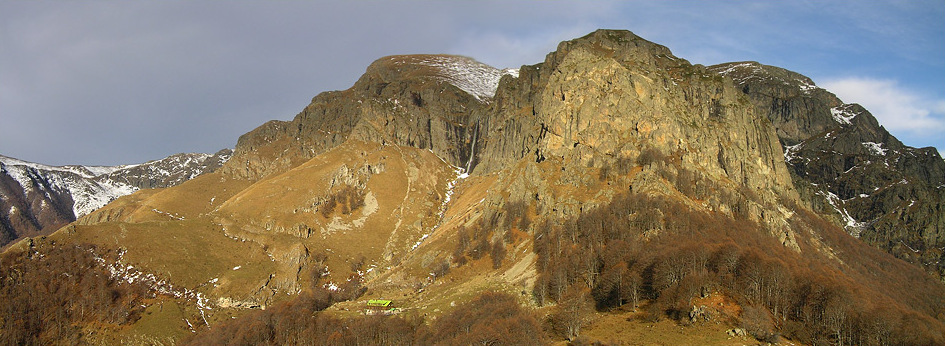
Central Balkan National Park
42.7203° N · 24.7814° E · National Park
Photo: krassiu @ Flickr. · CC BY 2.0 · Wikimedia Commons
Central Balkan National Park is a national park in Bulgaria. Established in 1991 after the end of communist rule. The free Lokali audio guide runs 8 minutes.
✓ Published October 2026 · how we write these guides
Visitor facts
| Lokali audio guide | 8 min · free |
|---|---|
| Type | National Park |
| Location | Stara Zagora, Bulgaria |
| Coordinates | 42.7203, 24.7814 |
| Official website | visitcentralbalkan.net |
| Languages | 50+, in the Lokali app |
The story
Start with the air. It is cooler here than in the valley, and it smells of wet beech leaves, crushed thyme and cold stone. Somewhere below you, water runs fast over rock. Above you, the ridge of the Balkan Mountains rises in long green and grey folds. Very few roads cross it. This is Central Balkan National Park, a protected stretch of the range that runs like a spine across the middle of Bulgaria.
The mountains have two names. Outside Bulgaria they are the Balkan Mountains, and they gave their name to the whole peninsula. Bulgarians call them Stara Planina, which means the Old Mountain. The name feels right. These ridges are weathered and rounded, not sharp and young like the Alps. From Stara Zagora the range sits to the north, a dark wall above the plains. It divides the country into north and south.
The park was created in 1991, in the first years after the end of communist rule in Bulgaria. It is one of only three national parks in the country. The other two protect the Rila and Pirin mountains in the southwest. Central Balkan is the only one of the three in the Old Mountain. It covers a long band of the main ridge and its slopes, and it is one of the larger protected areas in Europe. You can walk for days here and cross only a few paths.
Here is the first thing many visitors miss. Inside the national park there are nine separate nature reserves. They are the strictest zones of all, set aside for science and for the forest itself. Some are deep beech woods. Others are cliffs and gorges where people rarely go. Their names sound like a list of local stories. Kozya Stena means Goat Wall. Peeshti Skali means Singing Rocks. Severen Dzhendem means Northern Hell, after its steep and difficult ground.
The forests carry the park's greatest distinction. Several of its old beech woods are part of a UNESCO World Heritage site. It is a shared listing called the Ancient and Primeval Beech Forests of the Carpathians and Other Regions of Europe. Bulgaria's parts were added in 2017. Primeval means the forest has grown with very little human cutting. Trees fall, rot and feed new trees. If you walk into a beech stand here, look at the ground. Dead trunks lie where they fell, covered in moss and fungus, and nobody clears them away.
Above the trees, the landscape changes completely. The beech gives way to open grassland, stunted juniper and bare rock. This high ground is where the wind lives. On clear days you can see a long way, across ridge after ridge. On other days the cloud moves fast, and the view closes in a few minutes. Shepherds have grazed animals on these summer pastures for a very long time. In some areas you may still hear sheep bells, or meet a working dog guarding a flock.
The highest point is Botev Peak, at 2,376 metres. It is the highest summit in the entire Balkan range. The peak was once known by another name, Yumrukchal. It now carries the name of Hristo Botev, a nineteenth-century poet and revolutionary. Botev was born in Kalofer, a small town at the foot of the mountain on the southern side. He died in 1876 while fighting against Ottoman rule. A weather station and a tall mast stand on the summit, so the peak is easy to recognise from far away.
Below Botev Peak, on its southern face, is the second surprise. The waterfall called Raysko Praskalo drops about 125 metres down a rock wall. It is often described as the highest waterfall in Bulgaria and on the whole Balkan Peninsula. The name roughly means the Heavenly Sprinkler. In summer it can thin to a white thread. In late spring, when the snow melts, it becomes much stronger. A mountain hut called Rai, meaning Paradise, stands close by. Walkers often use it as a base.
The park also protects animals that have disappeared from much of Europe. Brown bears live in these forests, and so do wolves and wildcats. Balkan chamois, a kind of wild mountain goat, move across the cliffs. Golden eagles hunt over the high pastures. You will probably not see a bear, and that is a good thing. But you may find signs of animals: a scratched trunk, a turned-over stone, prints in soft mud near a stream.
The plants are just as special. The Old Mountain has a number of endemic species, which means plants that grow here and nowhere else in the world. On the high limestone cliffs, edelweiss grows, the small white star-shaped flower of the mountains. In early summer the alpine meadows fill with colour. Botanists come from many countries to study these slopes. The rule for everyone is simple. Look closely, take photographs, and leave every flower where it grows.
Now think about where you came from. The southern foot of this range meets the Valley of the Roses, the area around Kazanlak and Karlovo. Farmers there grow oil-bearing roses, and the valley is known for rose oil used in perfume. The mountain and the valley belong together. Cold air and water come down from the ridge. The ridge also shelters the valley from northern winds. When you drive back toward Stara Zagora, you are moving from one world into the other.
The park is not built for quick visits. There is no single gate or ticket office, and no road runs to the top. People enter on foot from towns and villages on both sides of the ridge, such as Kalofer, Karlovo, Apriltsi and Teteven. Marked trails link a network of mountain huts. The huts are simple. You may sleep in a shared room, eat soup at a long wooden table, and fill your bottle from a spring. That simplicity is part of the experience.
The mountain asks for respect. Weather on the high ridge can change quickly, even in July. Fog can hide the trail markers in minutes. Thunderstorms often build in the afternoon. Experienced local walkers start early, carry warm layers and rain gear, and know where the nearest hut is. Snow can stay on the high ground well into spring. If you are new to these mountains, a local guide or the park's visitor centres can help you choose a safe route.
Before you move on, stop for a moment. Listen to the wind in the grass, or the water somewhere below the path. Look at the line of the ridge against the sky. It has looked much the same for a very long time, through empires, wars and quiet centuries of shepherds. The forest around you was not planted, and it is not managed for timber. It is simply allowed to continue. As you walk away, notice the next beech tree you pass. It may be older than anything in the town below.
Key facts
What to look for
Practical tips
Common questions
Is there a free audio guide to Central Balkan National Park?
Yes — the Lokali app narrates Central Balkan National Park free of charge in 50+ languages. The guide runs about 8 minutes, covers the history, what to look for on site and practical tips, and works offline once downloaded.
Where is Central Balkan National Park?
Central Balkan National Park is near Stara Zagora, Bulgaria, at 42.7203, 24.7814. Tap the map link on this page for directions from where you are.
What is Central Balkan National Park known for?
Established in 1991 after the end of communist rule. One of only three national parks in Bulgaria.
What should you look for at Central Balkan National Park?
Fallen beech trunks left to rot on the forest floor. Weather station and mast on the summit of Botev Peak. Raysko Praskalo falling down the rock wall below Botev.
What should you know before visiting Central Balkan National Park?
Start high-ridge hikes early to avoid afternoon thunderstorms. Carry warm layers and rain gear even in summer.
When is the best time to visit Central Balkan National Park?
Visit Raysko Praskalo in late spring for strongest flow.
On the map
Opens directions to Central Balkan National Park from your location.
More to see near Central Balkan National Park


Hear Central Balkan National Park in your language
The full story, narrated, in 50+ languages. Download it before you go and it plays offline, at your own pace, with no ticket and no tour group.