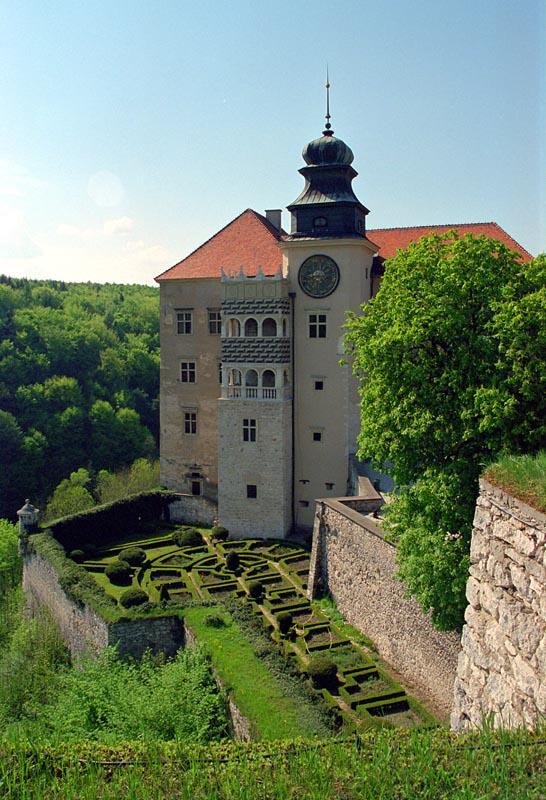
Photo: Marek and Ewa Wojciechowscy · CC BY-SA 3.0 · Wikimedia Commons
Pieskowa Skała is a castle in Poland. Part of the Trail of the Eagles' Nests castles. The free Lokali audio guide runs 6 minutes.
✓ Published October 2026 · how we write these guides
Visitor facts
| Lokali audio guide | 6 min · free |
|---|---|
| Type | Castle |
| Location | Sułoszowa, Poland |
| Coordinates | 50.2442, 19.7800 |
| Languages | 50+, in the Lokali app |
The story
Listen first. Below you, the Prądnik stream runs fast and clear over stones. Around you, the air smells of damp limestone and beech leaves. The rock under the castle is pale and grey, the colour of old bone. It rises straight out of the green valley floor. On top of it sits a castle that looks less built than grown, as if the rock simply decided to put on walls and a roof.
This is Pieskowa Skała, a castle in the Polish Jura, the long limestone upland that runs north from Kraków. You are standing inside Ojców National Park, one of the smallest national parks in Poland. It is also one of the most crowded with strange rock shapes. The valley is narrow and deep here. The castle uses that geography the way medieval builders always did — height, cliffs, and a view of anyone coming up the road.
The castle is one link in a chain. Medieval Polish rulers built a line of fortresses along this limestone ridge to guard the border between the Kingdom of Poland and Silesia. Today that chain is called the Trail of the Eagles' Nests, because the castles perch on rocks like nests on a cliff. Most of the other castles on the trail are ruins now. This one is different. It still has its roofs and its rooms, and it is still in use.
The first fortress here was a medieval stone stronghold. It dates back to the fourteenth century, the era of King Casimir the Great. He strengthened many of the castles along this frontier. Back then the building was plainer and harder. It was a defensive shell of thick walls and narrow openings. It was built for watching and waiting, not for comfort. Its job was to control the trade road that ran through the valley below.
The castle you see now owes its shape to a later family, the Szafrańcy, the Szafraniec family. They held Pieskowa Skała for generations. In the sixteenth century they rebuilt it as a Renaissance residence. Renaissance here means the new Italian style that reached Poland through the royal court in Kraków. It brought symmetry, arches, and a love of light. The Szafraniec family wanted a home that could show their wealth, not only defend it.
Walk into the inner courtyard and you will feel that change. On the upper level, a gallery of arches runs along the walls. These arcades open the building inward, toward the sky. Here is the first surprise. The same idea of an open, arcaded courtyard appears at Wawel, the royal castle in Kraków. Pieskowa Skała is a smaller cousin of that palace, carried out to the edge of the forest.
Now look closely at the arcades. Along the top of the gallery runs a row of carved stone faces called mascarons. They are decorative heads, a fashion of the Renaissance. Some look calm. Some look comic. Some look almost grotesque. Each one is different, and visitors often walk straight past them. Take a minute to study them one by one. They are among the most human details in the whole castle.
Castles collect stories, and this one has its own. Locals tell the legend of Dorotka, a young noblewoman. According to the tale, she was locked in a tower here as punishment and left to die. Her fate gave her name to the tower in the story. It is folklore, not documented history, and the details change depending on who tells it. But it shows how people here remember the darker side of castle life.
After the Szafraniec family, the castle passed through several owners over the following centuries. It was altered, damaged, repaired, and altered again. In the twentieth century it went through a long restoration. Conservators tried to bring back its Renaissance character. Today the castle is a branch of the Wawel Royal Castle museum in Kraków. So the link to the royal palace is not only in the architecture. It is also in who cares for the building now.
Inside, the museum rooms show how interiors changed across several centuries. You move from older styles toward later ones as you walk from room to room. There is furniture, painting, textiles, and decorative art. The aim is to give a sense of how a noble household looked and felt over time. Notice how the views from the windows change too. Each window frames another piece of the valley.
Back outside, look below the castle walls. Terraced gardens step down the slope in neat, geometric beds. This is an Italian-style garden layout, with clipped hedges and straight paths. It matches the Renaissance taste of the courtyard above. From the garden terraces you can look back up at the castle. That angle shows how tightly the walls follow the shape of the rock beneath them.
Now turn toward the road and look for a tall, lonely pillar of limestone. It is wider at the top than at the base, like a giant wooden club stuck into the ground. This is Maczuga Herkulesa, Hercules' Club. It is natural, shaped by water and weather over a very long time. Folklore gives it another origin. Locals say the devil himself carried the rock here. That is the second surprise. The most photographed rock in the valley is not part of the castle at all.
Before you leave, stand still for a moment. Listen again to the stream below, and to the wind in the beech trees on the valley sides. Look up at the arches, the pale rock, and that strange stone club by the road. Medieval soldiers, Renaissance nobles, and restorers all stood where you stand now. As you walk down the path, glance back once. Notice how the castle and the rock seem to become one shape again.
Key facts
What to look for
Practical tips
Common questions
Is there a free audio guide to Pieskowa Skała?
Yes — the Lokali app narrates Pieskowa Skała free of charge in 50+ languages. The guide runs about 6 minutes, covers the history, what to look for on site and practical tips, and works offline once downloaded.
Where is Pieskowa Skała?
Pieskowa Skała is near Sułoszowa, Poland, at 50.2442, 19.7800. Tap the map link on this page for directions from where you are.
What is Pieskowa Skała known for?
Part of the Trail of the Eagles' Nests castles. Origins reach back to the fourteenth century.
What should you look for at Pieskowa Skała?
Carved stone faces along the courtyard arcade gallery. Upper arcaded loggia circling the inner courtyard. Hercules' Club, the limestone pillar beside the road.
What should you know before visiting Pieskowa Skała?
Walk the terraced gardens for the best castle views. Wear sturdy shoes for the steep paths and slopes.
When is the best time to visit Pieskowa Skała?
Visit on a weekday morning to avoid crowds.
On the map
Opens directions to Pieskowa Skała from your location.
More to see near Pieskowa Skała


Hear Pieskowa Skała in your language
The full story, narrated, in 50+ languages. Download it before you go and it plays offline, at your own pace, with no ticket and no tour group.