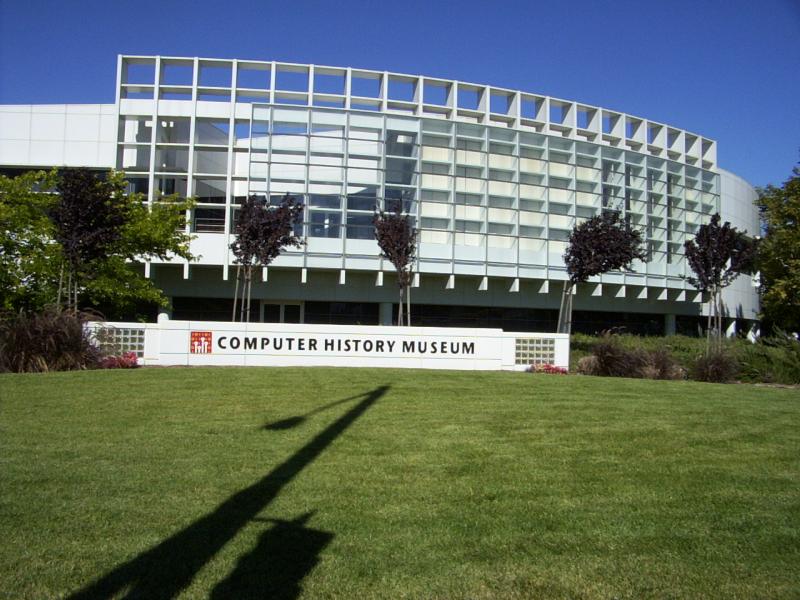
Computer History Museum
37.4144° N · 122.0770° W · Museum
Photo: Dzou · CC BY-SA 3.0 · Wikimedia Commons
Computer History Museum is a museum in Mountain View, California. The collection traces its roots to a Boston-area museum. The free Lokali audio guide runs 6 minutes.
✓ Published October 2026 · how we write these guides
Visitor facts
| Lokali audio guide | 6 min · free |
|---|---|
| Type | Museum |
| Location | Sunnyvale, United States |
| Coordinates | 37.4144, -122.0770 |
| Official website | computerhistory.org |
| Languages | 50+, in the Lokali app |
The story
Push through the glass doors and the first thing you notice is the quiet. The air is cool and still. Light falls softly across polished floors, and somewhere ahead a low hum carries from a machine that was built long before most of today's visitors were born. This is a building about speed and change, but inside it the pace slows. People lean close to glass cases and speak in murmurs, as if the machines might still be working.
A quick note on where you are standing. The Computer History Museum is usually listed with a Mountain View address, on the edge of Sunnyvale, close to the shoreline of San Francisco Bay. The city lines here run together, and locals simply call the whole area Silicon Valley. The name comes from silicon, the material inside computer chips. Many of the companies that built those chips started within a short drive of this spot.
The museum itself has a longer journey behind it than you might expect. Its roots trace back to a computer museum on the East Coast, in the Boston area. Over time the collection moved west, to the place where so much of the modern industry grew. The building you are in once served a technology company before it became a museum. It feels right that a former tech office now holds the history of the whole field.
The main exhibition is called Revolution, and it is built as a long, winding walk through time. It does not begin with screens or keyboards. It begins with counting. Look for the abacus, the slide rules, and the mechanical calculators with their brass gears and small numbered wheels. Before electricity, people solved problems with beads, sticks, and clever arrangements of metal. The idea of a computer is far older than the machine.
One of the first surprises comes with punched cards. In the late nineteenth century, the United States needed a faster way to count its population. An inventor named Herman Hollerith built a tabulating machine that read holes punched in cards. Each hole stood for a piece of information. His work fed into the company that later became IBM. Those simple stiff cards, with their neat rows of holes, guided business computing for decades.
As you move forward, the machines grow large. Very large. Early electronic computers filled whole rooms and used thousands of glowing vacuum tubes. The museum shows sections of these giants, including parts from ENIAC, one of the first general-purpose electronic computers, built in the 1940s. Stand beside the tall grey panels and imagine the heat, the noise, and the engineers walking between them. A single tube failure could stop everything.
Then comes a machine that people often remember most clearly. The Cray-1 supercomputer stands in a curved shape, almost like a horseshoe. Around its base is a padded bench. Visitors sometimes joke that it was the most expensive seat in the world. The bench was not decoration. It covered the power supplies and cooling equipment. The curved design kept the internal wires short, because in a machine this fast, every centimetre of wire mattered.
Here is a detail many visitors miss. In other rooms, the museum keeps older machines in working order, not just on display. Volunteers have restored historic IBM computers, and on some days they run demonstrations. You can hear the clatter of card readers and the rattle of old printers. If a demonstration is happening during your visit, stop and listen. It is one of the few places where this history still makes sound.
The story then shrinks — from rooms, to cabinets, to desks. Look for the arrival of the personal computer. There is an early Apple computer, assembled in a simple wooden case, a reminder of how small and handmade the beginning was. Nearby you will find the Xerox Alto, a research machine with a mouse and windows on the screen. Many of the ideas you use every day on your phone first appeared on machines like this one.
Another quiet surprise waits among the networking displays. One early server rack from Google shows how the company began on a tight budget. The computers sit close together on simple shelves, built with practical, low-cost parts. It looks almost like a student project. That is part of the point. Much of the internet that billions of people use today started in modest rooms with borrowed equipment and big ideas.
The museum also asks a wider question. Who built all of this? Look at the panels about the people behind the machines. You will meet mathematicians, engineers, programmers, and technicians. Many women worked as early programmers, though their names were often left out of the first histories. The museum keeps collecting oral histories, recorded interviews with people from the industry, so that future visitors can hear their stories in their own voices.
Take a moment to notice the visitors around you. Some are families with young children pressing buttons on interactive screens. Some are older engineers who stop in front of a machine and smile, because they once worked on one just like it. You may overhear someone explaining a memory to a friend. In this museum, the past is close. Many of the people who lived this history are still walking these halls.
As you walk back toward the entrance, look again at the device in your pocket. It is smaller than a single panel from those early room-sized computers, and far more powerful. Every case you passed today led, step by step, to that object in your hand. Outside, the wide Silicon Valley sky and the low office buildings carry on the same story. You are standing in the middle of a history that is still being written.
Key facts
What to look for
Practical tips
Common questions
Is there a free audio guide to Computer History Museum?
Yes — the Lokali app narrates Computer History Museum free of charge in 50+ languages. The guide runs about 6 minutes, covers the history, what to look for on site and practical tips, and works offline once downloaded.
Where is Computer History Museum?
Computer History Museum is near Sunnyvale, United States, at 37.4144, -122.0770. Tap the map link on this page for directions from where you are.
What is Computer History Museum known for?
The collection traces its roots to a Boston-area museum. Main exhibition Revolution follows computing from abacus to smartphone.
What should you look for at Computer History Museum?
The padded bench wrapped around the curved Cray-1 supercomputer. Neat rows of holes on early punched data cards. Brass gears inside the mechanical calculators near the entrance.
What should you know before visiting Computer History Museum?
Allow at least two to three hours for the Revolution exhibition. Check the museum calendar for live restored-machine demonstrations.
When is the best time to visit Computer History Museum?
Arrive early on weekends to avoid school groups and crowds.
On the map
Opens directions to Computer History Museum from your location.
More to see near Computer History Museum

Hear Computer History Museum in your language
The full story, narrated, in 50+ languages. Download it before you go and it plays offline, at your own pace, with no ticket and no tour group.