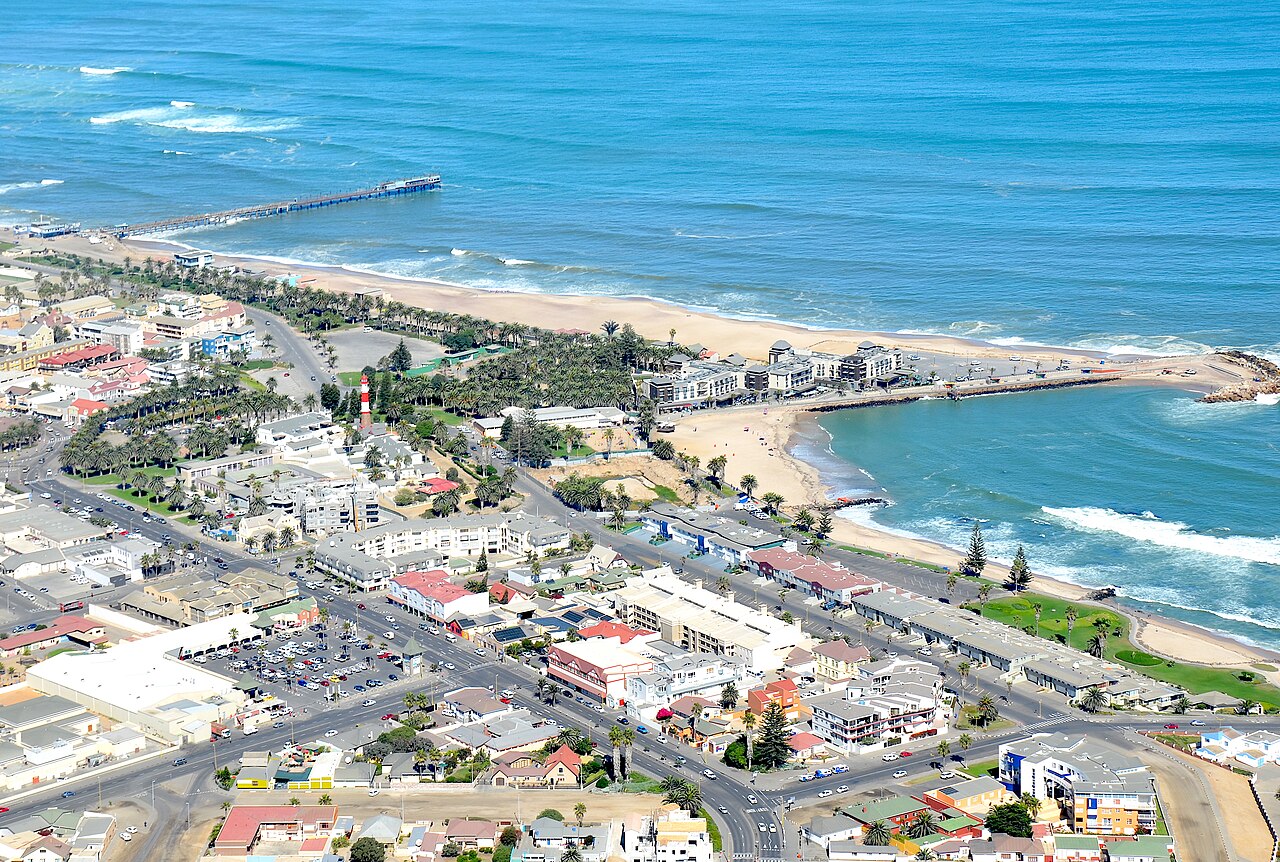
Swakopmund Museum is a museum in Swakopmund, Namibia. Comprehensive local history museum covering indigenous Nama and Herero cultures, German colonial settlement, diamond mining, and maritime heritage. Most visitors spend 1–1.5 hours here. The free Lokali audio guide runs 5 minutes.
✓ Verified August 2026 · how we write these guides
Visitor facts
| Time needed | 1–1.5 hours |
|---|---|
| Lokali audio guide | 5 min · free |
| Type | Museum |
| Best for | History |
| Location | Swakopmund, Namibia |
| Coordinates | -22.6692, 14.5345 |
| Languages | 45, in the Lokali app |
The story
Listen. Waves break against a stone sea wall. Gulls call above a red and white lighthouse. At its foot, close to the water, sits a low building full of glass cases and quiet rooms. This is the Swakopmund Museum, the largest privately run museum in Namibia. Inside, one small town on the edge of a desert keeps the memory of a whole country.
The museum began with one man's curiosity. Alfons Weber was a German dentist who settled in Swakopmund. He collected everything that passed through his hands. Minerals, insects, old tools, photographs, papers. In 1951 he opened his collection to the public as a museum. What started as one person's passion slowly grew into the town's shared memory.
Today the Swakopmund Scientific Society runs the museum. It is not a state institution. Members and volunteers have kept it going for more than seventy years. That history gives the place a personal feel. The displays stand dense and close together. Every case looks like someone arranged it by hand, because someone did. Take your time and look closely.
Start with the desert. The Namib runs along this whole coast, and scientists often call it one of the oldest deserts on Earth. The natural history rooms show how life holds on here. Beetles drink fog. Plants send roots deep under the gravel. The strange welwitschia grows only two leaves in its whole life, and it can live for centuries.
Fog is the quiet hero of this story. The cold Benguela Current flows just offshore. Warm desert air moves over that cold water, and thick fog rolls inland at night. For desert animals, fog is drinking water. Displays explain how geckos, snakes and beetles harvest the droplets. It is a lesson in survival with almost nothing to spare.
Then come the people. The People of Namibia display presents cultures from across the country. You see tools, dress, ornaments and household objects, each made by hand for daily use. Move slowly here. A single carved spoon or beaded apron can say more than a long text panel. Together, these objects show many different ways of living in one land.
Swakopmund itself was founded in 1892 as a landing station on a bare and difficult coast. The colonial rooms show those early years. Ships waited offshore. Goods came through the surf in small boats, and everything the town needed crossed the waves that way. Photographs show pianos, roof beams and barrels arriving wet on the sand.
One favorite room is the old pharmacy. It is a reconstructed apothecary from the early twentieth century. Dark wooden shelves climb the walls. Rows of glass bottles carry faded, careful labels. Brass scales, small drawers and porcelain jars stand ready, as if the chemist stepped out a moment ago. It is a small and complete world of its own.
The mineral section glitters. Namibia is famous among geologists and collectors, and its crystals travel to museums around the world. Cases hold quartz, tourmaline and desert stones in many colors. A separate display explains uranium mining at the Rössing mine inland from the coast, one of the large open pit uranium mines of the world. Mining shaped this region as strongly as the sea did.
Transport has its own space. Before railways and tarred roads, ox wagons crossed the gravel plains toward the interior. The museum keeps heavy wagons and early vehicles from that time. Think about the distances involved. The nearest big settlements lay weeks away. Every journey inland began here at the water's edge, with animals, wheels, and patience.
Give yourself about an hour, more if you like reading labels. The rooms connect in a loop, so you will not get lost. School groups pass through on weekday mornings, and afternoons are usually calmer. The building stays cool even on bright days, which is welcome after walking along the beach promenade in the sun.
Step outside afterward and look up. The lighthouse above the museum was first lit in 1902 and was later raised to stand taller. Beside it curves the Mole, the old harbor wall, begun in 1899. Sand filled its basin within a few years, and the sea won that argument. Today the sheltered beach behind it belongs to swimmers and families.
A museum like this is a town remembering itself. It keeps the fog, the wagons, the minerals and the shop shelves together in one place. Nothing here feels staged. It is simply kept, year after year, by people who care. When you walk out, the same cold sea still beats against the same stones. Stand a moment between lighthouse and water, and let it all settle.
Key facts
What to look for
Practical tips
Common questions
How long do you need at Swakopmund Museum?
Plan 1–1.5 hours. That is the time most visitors spend at Swakopmund Museum. The free Lokali audio guide adds about 5 minutes of narration you can listen to as you walk, so it fits inside your visit rather than adding to it.
Is there a free audio guide to Swakopmund Museum?
Yes — the Lokali app narrates Swakopmund Museum free of charge in 50+ languages. It covers the history, what to look for on site and practical tips, and it works offline once downloaded.
Where is Swakopmund Museum?
Swakopmund Museum is in Swakopmund, Namibia, at -22.6692, 14.5345. Tap the map link on this page for directions from where you are.
What should you know before visiting Swakopmund Museum?
Allow about one hour for the exhibits.
What is Swakopmund Museum known for?
Founded in 1951 by German dentist Alfons Weber.
What is the best time to visit Swakopmund Museum?
The ethnographic section shows traditional crafts and clothing; the mining exhibits explain why Swakopmund exists as a port.
On the map
Opens directions to Swakopmund Museum from your location.
Reference
More to see in Swakopmund


Hear Swakopmund Museum in your language
The full story, narrated, in 50+ languages. Download it before you go and it plays offline, at your own pace, with no ticket and no tour group.