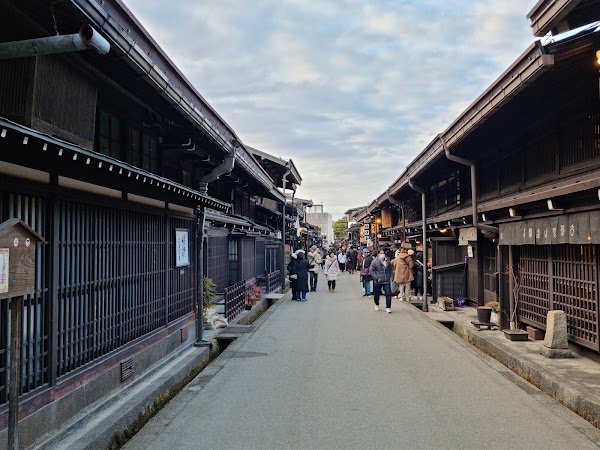
Sanmachi Suji
36.1452° N · 137.2531° E · Historic Street
Sanmachi Suji is a historic street in Takayama, Japan. Three beautifully preserved merchant streets from the Edo period, lined with wooden machiya townhouses, sake breweries, and small museums. Most visitors spend 60–90 min here. The free Lokali audio guide runs 5 minutes.
✓ Verified August 2026 · how we write these guides
Visitor facts
| Time needed | 60–90 min |
|---|---|
| Lokali audio guide | 5 min · free |
| Type | Historic Street |
| Best for | Local life |
| Location | Takayama, Japan |
| Coordinates | 36.1452, 137.2531 |
| Languages | 45, in the Lokali app |
The story
Water runs in a channel along the edge of the street. You can hear it before you see it, a steady trickle beside the stone. The houses lean close on both sides, dark wood and fine wooden lattice, low beneath deep eaves. Somewhere a ball of cedar hangs in a doorway. The lane is narrow, and the air itself feels older here.
This is Sanmachi Suji, the heart of Takayama's old town. The name refers to three main streets that run east of the Miyagawa River. In Japanese, their names mean the upper first, second, and third streets. Walking them is one of the simplest pleasures in Takayama. Little here has changed in shape for a very long time.
To understand these streets, return in your mind to the seventeenth century. Takayama sat in a region full of timber from its mountains. That made the area valuable. So the Tokugawa shogunate, the rulers of Japan at the time, took it under their direct control. A government office, the Takayama Jinya, was set up to manage the region, and merchants gathered around it.
These streets were the merchant quarter. Traders in rice, sake, miso, and crafts built their homes and shops along them. The houses you see were made for both work and family. The front opened to the street for business. The rooms behind and above were for living. Wealth flowed through these lanes, yet the buildings stayed modest on the outside.
Look at the fronts of the houses. They are dark, almost black, with low eaves that reach out over the street. The windows are covered with fine wooden lattice. The lattice was clever. It let light and air pass into the house while keeping the inside private from the eyes of people passing by. Use and form met in every detail.
Now look down at the channels of running water along the eaves. These were laid for fire. In a town built of wood, fire was the great fear. The channels kept water close at hand to fight the flames. Today they simply trickle along the streets, pleasant to the ear, but their purpose was a deadly serious one for the families who lived here.
Above some doorways hangs a ball of cedar leaves. It is called a sugidama. It marks a building where sake is brewed. Takayama has long been known for its sake, made with mountain rice and clean, cold water. Seven breweries still work within this district. The cedar ball is their old and quiet sign to the street.
Watch how the cedar ball changes through the year. When a brewery hangs a fresh one, it is green. Through the months, as the new sake matures, the leaves slowly dry and turn brown. So the ball works as a kind of calendar. By its color, a person passing by can guess how far along the season's sake has come.
Several of the breweries welcome visitors. Some offer tours, and some offer tastings of their own line. Each brewery holds its own style and pride. Stepping inside, you leave the street and enter a world of wooden vats, cool air, and a faint sweet smell. It is one of the finest ways to taste the region itself.
The shops along these streets sell the work of Hida. You will find lacquerware, carved wood, woven goods, and local foods. Hida is also known for its beef, and you may smell it grilling at small stalls. Take your time and look into the doorways. Much of what is sold here is still made by hand somewhere nearby.
In 1979, these streets were given national protection. They were named an Important Preservation District for groups of traditional buildings. That title means the town must keep the old look of the area. New signs and changes are strictly limited. It is the reason the lanes still feel whole, rather than scattered among modern blocks.
Pause at a corner and let the street empty for a moment. The water keeps running. The lattice throws thin shadows on the dark wood. Merchants once called out their prices here, and carts once rolled past these very doors. Now the lanes fall quiet between visitors, holding their shape, waiting. Listen to the water a little longer, then follow it down toward the river.
Key facts
What to look for
Practical tips
Common questions
How long do you need at Sanmachi Suji?
Plan 60–90 min. That is the time most visitors spend at Sanmachi Suji. The free Lokali audio guide adds about 5 minutes of narration you can listen to as you walk, so it fits inside your visit rather than adding to it.
Is there a free audio guide to Sanmachi Suji?
Yes — the Lokali app narrates Sanmachi Suji free of charge in 50+ languages. It covers the history, what to look for on site and practical tips, and it works offline once downloaded.
Where is Sanmachi Suji?
Sanmachi Suji is in Takayama, Japan, at 36.1452, 137.2531. Tap the map link on this page for directions from where you are.
What should you know before visiting Sanmachi Suji?
Arrive early in the morning to walk before the crowds.
What is Sanmachi Suji known for?
Takayama fell under direct shogunate control in the seventeenth century.
What is the best time to visit Sanmachi Suji?
Duck into the sake breweries mid-morning—you can smell the fermentation process and often taste samples.
On the map
Opens directions to Sanmachi Suji from your location.
More to see in Takayama


Hear Sanmachi Suji in your language
The full story, narrated, in 50+ languages. Download it before you go and it plays offline, at your own pace, with no ticket and no tour group.