
Photo: falco · CC0 · Wikimedia Commons
Bridge of Peace is a bridge in Tbilisi, Georgia. Pedestrian bridge over the Mtkvari river, opened in 2010. The free Lokali audio guide runs 6 minutes.
✓ Published October 2026 · how we write these guides
Visitor facts
| Lokali audio guide | 6 min · free |
|---|---|
| Type | Bridge |
| Location | Tbilisi, Georgia |
| Coordinates | 41.6930, 44.8083 |
| Languages | 50+, in the Lokali app |
The story
Listen for a moment. Underfoot, there is a soft give to the glass and steel, and the Mtkvari river moves below you, brown and quick. Above your head, a long canopy curves like a wave caught in mid-motion. Light filters through it in pale blue and white. On a warm afternoon, the air carries river damp, roasting corn from a cart, and the low hum of footsteps from both banks.
This is the Bridge of Peace, a pedestrian crossing that links the old heart of Tbilisi with Rike Park on the opposite bank. It opened in 2010, which makes it one of the youngest structures you can see from here. Around it stand churches, bathhouses, and fortress walls that are many centuries old. That contrast is the whole point of the bridge, and the whole argument about it.
The design came from the Italian architect Michele De Lucchi. He imagined something light and transparent, a shape that seems to float rather than sit. The frame is steel, and the roof is a long sweep of glass panels. Look at how the canopy rises and dips along its length. From a distance, many people say it looks like a wave, or like the curved body of a sea creature lying across the river.
Here is something most visitors never think about. The steel structure was not built here. It was fabricated in Italy, then cut into sections and brought overland to Georgia by a long convoy of trucks. The pieces were assembled on site and lifted into place over the river. So the bridge you are standing on travelled thousands of kilometres before it ever touched Georgian ground.
When it first appeared, the bridge divided the city. Supporters saw a bold sign of a new, outward-looking Georgia. Critics felt that glass and polished steel did not belong beside the brick and wooden balconies of the old town. Some locals gave it a cheeky nickname, comparing its shape to a feminine hygiene product. You may still hear that joke today, usually told with a grin.
The bridge was part of a wider wave of new architecture in the city around the end of the 2000s. During those years, the government of the day commissioned several striking modern buildings. Many of them were designed by foreign architects. The idea was to show the world a modern capital. Whether that worked is still debated in Tbilisi cafés, sometimes loudly, and often late into the night.
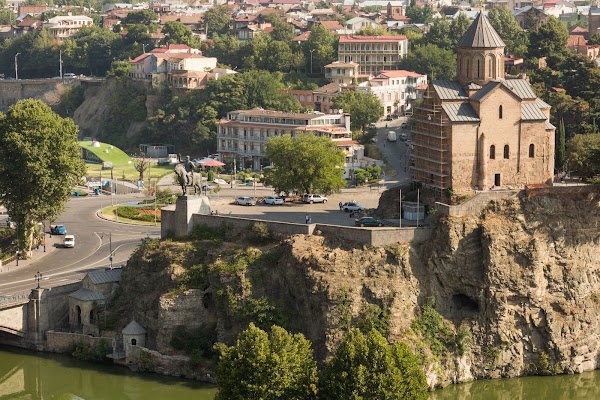
Now, turn and look up toward the hills. High on the ridge, you can see the walls of Narikala, the old fortress that once guarded the city. Below it, on the cliff edge across the water, stands Metekhi Church. Beside it rises an equestrian statue of King Vakhtang Gorgasali. According to tradition, he is the king who founded Tbilisi. From this bridge, he seems to watch over the river.
Across the water lies Rike Park, a wide open space with lawns, fountains, and paths. Look for two large, tube-shaped structures there. They were planned as a concert hall and exhibition centre, designed by another Italian architect, Massimiliano Fuksas. For many years they stood unfinished, a curious sight. From the park, a cable car also climbs up toward Narikala, giving another view of the bridge from above.
If you can, come back after dark. That is when the bridge changes character completely. Thousands of small lights are built into the structure, and they switch on in moving patterns across the canopy and the railings. The glass glows over the black water. The reflections ripple and break as the river runs underneath. Many people say the bridge makes more sense at night than in daylight.
There is a second surprise hidden in those lights. According to descriptions of the design, the light show along the railings carries a coded message. It is said to spell out the chemical elements of the periodic table in Morse code. Morse code is the old system of short and long signals once used for telegraph messages. Few passers-by know this. Most just see pretty flickering, without realising it might be a message.
The name itself carries weight here. Georgia sits at a crossroads of empires, faiths, and languages, and its recent history includes real conflict. A bridge called Peace, linking old and new, is a hopeful symbol. Whatever you think of its shape, the name asks people to cross over and meet in the middle. On busy evenings, you see exactly that: families, couples, students, and travellers sharing the same narrow span.
Pause in the centre and simply watch the life around you. Street musicians sometimes play near the ends of the bridge. Vendors sell small souvenirs, and couples stop to take photos against the river and the hills. Children press their faces to the glass to look down at the water. The bridge is not grand in size, but it is one of the city's favourite meeting points and lookout spots.
As you leave, notice how quickly the modern world falls away. A few steps from the end of the bridge, you are back on old stone, among carved balconies and narrow streets. Behind you, the steel and glass canopy rests over the river. Ahead, the hills of Tbilisi rise in layers of roofs and churches. Take a last look at the curve of the bridge, and listen once more to the river running beneath it.
Key facts
What to look for
Practical tips
Common questions
Is there a free audio guide to Bridge of Peace?
Yes — the Lokali app narrates Bridge of Peace free of charge in 50+ languages. The guide runs about 6 minutes, covers the history, what to look for on site and practical tips, and works offline once downloaded.
Where is Bridge of Peace?
Bridge of Peace is in Tbilisi, Georgia, at 41.6930, 44.8083. Tap the map link on this page for directions from where you are.
What is Bridge of Peace known for?
Pedestrian bridge over the Mtkvari river, opened in 2010. Designed by Italian architect Michele De Lucchi.
What should you look for at Bridge of Peace?
The wave-like rise and dip of the glass canopy. Equestrian statue of King Vakhtang Gorgasali on the cliff. Narikala fortress walls along the ridge above.
What should you know before visiting Bridge of Peace?
Return after dark to see the light display. Walk to Rike Park for a side view of the canopy.
When is the best time to visit Bridge of Peace?
Visit early morning to avoid evening crowds.
On the map
Opens directions to Bridge of Peace from your location.
More to see in Tbilisi


Hear Bridge of Peace in your language
The full story, narrated, in 50+ languages. Download it before you go and it plays offline, at your own pace, with no ticket and no tour group.