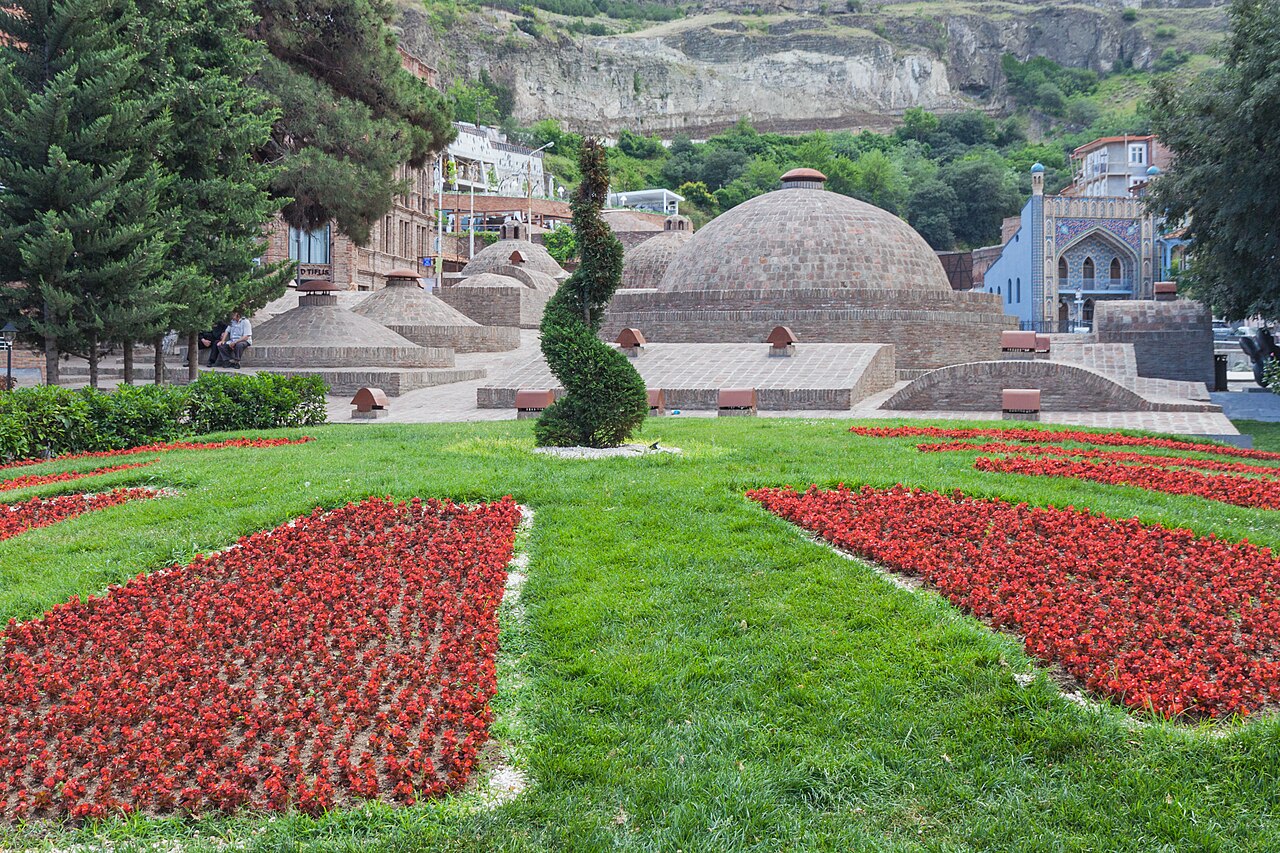
Sulfur Baths is a bathhouse in Tbilisi, Georgia. Historic public baths carved into the hillside below the old town, fed by natural hot springs rich in sulfur. Most visitors spend 1–2 hours here. The free Lokali audio guide runs 6 minutes.
✓ Verified August 2026 · how we write these guides
Visitor facts
| Time needed | 1–2 hours |
|---|---|
| Lokali audio guide | 6 min · free |
| Type | Bathhouse |
| Best for | Local life |
| Location | Tbilisi, Georgia |
| Coordinates | 41.7130, 44.8045 |
| Languages | 45, in the Lokali app |
The story
The first thing is the smell — a faint trace of struck matches and warm minerals that drifts up the lower lanes of the old town. Follow it downhill and you reach the sulfur baths of Tbilisi, where hot water rises on its own from deep underground and has been led into stone and brick bathhouses for many centuries. People do not come here to look. They come to get in the water.
Understand first what makes this water special. It surfaces already hot, with no heating, and it is heavy with sulfur, which gives it both the eggy smell and the reputation. For hundreds of years people have believed it eases aching joints and clears the skin, and whether or not every claim holds, the warmth is real and the effect on a tired body is immediate.
The baths sit at the very root of the city. The founding legend tells of a fifth-century king, Vakhtang Gorgasali, hunting in this wooded valley when his falcon brought down a bird that fell into a steaming spring. He took the warm water as a sign and founded his capital on the spot. The Georgian word tbili means warm, and the name Tbilisi grows straight out of it.
How a visit works is simple once you know it. Most bathhouses rent private rooms by the hour, each with its own hot pool, a cold tap, and a tiled bench, and most also keep cheaper public sections divided for men and women. In the private rooms and the single-sex sections people bathe undressed; that is ordinary here, and no one pays it any attention.
The ritual most visitors remember is the kisi, the scrub. An attendant works over your skin with a coarse mitt and then buries you in a cloud of soapy foam, rinsing it all away at the end. It is brisk and not gentle, and you come out feeling scrubbed to a polish. Add it on when you book; it is inexpensive and it is the part people talk about afterwards.
Travellers have written about these baths for a very long time. A Russian poet who passed through in the early nineteenth century praised them warmly in print, and a French novelist left his own enthusiastic account a few decades later. What they described — the heat, the foam, the attendants, the heavy mineral air — is recognisably the same experience you can still book today.
Step outside between baths and the setting is half the pleasure. The bathhouses cluster in a narrow valley directly below the Narikala fortress, their brick domes pushing up at street level with little glass skylights to let the steam escape. A short walk up the gorge brings you to a small waterfall, a pocket of cool water and greenery hidden right inside the city.
A few practical notes will make the visit easier. Bring a towel and flip-flops, or rent them at the door. Drink water before and after, because the heat pulls it out of you, and do not linger too long in the hottest pool your first time. Prices swing widely between the plain public halls and the smarter private rooms, so ask before you commit to a room.
Timing matters too. Early morning and late evening are the calmest, while the middle of the day fills with both locals and visitors. The water is hot year-round, but the baths are especially welcome in winter, when stepping from cold streets into the steam feels like the whole point of the place.
Try not to rush it. The baths were never only about washing; for centuries this was where deals were settled, matches were made, and news was traded, and that unhurried, social rhythm still lingers in the warm rooms. Give yourself an hour at least, and let the heat do its slow work.
A word on the public sections, if the private rooms are full or you simply want the cheaper option. They are large, plain, tiled halls with communal pools, divided by gender, where regulars sit and talk for an hour at a time. It is less private but more sociable, and it is how most locals have always used the baths.
The mineral content is what sets these springs apart from an ordinary spa. The sulfur gives the water its smell and a slightly soft, slippery feel, and the heat comes straight from deep underground rather than from any boiler. That exact combination is what drew the city to this spot in the first place.
When you step back out into the cool air afterwards, skin tingling and shoulders loose, the noise of the old town feels softer and farther away. You have just done something Tbilisians have done in this exact valley for more than a thousand years. Walk it off slowly through the lanes, and the warmth — and a little of the mineral scent — will stay with you for a while.
Key facts
What to look for
Practical tips
Common questions
How long do you need at Sulfur Baths?
Plan 1–2 hours. That is the time most visitors spend at Sulfur Baths. The free Lokali audio guide adds about 6 minutes of narration you can listen to as you walk, so it fits inside your visit rather than adding to it.
Is there a free audio guide to Sulfur Baths?
Yes — the Lokali app narrates Sulfur Baths free of charge in 50+ languages. It covers the history, what to look for on site and practical tips, and it works offline once downloaded.
Where is Sulfur Baths?
Sulfur Baths is in Tbilisi, Georgia, at 41.7130, 44.8045. Tap the map link on this page for directions from where you are.
What should you know before visiting Sulfur Baths?
Bring or rent a towel and flip-flops.
What is Sulfur Baths known for?
Fed by natural hot springs rich in sulfur.
What is the best time to visit Sulfur Baths?
Book a private room with a guide if visiting for the first time — the baths can feel chaotic otherwise.
On the map
Opens directions to Sulfur Baths from your location.
More to see in Tbilisi


Hear Sulfur Baths in your language
The full story, narrated, in 50+ languages. Download it before you go and it plays offline, at your own pace, with no ticket and no tour group.