
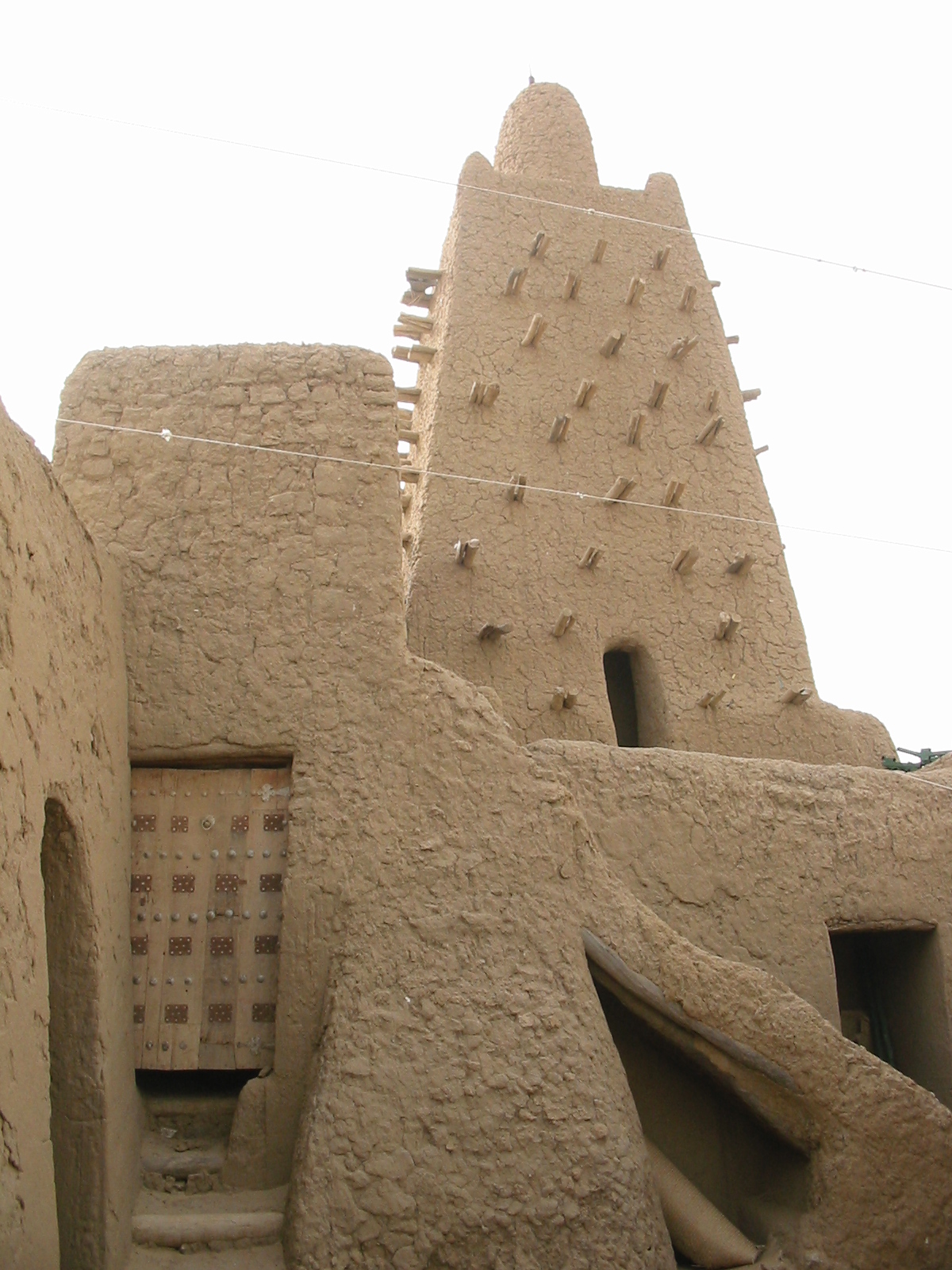
Photo: Baz Lecocq at nl.wikipedia · CC BY 2.5 nl · Wikimedia Commons
Sankoré Madrasah is an ancient center of learning in Timbuktu, Mali. Part of Timbuktu's UNESCO World Heritage site since 1988. The free Lokali audio guide runs 6 minutes.
✓ Published October 2026 · how we write these guides
Visitor facts
| Lokali audio guide | 6 min · free |
|---|---|
| Type | Mosque |
| Location | Timbuktu, Mali |
| Coordinates | 16.7758, -3.0056 |
| Languages | 50+, in the Lokali app |
The story
Listen first to the sand. In Timbuktu it is everywhere. It drifts against doorways and softens the edges of the lanes. It whispers under your shoes as you walk toward a low, earth-coloured building at the northern edge of the old town. The walls in front of you are not stone. They are mud, shaped by hand and smoothed by hand. In the late afternoon they glow the warm colour of baked bread.
This is the Sankoré Mosque. For centuries it stood at the heart of one of the great centres of learning in the Islamic world. People often call it the Sankoré Madrasah, or even the University of Sankoré. That name is worth a moment, because it can mislead. There were no lecture halls here, no registrar, no single institution handing out degrees. The learning was looser, more personal, and in many ways richer than that.
Picture the city several hundred years ago. Timbuktu sat where the desert meets the great bend of the Niger River. Camel caravans came south across the Sahara carrying salt. Boats came up the river carrying gold, grain and goods from the forest lands. Where trade gathers, people gather. Where people gather, ideas follow. Merchants brought books. Scholars followed the books. Slowly this trading town became a city of the written word.
Timbuktu reached its height under the Songhai Empire in the fifteenth and sixteenth centuries. During that period, scholarship in the city clustered around three great mosques. This one is Sankoré. The others are Djinguereber and Sidi Yahia. Together with the city's old cemeteries and shrines, they form the World Heritage site that UNESCO recognised in 1988. Sankoré became especially known as a gathering place for scholars and their students.
So how did teaching actually work? A student attached himself to a master — a respected teacher, often from one of the city's learned families. He studied in the master's home, in a courtyard, or in the shade of the mosque. He moved from one text to the next. When he mastered a book, the teacher could give him a licence, a kind of written permission to teach that text himself. Knowledge passed from person to person, like a chain.
The subjects were wide. Students studied the Quran and Islamic law, of course. But they also studied Arabic grammar, logic, rhetoric, history, and astronomy. Some scholars wrote about medicine and mathematics. And here is a detail many visitors miss. Timbuktu's scholars did not only copy books from elsewhere. They wrote their own. Their commentaries, legal opinions and chronicles were read far beyond the Niger bend.
Now look up at the building itself. The style is called Sudano-Sahelian — the earthen architecture of the dry lands just south of the Sahara. The walls are built from mud brick and covered with a coat of mud plaster. Notice the wooden beams that stick out from the walls like rows of pegs. They are not decoration. They help hold the structure together, and they act as built-in scaffolding when workers climb up to repair the surface.
That repair is the second surprise. A mud building is never truly finished. Rain softens the plaster, and wind wears it away. So the people of Timbuktu have long gathered to replaster their mosques, layer by layer. It is communal work, and it carries great pride. In a very real sense, the building you see is not a single old object. It is the result of generations of hands, returning again and again to renew it.
The tower rising above the mosque narrows as it climbs, giving it a stepped, almost pyramid-like outline. Its corners are soft rather than sharp. Against the pale desert sky, it looks less like something built and more like something grown out of the ground. Historical accounts record a major rebuilding in the late sixteenth century, led by the city's judge, al-Aqib. Much of the form you see follows the shape his builders gave it.
There is also a story about the mosque's beginnings. According to local tradition, a wealthy and pious woman paid for its construction. Some versions add that the inner courtyard was laid out to match the dimensions of the Kaaba in Mecca, the holiest site in Islam. These stories are told with affection, but they are tradition rather than documented fact. They show how much the people of Timbuktu have cherished this place.
The golden age did not last. In 1591 an army from Morocco defeated the Songhai Empire. In the years that followed, leading scholars of Timbuktu were arrested and taken north. The most famous of them, Ahmad Baba, spent years in exile in Marrakesh. He wrote there and kept teaching, and he eventually returned home. But the city's learned community never fully regained its earlier strength.
What survived, remarkably, were the books. Families across Timbuktu kept manuscripts in trunks, cupboards and storerooms, sometimes for centuries. When armed groups occupied the city in 2012, shrines were damaged and many manuscripts were at risk. Local librarians and families smuggled huge numbers of them to safety, often in secret and at real personal risk. That same year, Timbuktu was placed on UNESCO's list of World Heritage in Danger.
So as you stand here, take a moment before you move on. Feel the warmth still held in these earthen walls. Notice the beams, the soft corners, the patches where fresh plaster meets older layers. Somewhere nearby, in a family home or a library, there may be a page written by a scholar who studied in this very spot. When you walk back into the sandy lanes, listen again to your footsteps. This city has always kept its treasures quietly.
Key facts
What to look for
Practical tips
Common questions
Is there a free audio guide to Sankoré Madrasah?
Yes — the Lokali app narrates Sankoré Madrasah free of charge in 50+ languages. The guide runs about 6 minutes, covers the history, what to look for on site and practical tips, and works offline once downloaded.
Where is Sankoré Madrasah?
Sankoré Madrasah is in Timbuktu, Mali, at 16.7758, -3.0056. Tap the map link on this page for directions from where you are.
What is Sankoré Madrasah known for?
Part of Timbuktu's UNESCO World Heritage site since 1988. Peak scholarship came under the Songhai Empire.
What should you look for at Sankoré Madrasah?
Wooden beams projecting from the mud walls like pegs. The stepped, tapering outline of the earthen tower. Patches where fresh plaster meets older weathered layers.
What should you know before visiting Sankoré Madrasah?
Check current travel advisories carefully before planning a visit. Hire a licensed local guide for safe, informed access.
When is the best time to visit Sankoré Madrasah?
Visit in late afternoon for softer heat and warmer light.
On the map
Opens directions to Sankoré Madrasah from your location.
More to see near Sankoré Madrasah
Hear Sankoré Madrasah in your language
The full story, narrated, in 50+ languages. Download it before you go and it plays offline, at your own pace, with no ticket and no tour group.