
Photo: Gisling · CC BY-SA 3.0 · Wikimedia Commons
Bata Shoe Museum is a footwear museum in Toronto, Ontario, Canada. Opened in Toronto in 1995. The free Lokali audio guide runs 7 minutes.
✓ Published October 2026 · how we write these guides
Visitor facts
| Lokali audio guide | 7 min · free |
|---|---|
| Type | Museum |
| Location | Toronto, Canada |
| Coordinates | 43.6673, -79.4001 |
| Official website | batashoemuseum.ca |
| Languages | 50+, in the Lokali app |
The story
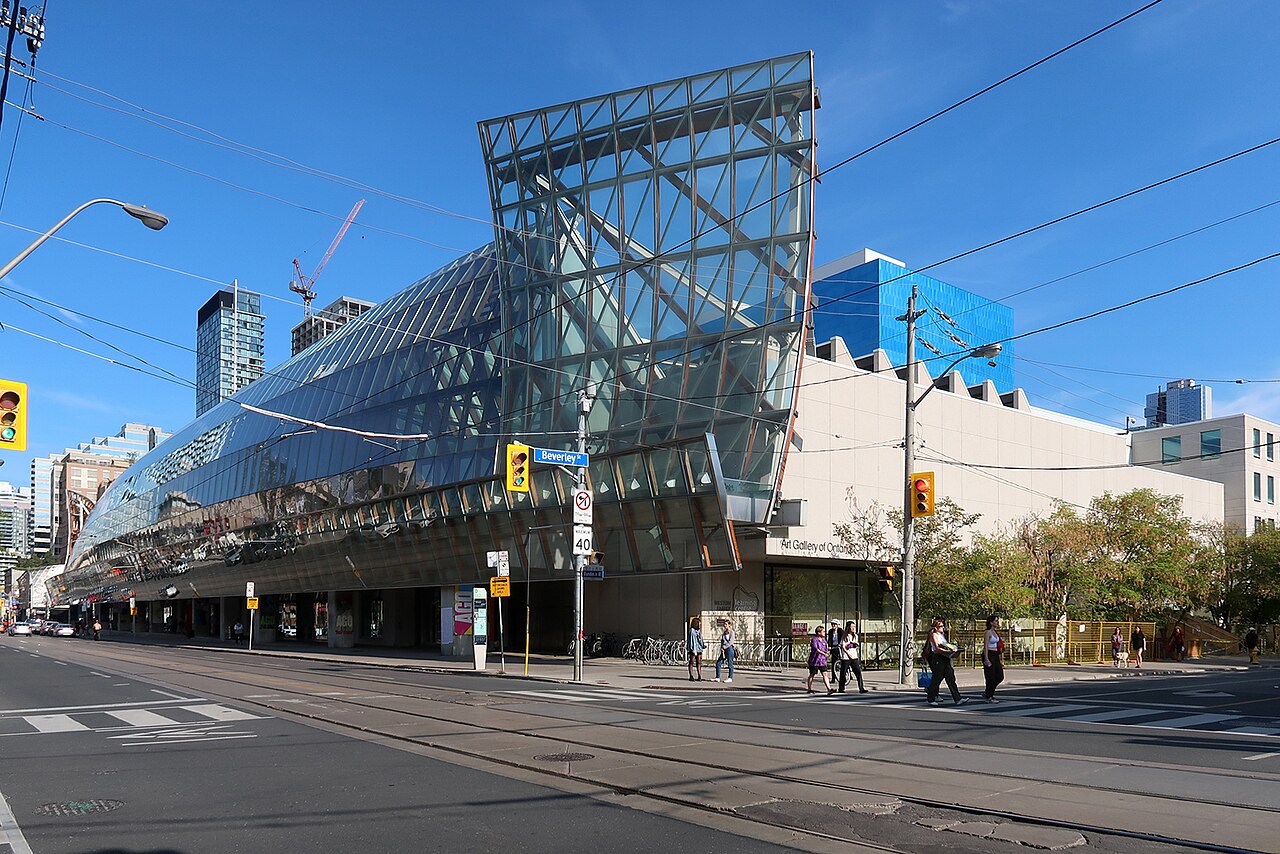
Stand on the corner for a moment and look up. The building in front of you has a strange, tilted top edge, as if someone lifted the lid slightly and forgot to close it. Traffic hums along Bloor Street. Students from the nearby university pass with backpacks and coffee cups. And here, on a busy downtown corner of Toronto, sits a museum devoted entirely to the things on your feet.
That tilted roofline is not an accident. The building was designed by the Canadian architect Raymond Moriyama, who also designed the Ontario Science Centre. He shaped this museum to suggest a shoebox, with the lid just slightly open. Once you see it, you cannot unsee it. The joke is gentle, almost easy to miss. Many people walk past every day and never notice it.
The museum opened its doors in 1995. Behind it stands one woman — Sonja Bata. She married into the Bata family, whose shoe company grew into one of the largest footwear businesses in the world. But Sonja was not simply a company wife. She trained in architecture, she travelled constantly, and for decades she collected shoes wherever she went. Her private collection grew so large that it needed a permanent home.
Here is the first surprise. Sonja Bata did not collect shoes because they were glamorous. She collected them because she believed footwear tells the story of how people live. A shoe shows the climate a person faced, the work they did, the status they held, and the beliefs they kept. To her, a worn sandal said as much about a society as a crown or a cathedral. This museum grew out of that idea.
The collection now holds well over ten thousand objects. It spans roughly four and a half thousand years of human history. That range is hard to picture. At one end, you find footwear from the ancient world. At the other, you find shoes worn by modern celebrities and designed by contemporary fashion houses. Between them sits almost every way humans have ever found to protect, decorate, or restrict their feet.
Inside, the galleries spread over several floors. One long-running exhibition, called All About Shoes, walks you through the broad story — from early footwear to the present day. Other floors host changing exhibitions. These rotate regularly, so what you see today may be quite different from what a friend saw last year. Some shows focus on a single theme, such as sneakers, high heels, or the shoes of one culture.
One of the most powerful parts of the collection deals with Chinese foot binding. For centuries, many girls in China had their feet tightly wrapped from a young age. The goal was to keep the feet very small, which was seen as a mark of beauty and status. The tiny embroidered shoes made for these feet are delicate and colourful. They are also painful to look at once you understand what they meant for the women who wore them.
The museum also holds a strong collection of footwear from the Arctic and the circumpolar north. This was close to Sonja Bata's heart. She was especially interested in the boots made by Indigenous peoples in cold regions — boots of hide, fur, and careful stitching, built to survive extreme cold. These objects are not fashion. They are survival technology, refined over many generations, and the craftsmanship up close is remarkable.
Here is the second surprise. Some of the strangest objects in the museum were made for work, not for wear on the street. Look for heavy wooden clogs with spikes on the bottom. In parts of Europe, people wore shoes like these to crush the spiky outer shells of chestnuts. It is a reminder that for most of history, shoes were tools first. Beauty came second, if it came at all.
Of course, there is glamour too. The museum has shown shoes linked to famous performers and public figures — towering stage platforms, dancing shoes, and slippers worn by royalty. These pieces draw crowds, and they are fun. But notice how they sit in the same building as a farmer's clog or a hunter's boot. That mix is the quiet message of the place. Every pair here belonged to a real person, with a real life.
As you walk through, pay attention to the soles. Visitors tend to look at the top of a shoe — the colour, the buckle, the embroidery. The soles often show more. Wear patterns show how someone walked. Repairs show that a pair was precious enough to fix. Some soles are almost untouched, which tells you the shoes were for ceremony, not for daily life. A shoe carries its owner's habits in a way few objects can.
The museum also works as a research centre. Curators here study footwear seriously, publishing books and organising exhibitions that travel. Scholars, designers, and students come to use the collection. So while it may seem like a playful idea for a museum, the work behind the glass is careful and academic. That balance — light on the outside, serious on the inside — is part of its charm.
The neighbourhood suits it well. The University of Toronto campus is just steps away, and the Royal Ontario Museum is a short walk east along Bloor Street. The area mixes old brick houses, university halls, and busy shops. If you have time, a walk between the two museums makes a good afternoon. You move from dinosaurs and world cultures to the history of the human foot.
When you step back outside, look once more at that tilted roofline above the entrance. Then look down — at your own shoes, and at the shoes of the people passing by. Running shoes, boots, sandals, polished leather. Every pair on this street is part of the same long story you just walked through. And somewhere, perhaps, a future curator would find yours worth keeping.
Key facts
What to look for
Practical tips
Common questions
Is there a free audio guide to Bata Shoe Museum?
Yes — the Lokali app narrates Bata Shoe Museum free of charge in 50+ languages. The guide runs about 7 minutes, covers the history, what to look for on site and practical tips, and works offline once downloaded.
Where is Bata Shoe Museum?
Bata Shoe Museum is in Toronto, Canada, at 43.6673, -79.4001. Tap the map link on this page for directions from where you are.
What is Bata Shoe Museum known for?
Opened in Toronto in 1995. Founded by collector Sonja Bata.
What should you look for at Bata Shoe Museum?
The tilted roofline shaped like a shoebox lid. Tiny embroidered shoes made for bound feet. Spiked wooden clogs once used to crush chestnuts.
What should you know before visiting Bata Shoe Museum?
Check current temporary exhibitions before visiting. Start upstairs galleries after the main permanent exhibition.
On the map
Opens directions to Bata Shoe Museum from your location.
More to see in Toronto


Hear Bata Shoe Museum in your language
The full story, narrated, in 50+ languages. Download it before you go and it plays offline, at your own pace, with no ticket and no tour group.