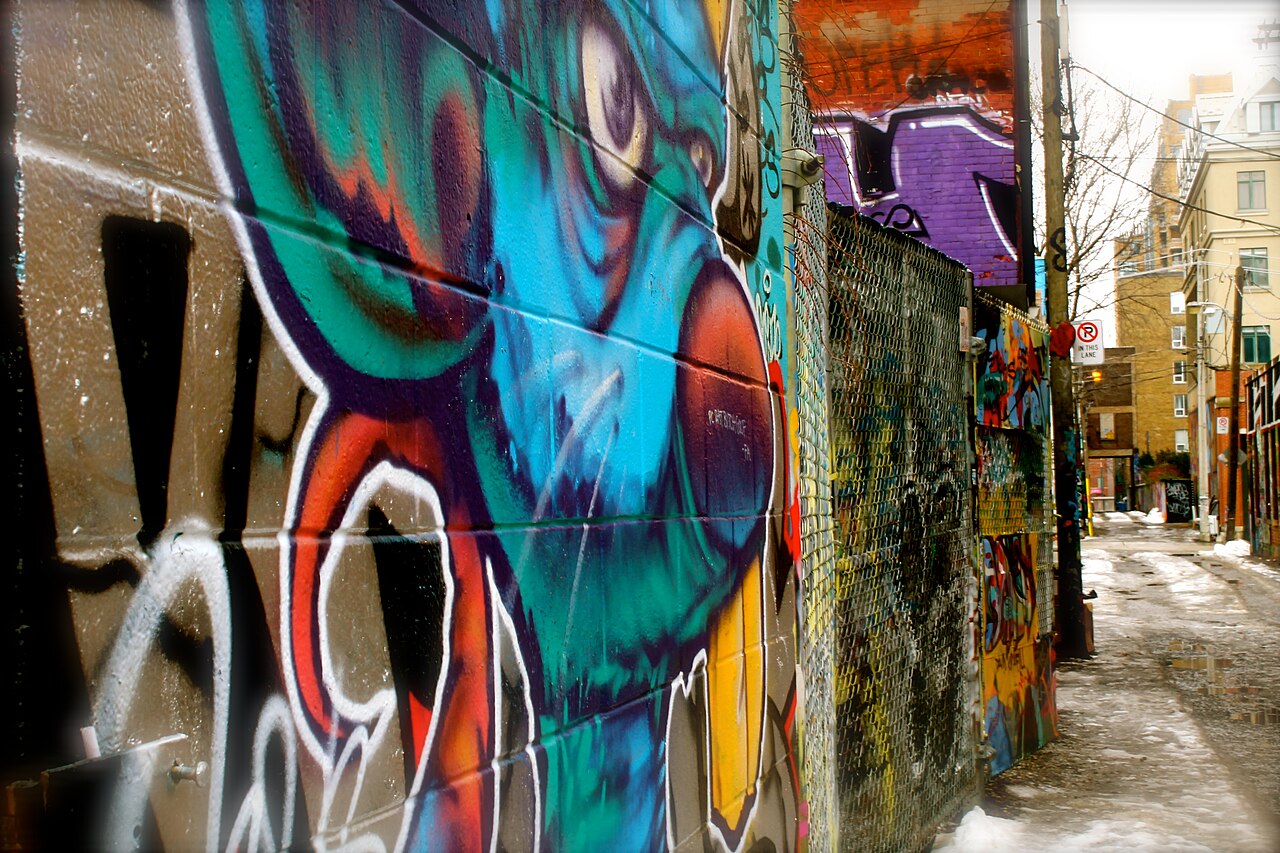
Graffiti Alley is a laneway in the Fashion District where street artists are permitted to paint murals legally. It is in Toronto, Canada. Most visitors spend 20–30 min here. The free Lokali audio guide runs 5 minutes.
✓ Verified August 2026 · how we write these guides
Visitor facts
| Time needed | 20–30 min |
|---|---|
| Lokali audio guide | 5 min · free |
| Type | Street Art |
| Best for | Photography |
| Location | Toronto, Canada |
| Coordinates | 43.6596, -79.3973 |
| Languages | 45, in the Lokali app |
The story
Color hits you first. Walls of it, from the ground to the roofline, on both sides of a narrow lane. Spray paint, brushwork, paste-ups, and tags overlap in thick layers. The air smells faintly of aerosol and warm brick. Somewhere a back door props open, and the noise of a kitchen drifts out. You have stepped off a busy street into an open-air gallery that no one curates and everyone shares.
This is Graffiti Alley. It runs through the laneways just south of Queen Street West, in the part of downtown Toronto known as the Fashion District. The painted stretch reaches for about one kilometer, mostly along a lane called Rush Lane. There is no gate and no ticket. The lane is a working back-alley, lined with loading doors, dumpsters, and the rear walls of shops and restaurants. The closest cross streets are Spadina Avenue and Portland Street, and the nearest transit stops leave a short walk through the shops of Queen West. Most people arrive on foot, pulled in from the main street by a flash of color down a side lane.
What makes the place unusual is that the art never holds still. A mural you photograph today may be painted over next month. Artists work on top of each other's pieces in a constant exchange. Some walls carry large, planned murals. Others hold quick tags and stickers. The surface records hundreds of hands, and none of them stay for long.
Walking here is slow. You stop, look up, step back, and look again. Faces appear in the brushwork. Cartoon characters. Words in fat bubble letters. Portraits as tall as a doorway. Birds, robots, flowers, slogans. Look closely and you find small pieces tucked beside the big ones, easy to miss on a first pass.
The lane became known beyond the neighborhood partly through television. The comedian Rick Mercer filmed his on-camera rants while walking these walls for years, the shifting art moving behind him. That backdrop carried the alley into living rooms across Canada and gave it a kind of fame it never asked for.
Street art and the city have not always agreed. Graffiti sits in a gray zone between vandalism and culture. Over the years, the city and local property owners reached an uneasy peace here, treating much of this corridor as a place where painted walls are welcomed rather than scrubbed clean. That tolerance is part of why the art has grown so dense.
Light changes the lane through the day. Morning sun reaches one wall while the other stays in shadow. By afternoon the colors flatten under bright overhead light. Photographers tend to come early, before the crowds and before delivery trucks fill the narrow space. On weekends, you may share the lane with photo shoots and small tour groups.
Pay attention to the surfaces themselves. Brick, metal roll-up doors, wooden fences, and concrete each take paint in their own way. A piece on a ridged metal door looks broken into stripes up close, then snaps into focus from a distance. The artists work with these textures rather than against them.
The lane is also a record of its moment. Murals respond to the news, to the seasons, to losses and celebrations. A wall may carry a tribute to a musician, a message about the city, or a joke only locals will catch. Because the art keeps changing, the alley always reflects something close to now.
Treat the space with the respect a working lane deserves. People live and work on either side. Keep the loading doors clear. Lower your voice near the homes. The art is free to see, and that freedom depends on visitors who do not damage the walls or block the businesses.
When you reach the end, turn around and walk it back the other way. The walls read differently in the opposite direction. Pieces you missed appear. The light has shifted. You begin to notice the layering, how one image sits over the ghost of another, paint on paint on paint.
The painted area is larger than a single lane. Side branches and connecting alleys carry the art deeper into the block, and they are worth following. The murals spill around corners and onto fences you would never find from the main path. Give yourself time to get a little lost. The dead ends and narrow gaps often hold the boldest work, set away from the foot traffic of the central stretch.
Most galleries ask you to be quiet and keep your distance. This one asks nothing. It will look different the next time you come, and the version you saw today is already gone for someone else. That is the quiet lesson of the lane. Some beauty is made to be temporary, and it is no less worth seeing for that.
Key facts
What to look for
Practical tips
Common questions
How long do you need at Graffiti Alley?
Plan 20–30 min. That is the time most visitors spend at Graffiti Alley. The free Lokali audio guide adds about 5 minutes of narration you can listen to as you walk, so it fits inside your visit rather than adding to it.
Is there a free audio guide to Graffiti Alley?
Yes — the Lokali app narrates Graffiti Alley free of charge in 50+ languages. It covers the history, what to look for on site and practical tips, and it works offline once downloaded.
Where is Graffiti Alley?
Graffiti Alley is in Toronto, Canada, at 43.6596, -79.3973. Tap the map link on this page for directions from where you are.
What should you know before visiting Graffiti Alley?
Come early morning to avoid crowds and delivery trucks.
What is Graffiti Alley known for?
Runs about one kilometer through laneways south of Queen West.
What is the best time to visit Graffiti Alley?
The alley runs east-west behind Spadina between Dundas and College.
On the map
Opens directions to Graffiti Alley from your location.
More to see in Toronto



Hear Graffiti Alley in your language
The full story, narrated, in 50+ languages. Download it before you go and it plays offline, at your own pace, with no ticket and no tour group.