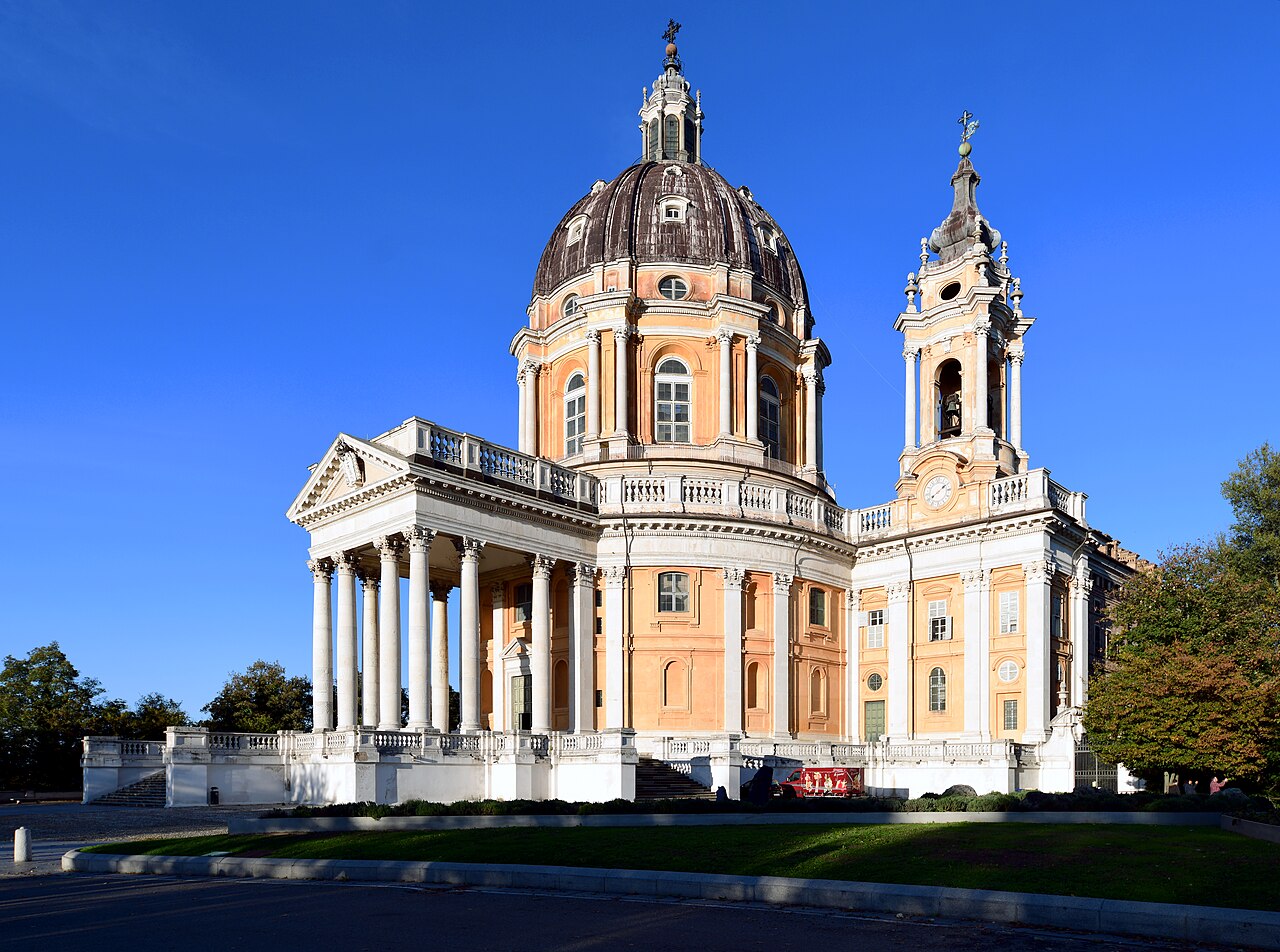
Basilica of Superga is a Baroque basilica on a hilltop overlooking Turin, built in the 18th century as a votive offering. It is in Turin, Italy. Most visitors spend 1–1.5 hours here. The free Lokali audio guide runs 5 minutes.
✓ Verified August 2026 · how we write these guides
Visitor facts
| Time needed | 1–1.5 hours |
|---|---|
| Lokali audio guide | 5 min · free |
| Type | Cathedral |
| Best for | Romantic |
| Location | Turin, Italy |
| Coordinates | 45.0532, 7.7165 |
| Languages | 45, in the Lokali app |
The story
The climb leaves the city behind. As you rise, the streets fall away and the air grows fresh. Trees close in on both sides. Then, at the top of the hill, a great pale church appears against the sky. Its dome and columns face the whole valley. This is the Basilica of Superga, and it watches over Turin from above.
The story starts with a war. In 1706 an enemy army surrounded the city. The siege was long and the danger was real. The duke, Victor Amadeus the Second, climbed this hill to look down on his trapped city. There, it is said, he made a vow. If the city were saved, he would build a great church on this spot to give thanks.
The city was saved. The siege broke and the enemy retreated. The duke kept his word. He called on Filippo Juvarra, the finest architect of the region, to design the church. Work went on from 1717 to 1731. The result is a tall and balanced building in the Baroque style, set alone on the green hilltop.
Look at the front. A row of high columns forms a porch, like the front of an ancient temple. Above and behind rises a round dome, pale against the clouds. Two bell towers stand on either side. The whole design is calm and clear. Juvarra wanted the building to be seen from far below, and it is.
Step inside. The space under the dome is round and bright. Light falls from windows high above. The floor is patterned stone. Side chapels open around the center. After the climb and the open sky outside, the cool quiet within feels like a held breath. Voices drop low here without anyone asking them to.
Below the church lies the royal crypt. Here the kings and princes of the House of Savoy are buried. Their tombs fill the cool underground rooms. For more than two hundred years this was the resting place of the ruling family. Walk down and read the names carved in the stone. The line of rulers stretches back through many ages.
But this hill holds a more recent sorrow. On the fourth of May, 1949, a plane was flying back to the city through thick fog and cloud. It carried the football team of Turin, then the strongest team in the land. The pilots could not see the hill. The plane struck the rear wall of the basilica. No one aboard survived.
The whole team was lost in a moment. Players, staff, and others, more than thirty people in all. The city fell into deep grief. The team had been the pride of Turin, champions year after year. In a single crash that golden side was gone. The wound is still felt by football fans across the country.
Walk around to the back of the church. There you will find a memorial to the lost team. Fans still come. They leave scarves, flowers, and notes in the team's colors. Even people too young to remember the crash make the climb to pay their respects. The spot has become a place of quiet pilgrimage.
To reach the hill, many visitors take an old rack railway. It runs up from the district of Sassi, climbing the steep slope on a toothed track. The cars are historic and slow. Through the windows the city sinks away below you. The ride itself is part of the day, a gentle journey from the streets to the heights.
From the open ground in front of the church, the view is wide. The whole of Turin spreads on the plain below, laid out in neat blocks. Beyond the city, on a clear day, the Alps form a long white wall along the horizon. The river winds through it all. People linger here, simply looking, before they go back down.
Each year, on the date of the crash, people climb the hill once more. Officials, former players, and ordinary fans gather at the back wall of the church. The names of the dead are read aloud, one by one. The team's anthem is sung. For a single morning the quiet hilltop fills with voices. Then the crowd goes down again, and the church returns to its long silence above the city.
This one hill holds so much. A promise kept after a war. A royal tomb. A team's last moment. Faith, power, and loss, all gathered on a single green height above the city. Stand at the edge and look out over Turin. Then turn back to the quiet church, and let it hold its many stories a little longer.
Key facts
What to look for
Practical tips
Common questions
How long do you need at Basilica of Superga?
Plan 1–1.5 hours. That is the time most visitors spend at Basilica of Superga. The free Lokali audio guide adds about 5 minutes of narration you can listen to as you walk, so it fits inside your visit rather than adding to it.
Is there a free audio guide to Basilica of Superga?
Yes — the Lokali app narrates Basilica of Superga free of charge in 50+ languages. It covers the history, what to look for on site and practical tips, and it works offline once downloaded.
Where is Basilica of Superga?
Basilica of Superga is in Turin, Italy, at 45.0532, 7.7165. Tap the map link on this page for directions from where you are.
What should you know before visiting Basilica of Superga?
Ride the historic rack railway up from Sassi.
What is Basilica of Superga known for?
Designed by Filippo Juvarra, built 1717 to 1731.
What is the best time to visit Basilica of Superga?
Take the tram up the hill—the ride itself is a local ritual.
On the map
Opens directions to Basilica of Superga from your location.
More to see in Turin


Hear Basilica of Superga in your language
The full story, narrated, in 50+ languages. Download it before you go and it plays offline, at your own pace, with no ticket and no tour group.