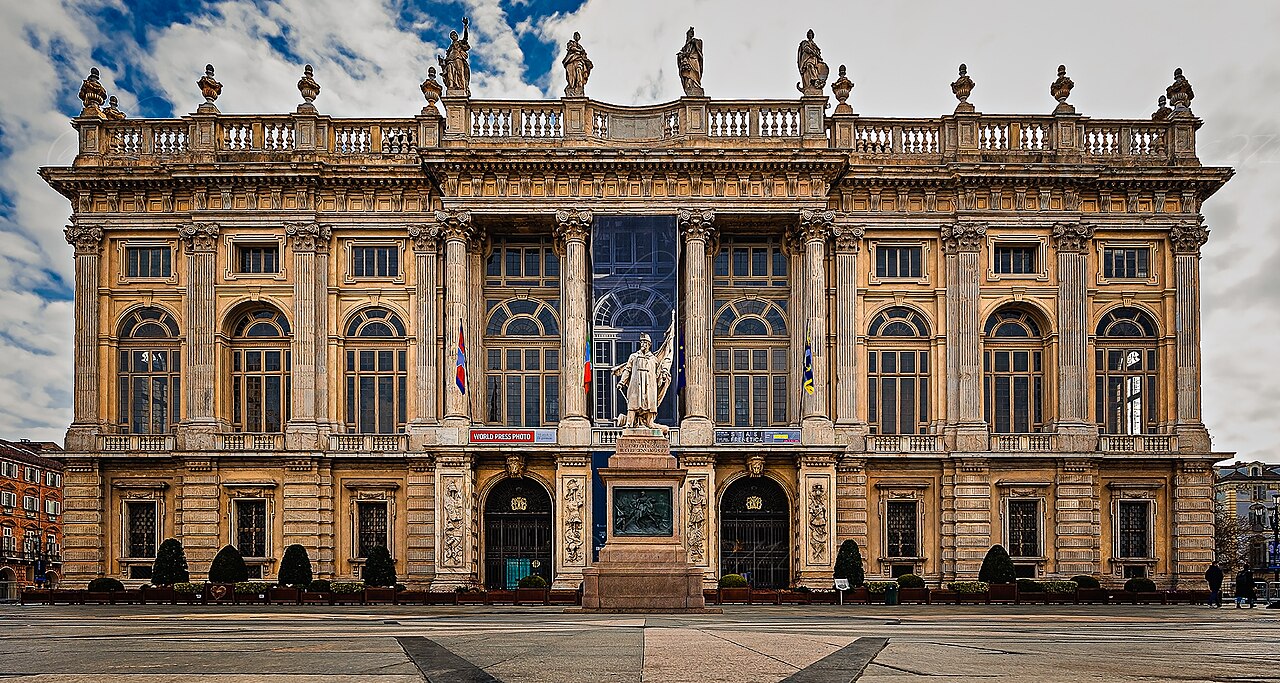
Palazzo Madama is a medieval castle transformed into a Baroque palace, now housing the Museum of Ancient Art. It is in Turin, Italy. Most visitors spend 1–1.5 hours here. The free Lokali audio guide runs 5 minutes.
✓ Verified August 2026 · how we write these guides
Visitor facts
| Time needed | 1–1.5 hours |
|---|---|
| Lokali audio guide | 5 min · free |
| Type | Palace |
| Best for | History |
| Location | Turin, Italy |
| Coordinates | 45.0684, 7.6865 |
| Languages | 45, in the Lokali app |
The story
Stand in the great square and turn toward the building with the pale stone front. Tall windows catch the light. A wide staircase waits behind the glass. From this side it looks like an elegant palace. But walk around it, and the story changes. The back is rough, brown, and old. This single building holds almost two thousand years of the city's life. It is called Palazzo Madama.
Begin with what lies beneath. Long ago, when this was a Roman town, a gate stood on this very spot. It guarded the eastern entrance through the city wall. Soldiers passed under it. Carts rolled through. Parts of that ancient gate are still here, built into the structure you see. The city simply grew around them and never let go.
In the Middle Ages, the old gate became a castle. Two tall brick towers went up. Thick walls were raised for defense. You can still see these medieval parts at the rear of the building. They are plain and strong, made for hard times. Look at the brown brick and imagine guards on the walls, watching the roads below.
Centuries later, the building changed again. It became a home for royal women of the House of Savoy. Two widows lived here in turn. Each was known as Madama Reale, which means Royal Madam. It is from them that the palace takes its name. They wanted comfort and beauty, not defense, and they reshaped the place to match.
One of these women called for a new front. She hired Filippo Juvarra, the leading architect of the day. He finished his grand facade in 1721. It is built in the Baroque style, full of movement and light. Tall columns rise between large windows. The stone seems to ripple. It hides the old castle behind a calm and noble face.
Step inside, and the famous staircase opens before you. It is wide enough for many people to climb side by side. Light pours down from high windows. The stone steps curve and spread. This was made to impress visitors, to make them feel they were rising into a higher world. Climb slowly and look up as you go.
Today the palace holds the Civic Museum of Ancient Art. Its rooms are full of paintings, sculpture, and fine objects gathered over centuries. There is old furniture, painted glass, and gold work. Each floor reaches into a different age. The building itself is the largest object in the collection, and every room teaches part of its long past.
One painting draws many visitors on its own. It is a small portrait of an unknown man by Antonello da Messina, painted in the fifteenth century. The man looks straight out at you, calm and alert, as if he is about to speak. Among all the grand rooms and old stone, this quiet face is what many people remember best long after they leave.
Go down into the lower levels. Here the air grows cool and the walls turn to bare stone. This is the medieval heart, kept open for visitors. You can see the foundations and the base of the Roman gate. In one building you pass from a royal hall above to a dark fortress below in just a few steps.
Then climb one of the towers. The stairs are narrow and worn. At the top, the city opens around you. You look down on the great square, on the rooftops, on the hills beyond. From here the shape of the old town is clear. The towers once watched for danger. Now they offer only a fine view.
In 1997 this palace was named a UNESCO World Heritage site. It was honored together with the other homes of the House of Savoy across the region. The award marks not just its beauty but its layers. Few buildings show so many ages of history stacked so plainly, one upon another, in the same walls.
As you leave, walk all the way around the outside. Start at the smooth Baroque front. Then follow the wall to the rough brown back. In that short walk you cross from the eighteenth century to the Middle Ages to ancient Rome. The building wears all its lives at once and hides none of them.
Most places choose one face to show the world. This one refuses. It keeps the gate, the fortress, the palace, and the museum together in a single frame. Stand in the square once more and take it in. You are looking at the whole story of a city, written in stone, still standing in plain sight.
Key facts
What to look for
Practical tips
Common questions
How long do you need at Palazzo Madama?
Plan 1–1.5 hours. That is the time most visitors spend at Palazzo Madama. The free Lokali audio guide adds about 5 minutes of narration you can listen to as you walk, so it fits inside your visit rather than adding to it.
Is there a free audio guide to Palazzo Madama?
Yes — the Lokali app narrates Palazzo Madama free of charge in 50+ languages. It covers the history, what to look for on site and practical tips, and it works offline once downloaded.
Where is Palazzo Madama?
Palazzo Madama is in Turin, Italy, at 45.0684, 7.6865. Tap the map link on this page for directions from where you are.
What should you know before visiting Palazzo Madama?
Walk up the grand staircase to the upper halls.
What is Palazzo Madama known for?
Built on an ancient Roman city gate.
What is the best time to visit Palazzo Madama?
The staircase by Juvarra is a masterpiece of Baroque drama—all curves and light.
On the map
Opens directions to Palazzo Madama from your location.
Reference
More to see in Turin


Hear Palazzo Madama in your language
The full story, narrated, in 50+ languages. Download it before you go and it plays offline, at your own pace, with no ticket and no tour group.