
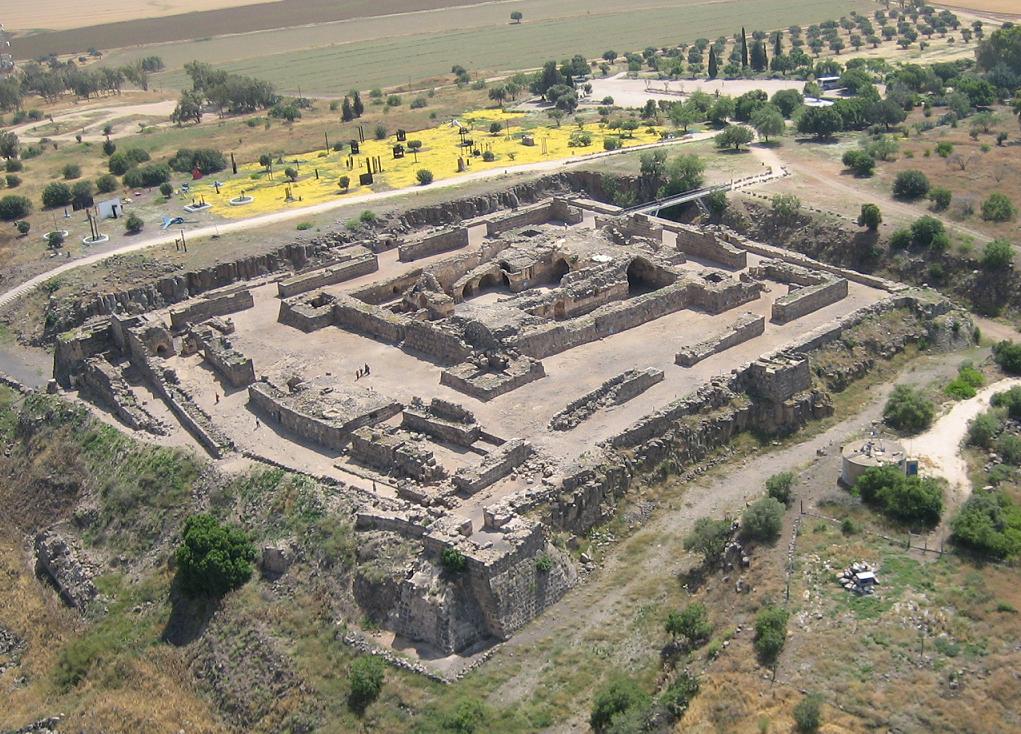
Photo: Samir I. Sharbaty · CC BY-SA 3.0 · Wikimedia Commons
Gadara is an archaeological site in Jordan, former city of the ancient Decapolis. Gadara belonged to the Decapolis, a group of Greek-style cities. The free Lokali audio guide runs 7 minutes.
✓ Published October 2026 · how we write these guides
Visitor facts
| Lokali audio guide | 7 min · free |
|---|---|
| Type | Archaeological Site |
| Location | Umm Qais, Jordan |
| Coordinates | 32.6555, 35.6778 |
| Languages | 50+, in the Lokali app |
The story
Feel the ground under your shoes. In many places here it is not pale stone at all, but black basalt — dark, porous, slightly rough, warm in the afternoon sun. Then lift your eyes. On a clear day the land drops away in front of you, and far below, a sheet of blue water catches the light. That is the Sea of Galilee. Few ancient cities had a view like this one, and the people of Gadara knew it.
You are standing on a ridge in the far north of Jordan, above the modern village of Umm Qais. To the north, the Yarmouk River cuts a deep gorge. Beyond it rise the Golan Heights. To the west lies the lake, and on very clear days the hills of Galilee beyond it. Three landscapes meet within a single glance. This is why a city grew here — high ground, cool winds, and control over the routes below.
Gadara was a Greek-speaking city of the Hellenistic age, the period after Alexander the Great, when Greek culture spread across the eastern Mediterranean. Later it became part of the Decapolis. The name means ten cities in Greek. It was a loose group of towns in this region that shared Greek language, Greek gods and Greek ways of city life. Their neighbours included Jerash to the south and Amman, which was then called Philadelphia.
In 63 BC, the Roman general Pompey arrived in the region and reorganised it. The ancient historian Josephus writes that Pompey rebuilt Gadara as a favour to one of his freedmen, a man from this city named Demetrius. Roman rule brought stability, money and building. Over the next centuries the city filled with temples, baths, colonnaded streets and theatres. Much of what you see today belongs to that Roman and later Byzantine world.
Here is the first surprise. This hilltop town was famous across the ancient world for its writers and thinkers. The satirist Menippus came from Gadara. So did the poet Meleager, who gathered short Greek poems into a collection he called the Garland — one of the ancestors of every poetry anthology since. The Epicurean philosopher Philodemus was also born here. For a small city on the edge of the empire, that is a remarkable list.
Now look for the West Theatre. It is built almost entirely of black basalt, and that dark stone gives it a serious, heavy beauty. The seats curve around the stage in tight rows. Basalt is very hard, which made it difficult to carve, but it also helped the theatre survive. Sit for a moment in one of the upper rows. Even today, a voice from the stage carries well. Imagine an audience here, with the lake shining behind them.
From the theatre area, walk toward the main street, the decumanus maximus. That is the Latin name for the main east-west road of a Roman city. It is still paved with large basalt blocks. Look closely at the surface. In places you can see grooves worn by the wheels of carts over many generations. Columns once lined both sides, with shops behind them. Some column bases and shafts still stand, while others lie where they fell.
Near the theatre, a raised terrace holds the remains of a Byzantine church with an unusual octagonal plan. By the Byzantine period, from about the fourth century onward, Gadara was a Christian city with a bishop. Around the church you will notice tall columns of black basalt mixed with pale limestone. This mix of dark and light stone appears across the whole site. It gives Gadara a look quite different from the golden ruins of Jerash.
The second surprise is a story rather than a stone. In the Gospel of Matthew, Jesus casts demons out of two men in the country of the Gadarenes, and the demons enter a herd of pigs that rush into the lake. Other gospels name the place differently, and scholars still debate exactly where it happened. Local tradition connects the story with this landscape. Whatever the truth, you can see why the setting fits — steep slopes running down toward water.
Water was always a challenge on this dry ridge. The Roman engineers solved it with remarkable effort. A long underground aqueduct, cut through solid rock over many kilometres, brought water toward the region's cities, including Gadara. Inside the city, water fed a public fountain, called a nymphaeum, and large bath complexes. As you walk, look for low walls and channels near the main street. They belonged to this system of baths and fountains.
The ancient city did not end gently. A powerful earthquake struck the region in the eighth century, in the year 749, and it brought down many buildings across the Jordan Valley. Gadara shrank to a small village. Centuries later, during the Ottoman period, villagers built new stone houses on top of the old ruins, often using ancient blocks. Some of those houses still stand on the hilltop today, with arched doorways and thick walls.
Those Ottoman houses are worth your time. They show how people lived here long after the Romans. Look for carved stones, pieces of columns or old inscriptions set into later walls. One of the larger houses holds a small museum with finds from the site, including sculpture and mosaic. Archaeologists from Jordan and Germany, among others, have worked here for decades, and their work continues to change what we know about the city.
If you have time, walk to the edge of the hill, away from the main paths. The wind is often steady here, and it carries the sounds of the village — a dog, a car, the call to prayer from a nearby mosque. Olive trees grow between the ruins. In spring the ground fills with small wild flowers. In late afternoon the light turns soft and golden, and the basalt changes from black to a deep grey-brown.
Before you leave, stand still and look once more across the valley to the lake. The same view filled the eyes of poets, soldiers, bishops and farmers here for more than two thousand years. Then look down at the dark stones under your feet. Some of them were set in place by Roman hands. As you walk back toward the village, notice how old stone and new life sit side by side on this quiet hill.
Key facts
What to look for
Practical tips
Common questions
Is there a free audio guide to Gadara?
Yes — the Lokali app narrates Gadara free of charge in 50+ languages. The guide runs about 7 minutes, covers the history, what to look for on site and practical tips, and works offline once downloaded.
Where is Gadara?
Gadara is near Umm Qais, Jordan, at 32.6555, 35.6778. Tap the map link on this page for directions from where you are.
What is Gadara known for?
Gadara belonged to the Decapolis, a group of Greek-style cities. Pompey reorganised the region and rebuilt Gadara in 63 BCE.
What should you look for at Gadara?
The West Theatre built almost entirely of black basalt. Cart-wheel grooves worn into the basalt paving of the main street. Black basalt columns beside pale limestone at the octagonal church.
What should you know before visiting Gadara?
Come in late afternoon for softer light on the basalt. Wear sturdy shoes for uneven basalt paving and loose stones.
When is the best time to visit Gadara?
Come in late afternoon for softer light on the basalt.
On the map
Opens directions to Gadara from your location.
More to see near Gadara


Hear Gadara in your language
The full story, narrated, in 50+ languages. Download it before you go and it plays offline, at your own pace, with no ticket and no tour group.