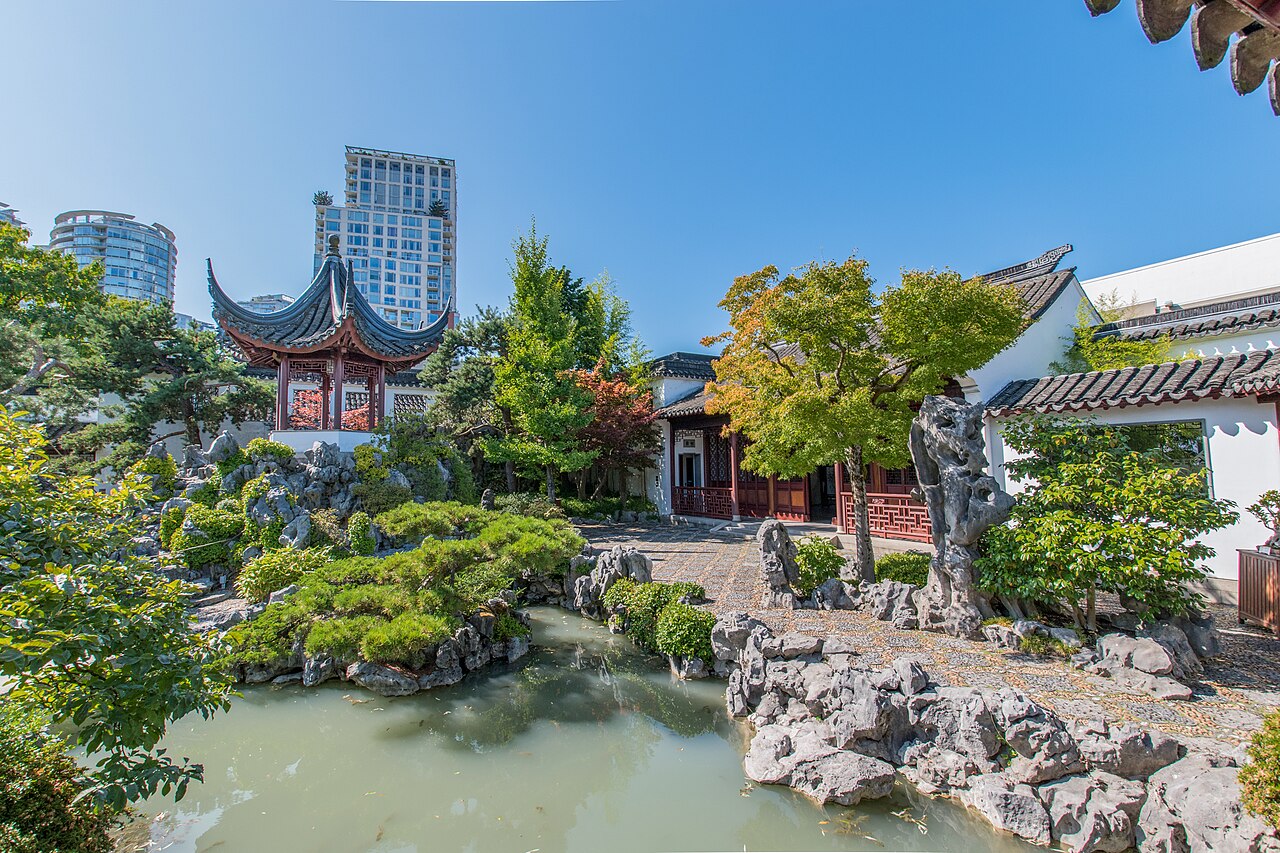
Dr. Sun Yat-Sen Classical Chinese Garden
49.2793° N · 123.0668° W · Garden
Dr. Sun Yat-Sen Classical Chinese Garden is a Ming Dynasty-style garden in Chinatown, built with traditional materials and techniques without nails or glue. It is in Vancouver, Canada. Most visitors spend 45–75 min here. The free Lokali audio guide runs 5 minutes.
✓ Verified August 2026 · how we write these guides
Visitor facts
| Time needed | 45–75 min |
|---|---|
| Lokali audio guide | 5 min · free |
| Type | Garden |
| Best for | Romantic |
| Location | Vancouver, Canada |
| Coordinates | 49.2793, -123.0668 |
| Languages | 45, in the Lokali app |
The story
Step through the round gate and the city goes quiet. The traffic of Chinatown falls away behind a high white wall. Before you lies still water the color of jade. Curved roofs are reflected in it. The air smells of damp stone and pine. A few steps have carried you into another world.
This is the Dr. Sun Yat-Sen Classical Chinese Garden. It was the first full garden of its kind built outside China. The work was done in 1985 and 1986. When it opened, no place like it existed anywhere beyond the homeland of its design. People came simply to see how it had been done. Many had never seen such a thing in person.
The garden follows a style perfected long ago by Chinese scholars. Such gardens were private retreats. A scholar would walk here to think, to paint, or to write a poem. Friends would gather to drink tea and talk. Every view was arranged with care. Nothing was left to chance, yet all was made to feel natural. The art lay in hiding all the effort.
To build it truly, artisans came from the city of Suzhou in China. They brought old skills and old materials with them. They raised the halls and walls by hand. They used wooden joints that lock together without nails or screws. No power tools touched the work. The building you see was made the way it would have been made long ago.
A classical garden rests on four things. There is rock. There is water. There are plants. And there are buildings. The makers weave these four together. Each one frames the others. You move among them, and the garden seems to breathe and change with every step you take. The balance among them is the whole art.
Look at the strange pale stones beside the pond. They come from a lake in China called Tai. Slow water carved them over many long years, leaving holes and twisted shapes. The makers prized such stones. To the scholar's eye, a single stone could stand for a whole mountain range. Walk slowly around them, and the shapes seem to shift.
The water itself looks cloudy, not clear. This is done on purpose. The soft green surface works like a mirror. It catches the roofs, the stones, and the sky, and holds them gently. A clear pool would show the mud below. This one shows the heavens instead, doubling the garden above it. Look down, and a second garden looks back.
Covered walkways run along the edges of the pond. Their roofs curve upward at the ends. As you pass, windows open in the wall beside you. No two are cut the same. Each frames a different view, like a living painting set in the stone. Stop at each one and look through before you move on. The walls themselves become picture frames.
The plants are chosen for meaning, not only for beauty. Pine stands for long life and strength. Bamboo bends in the wind but does not break. The flowering plum opens in the cold, a sign of courage. Together these three speak a quiet language, well understood by those who know the old signs.
The garden carries the name of Sun Yat-Sen. He is a leader honored by many Chinese around the world. He once traveled through Canada to gather support for change at home. The garden stands in his memory. It sits in the heart of an old Chinese quarter, far across the ocean from China.
Find a seat in one of the pavilions. Let the noise of your own thoughts settle. Watch a fish move slowly under the green water. Hear the wind pass through the bamboo. A bird may call from the roof above. The garden asks nothing of you here. It offers only a place to be still. Stay as long as you like, for no one will hurry you.
Each season changes the garden. In spring the plum blooms. In summer the leaves are full and the pond is deep green. In autumn the colors turn. In winter the bare branches and stones stand clear. The makers planned for all of this. They built a place that is never quite the same on any two visits.
Outside the wall, the modern city rushes on. Inside, the same four things hold their quiet balance: stone, water, leaf, and roof. People walked gardens like this hundreds of years ago. They were seeking the same calm you feel right now. Carry a little of it back out with you through the gate.
Key facts
What to look for
Practical tips
Common questions
How long do you need at Dr. Sun Yat-Sen Classical Chinese Garden?
Plan 45–75 min. That is the time most visitors spend at Dr. Sun Yat-Sen Classical Chinese Garden. The free Lokali audio guide adds about 5 minutes of narration you can listen to as you walk, so it fits inside your visit rather than adding to it.
Is there a free audio guide to Dr. Sun Yat-Sen Classical Chinese Garden?
Yes — the Lokali app narrates Dr. Sun Yat-Sen Classical Chinese Garden free of charge in 50+ languages. It covers the history, what to look for on site and practical tips, and it works offline once downloaded.
Where is Dr. Sun Yat-Sen Classical Chinese Garden?
Dr. Sun Yat-Sen Classical Chinese Garden is in Vancouver, Canada, at 49.2793, -123.0668. Tap the map link on this page for directions from where you are.
What should you know before visiting Dr. Sun Yat-Sen Classical Chinese Garden?
Sit quietly in a pavilion for a while.
What is Dr. Sun Yat-Sen Classical Chinese Garden known for?
First full classical Chinese garden built outside China.
What is the best time to visit Dr. Sun Yat-Sen Classical Chinese Garden?
Each corner reveals a new composed view—the garden is designed to unfold like a scroll painting.
On the map
Opens directions to Dr. Sun Yat-Sen Classical Chinese Garden from your location.
Reference
More to see in Vancouver


Hear Dr. Sun Yat-Sen Classical Chinese Garden in your language
The full story, narrated, in 50+ languages. Download it before you go and it plays offline, at your own pace, with no ticket and no tour group.