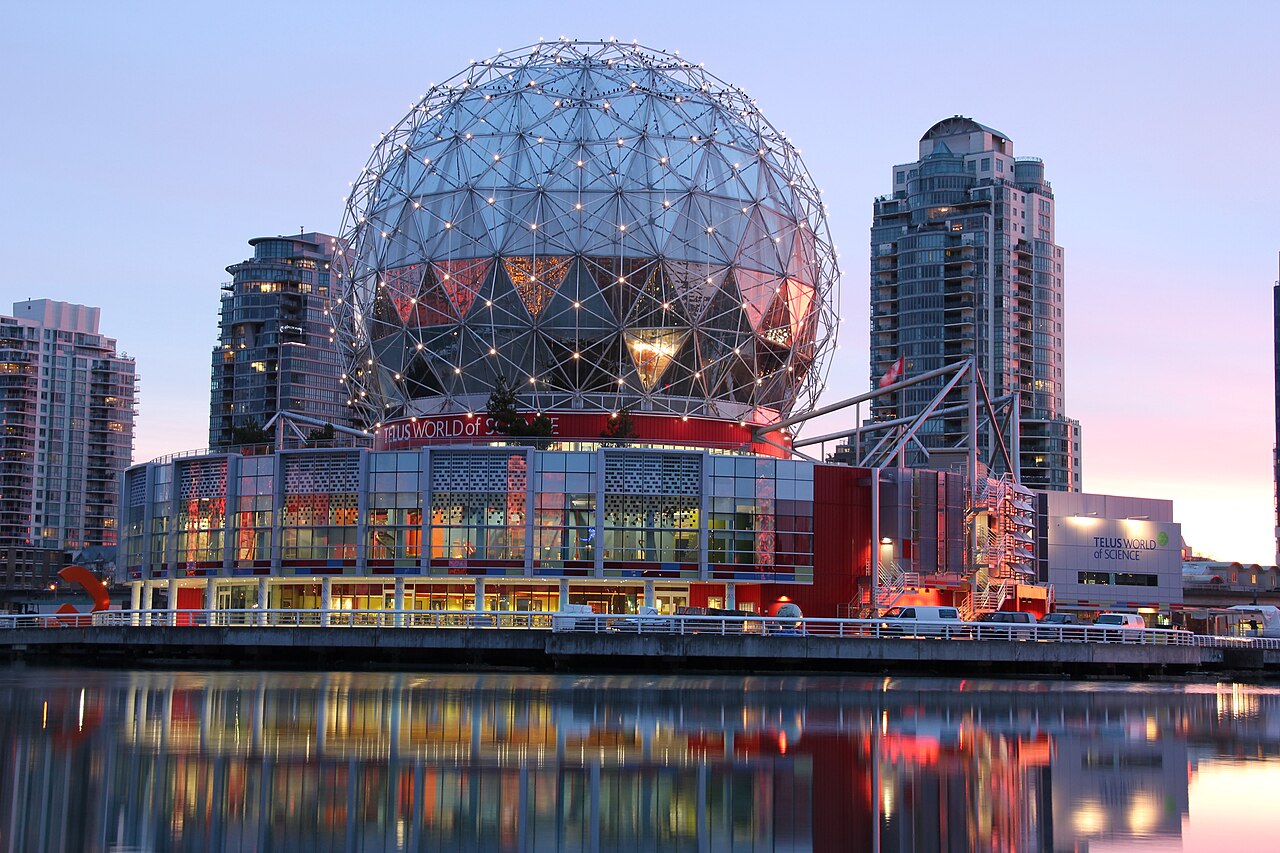
Science World is a geodesic dome on False Creek housing interactive science exhibits, an OMNIMAX theatre, and hands-on learning spaces. It is in Vancouver, Canada. Most visitors spend 2–3 hours here. The free Lokali audio guide runs 5 minutes.
✓ Verified August 2026 · how we write these guides
Visitor facts
| Time needed | 2–3 hours |
|---|---|
| Lokali audio guide | 5 min · free |
| Type | Museum |
| Best for | Family |
| Location | Vancouver, Canada |
| Coordinates | 49.2734, -123.1007 |
| Languages | 45, in the Lokali app |
The story
You see it before you reach it. A great silver ball rises over the water at the end of False Creek. By day it shines like a drop of mercury. The sun slides across its surface as you walk. By night it wears a net of small lights that switch and ripple across its curve. Few buildings in the city are so easy to know from far away.
This is Science World. The shape is called a geodesic dome. It is built from short straight struts that join into triangles. The triangles together bend into a sphere. The design spreads weight across the whole surface, so no inner columns are needed. The space inside feels open and tall. You can stand at the bottom and look all the way up the curve.
The dome was built for a world's fair. In 1986 Vancouver hosted Expo 86, a six-month exposition on transport and communication. The event drew more than twenty million visits to the city. People came from across the world. This building stood near the entrance and served as the Expo Centre. It welcomed crowds from the very first day.
When the fair ended, most of its pavilions came down. This one stayed. The city wanted a permanent home for science. In 1989 the dome opened again as a science centre. Children who had come to the fair could now return to learn. What had been a stop on a summer visit became a place to come back to.
Step inside and the sound changes. Voices rise toward the curved ceiling and soften. All around you, the exhibits invite touch. You can pull a lever. You can spin a wheel. You can lift a ball on a jet of air. The idea is simple. You learn by doing, not only by reading. Hands move first, and understanding follows.
There are galleries for the body, for water, for light and sound. A large open hall holds machines and puzzles. In one corner a tall structure lets a ball roll, drop, and chime through loops and tracks. Parents and children stop and watch the same ball together. For a moment, age does not matter. Everyone waits to see where it falls.
Look up at the frame of the dome. Trace one triangle, then the next. See how each one shares its edges with its neighbors. This pattern is strong because force travels along many paths at once. Press on a single point and the whole shell answers. The strength is in the sharing, not in any single piece.
The thinker who made this shape known was Buckminster Fuller. He wanted to cover the most space with the least material. A sphere does this well. The geodesic dome was his answer in struts and joints. He built such domes around the world. Vancouver's dome is one of its best-loved forms, and one of the largest you can walk inside.
Outside, a walkway follows the water. This is the eastern tip of False Creek, a narrow inlet that reaches into the city. Boats pass slowly by. Ducks paddle near the shore. Across the water stand towers of glass. The dome holds its own among them, round where they are sharp. It does not try to match their height. It simply keeps its own shape.
In the evening the lights begin. Thousands of small bulbs cover the dome's skin. They switch on in patterns. They chase around the curve. They shift through slow colors. From a bench across the creek, the show is quiet and steady. The great ball seems to breathe in the dark. People slow their steps to watch.
The building has carried more than one name over the years. Each name is tied to those who have helped to fund it. People in the city pay little mind to this. They still call it, with affection, the golf ball, or simply the dome. The shape, more than any name, is what they remember and return to.
Plan to spend a few hours here if you can. There is a theatre with a giant screen above the main hall. There are shows where staff set off small safe bursts of light and sound. Each one draws a circle of watchers. Between them, the open floor invites you to wander and try whatever catches your eye.
Stand for a moment and watch the lights move. A fair that lasted one summer left this behind. The crowds went home long ago. The dome stayed, and filled with the next questions of the next children. Some buildings end when their event ends. This one only began. It still asks the young to come in and wonder.
Key facts
What to look for
Practical tips
Common questions
How long do you need at Science World?
Plan 2–3 hours. That is the time most visitors spend at Science World. The free Lokali audio guide adds about 5 minutes of narration you can listen to as you walk, so it fits inside your visit rather than adding to it.
Is there a free audio guide to Science World?
Yes — the Lokali app narrates Science World free of charge in 50+ languages. It covers the history, what to look for on site and practical tips, and it works offline once downloaded.
Where is Science World?
Science World is in Vancouver, Canada, at 49.2734, -123.1007. Tap the map link on this page for directions from where you are.
What should you know before visiting Science World?
Allow two to three hours for the galleries.
What is Science World known for?
Built as the Expo Centre for Expo 86.
What is the best time to visit Science World?
The exterior reflection in False Creek is stunning at sunset.
On the map
Opens directions to Science World from your location.
Reference
More to see in Vancouver


Hear Science World in your language
The full story, narrated, in 50+ languages. Download it before you go and it plays offline, at your own pace, with no ticket and no tour group.