Photo: Sacranon · Public domain · Wikimedia Commons
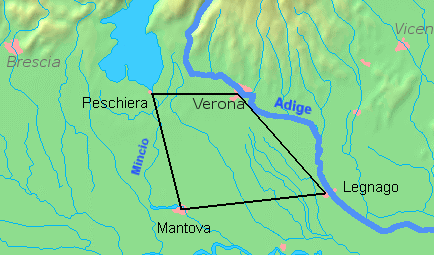
Quadrilatero is a defensive system of the Austrian Empire. It is in Verona, Italy. Four fortress towns: Verona, Peschiera, Mantua, Legnago. The free Lokali audio guide runs 8 minutes.
✓ Published October 2026 · how we write these guides
Visitor facts
| Lokali audio guide | 8 min · free |
|---|---|
| Type | Fortification |
| Location | Verona, Italy |
| Coordinates | 45.2942, 10.9683 |
| Languages | 50+, in the Lokali app |
The story
Run your hand along the brick here. It is cool, slightly rough, and laid in long, patient rows. These walls were not built to look beautiful. They were built to absorb cannon fire... and somehow they ended up beautiful anyway. Around you, Verona hums with scooters, church bells, and café cups on saucers. But under that ordinary noise sits one of the largest military systems of nineteenth-century Europe. Its name is the Quadrilatero, the Quadrilateral, and Verona was its heart.
The Quadrilatero was not one building. It was a square of four fortress towns working together. Verona was the largest. The other three were Peschiera del Garda, at the southern tip of Lake Garda, Mantua to the south, and Legnago, downstream on the Adige River. Draw lines between them on a map and you get a rough four-sided shape. Two rivers, the Mincio and the Adige, framed that shape like natural moats. Inside it, an army could rest, resupply, and strike out in any direction.
Who built it? After the fall of Napoleon, in 1815, this part of northern Italy passed to the Austrian Empire. Austria now ruled Lombardy and the Veneto, the region around Venice. Its generals saw that this corner of the plain was the key door between Italy and the Alps. Whoever held it could block an invasion from the west, or move troops quickly toward Vienna's southern routes. So Austria began to turn Verona into a fortress city.
The work grew much faster after 1848. That year, revolutions broke out across Europe, and Italian patriots rose against Austrian rule. The old Austrian field marshal Joseph Radetzky pulled his army back into the Quadrilatero — and the system did its job. Protected by the fortresses, his troops recovered and defeated the Piedmontese army near Custoza, a village just southwest of Verona. After that victory, Austria poured money and engineering skill into making the four towns even stronger.
Here in Verona, that meant more than one wall. Austrian engineers rebuilt the old city ramparts and added thick bastions, gun positions, and gates. Then they pushed outward. Rings of detached forts were placed in the surrounding countryside, so an enemy would have to fight through them before reaching the city itself. On the hills to the north, round towers watched the valleys. The city became a layered defence, like an onion with stone skins.
Here is something many visitors miss. Verona's walls are not from one age. Look closely and you can sometimes see the layers. There are traces of Roman work, medieval walls from the time of the della Scala family, who ruled Verona in the Middle Ages, and Venetian additions from the centuries when Venice controlled the city. The Austrians did not erase all of this. They often built on top of it, reusing older lines and strengthening them for modern artillery.
The Austrian style itself is quite recognisable. Watch for long, low façades in pale stone and brick, often very regular, with rows of small openings. Many buildings have a calm, almost classical look — straight lines, simple arches, little decoration. This was deliberate. Military architecture of the period aimed for order and solidity. It needed to look disciplined, because it represented an imperial army. Yet the craftsmanship is careful, and the stone has weathered into soft greys and honey tones.
Two large Austrian structures still shape the city skyline. One is the Arsenale, a huge complex on the right bank of the Adige, across the river from Castelvecchio, the medieval castle. It served as a workshop and depot for weapons and supplies. The other sits high on the hill of San Pietro, above the Roman theatre. There, a long barracks building looks down over the river bends and the rooftops. From the old centre, it is easy to spot.
That hilltop barracks is a good example of how the Quadrilatero changed the feeling of the city. Soldiers could see almost all of Verona from up there. The river, the bridges, the main roads — everything was in view. For the people living below, this was a constant reminder of who held power. Today the same hill is a favourite viewpoint. Couples lean on the railings at sunset, and the military gaze has turned into a tourist's gaze.
The system was tested again in 1859 and in 1866, in further wars for Italian unity. Austria lost Lombardy in 1859, but kept the Quadrilatero and the Veneto. In 1866, Austria won again near Custoza. Still, the wider war went against the empire, and the Veneto, with Verona, passed to the new Kingdom of Italy. Here is the second surprise — the fortress was never truly stormed. It was given up at a negotiating table, not taken by assault.
After that, the Italian army used many of the buildings for its own purposes. Over the following century, some forts fell into ruin. Trees grew through the brick. Ditches filled with water and reeds. In recent decades, more attention has turned to this heritage. The city's walls and fortifications are part of the reason Verona is listed as a UNESCO World Heritage Site. Parts of the defences now hold parks, footpaths, cultural spaces, and quiet green corners.
If you want to feel the Quadrilatero rather than just read about it, walk the line of the walls. The ramparts curve around the southern and western edges of the old city. In places, there are grassy ditches below and tall trees above. Joggers pass. Dogs pull at their leads. The noise of traffic drops away, and you can hear birds in the bastions. It is strange, and rather lovely, that a machine built for war now gives the city some of its calmest spaces.
Think, too, about the people who lived inside this system. Thousands of soldiers from across the Austrian Empire were stationed here — men who spoke German, Hungarian, Croatian, Czech, and other languages. They bought bread in Verona's markets and drank in its taverns. Local workers cut stone and laid brick for the new defences. The Quadrilatero was an imperial project, but it was built by many hands, and it shaped daily life in the streets around you.
So take one more look at the wall, the gate, or the long barracks line in front of you. Notice the tight joints between the bricks, the slope of the earth, the shadows in the gun openings. These details were planned to stop an army. Now they hold moss, swallows, and the warmth of the afternoon sun. As you walk back toward the centre, listen for the shift — from quiet ramparts to café voices — and remember that this square of fortresses once decided the future of Italy.
Key facts
What to look for
Practical tips
Common questions
Is there a free audio guide to Quadrilatero?
Yes — the Lokali app narrates Quadrilatero free of charge in 50+ languages. The guide runs about 8 minutes, covers the history, what to look for on site and practical tips, and works offline once downloaded.
Where is Quadrilatero?
Quadrilatero is in Verona, Italy, at 45.2942, 10.9683. Tap the map link on this page for directions from where you are.
What is Quadrilatero known for?
Four fortress towns: Verona, Peschiera, Mantua, Legnago. Built up by the Austrian Empire after 1815.
What should you look for at Quadrilatero?
Long pale barracks façade crowning San Pietro hill. Layers of Roman, medieval, and Venetian stonework in walls. Small gun openings set low in the bastions.
What should you know before visiting Quadrilatero?
Walk the southern ramparts for shade and quiet paths. Climb San Pietro hill near sunset for city views.
When is the best time to visit Quadrilatero?
Bring water when exploring outer forts in summer.
On the map
Opens directions to Quadrilatero from your location.
More to see in Verona


Hear Quadrilatero in your language
The full story, narrated, in 50+ languages. Download it before you go and it plays offline, at your own pace, with no ticket and no tour group.