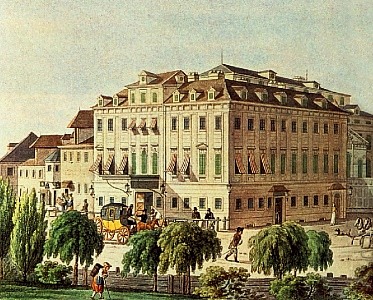
Photo: Alt, Jakob (1789 – 1872) · Public domain · Wikimedia Commons
Theater an der Wien is a historic theatre and Opera building in Vienna and Gemeindebau building located on the Left Wienzeile in the Mariahilf district. Founded in 1801 by Mozart's librettist Emanuel Schikaneder. The free Lokali audio guide runs 6 minutes.
✓ Published October 2026 · how we write these guides
Visitor facts
| Lokali audio guide | 6 min · free |
|---|---|
| Type | Theatre |
| Location | Vienna, Austria |
| Coordinates | 48.1997, 16.3639 |
| Languages | 50+, in the Lokali app |
The story
Stand on the pavement of the Linke Wienzeile for a moment and listen. Trams grind past. Market traders call out from the Naschmarkt across the road, and the air carries the smell of spices, olives and fresh bread. Behind you sits a theatre that most passers-by barely notice. Its street front is calm and modest. Yet inside these walls, some of the most important music ever written was heard for the very first time.
This is the Theater an der Wien, which means the Theatre on the Wien. The name refers to a river, not the city itself. The Wien river once flowed openly just beside this spot. Today it runs mostly hidden, covered over, and the long market you can see stands on top of it. So the theatre kept the name of a river that most visitors never actually see.
The theatre opened in 1801, and its story begins with one remarkable man: Emanuel Schikaneder. He was an actor, a singer, a director and a writer. He also wrote the libretto, the words, for Mozart's opera The Magic Flute. Schikaneder sang the role of Papageno himself at its premiere in 1791, in an older suburban theatre nearby. That success gave him the money and the confidence to build something grander, right here.
Here is a detail many visitors miss. Walk around the corner into the side street, Millöckergasse, and look for the old entrance known as the Papageno Gate. Above it, you will find sculpted figures. Schikaneder appears there dressed as Papageno, the cheerful bird-catcher from The Magic Flute. In a sense, the founder of this theatre put his favourite role over the door. It is one of the oldest surviving parts of the original building.
Now for the name that changes everything here: Ludwig van Beethoven. In the early 1800s, Schikaneder offered the young composer a commission and rooms inside the theatre building itself. For a time, Beethoven lived and worked under this roof. Imagine him climbing the stairs at night, the smell of lamp oil and paint around him, while rehearsals carried on below.
Beethoven's only opera, Fidelio, had its first performance here in 1805. The timing was terrible. Napoleon's troops had just occupied Vienna, and many of the composer's aristocratic supporters had left the city. The audience included French officers who did not understand the German text. The opera struggled. Beethoven revised it more than once over the following years, and the later version became a cornerstone of the repertoire.
The second surprise is even larger. On a freezing evening in December 1808, Beethoven held a marathon concert in this hall. Historical accounts describe the theatre as bitterly cold, and the programme lasted around four hours. That single night included the first public performances of his Fifth Symphony and his Sixth, the Pastoral. Two of the best-known symphonies in the world were first heard together, in one sitting, on this site.
The nineteenth century brought a change of mood. Vienna fell in love with comic theatre and, later, with operetta, a lighter form of opera with spoken dialogue, waltzes and witty plots. In 1874, Johann Strauss the Younger premiered Die Fledermaus here, a story of masked balls, champagne and mistaken identity. It is still performed every New Year's Eve in many opera houses. Its first audience sat in this building.
The operetta era continued into the twentieth century. In 1905, Franz Lehár's The Merry Widow had its premiere on this stage. Its melodies travelled across Europe and America within a few years. So this theatre links two very different Viennas: the serious, revolutionary world of Beethoven, and the elegant, dancing world of the waltz. Few houses anywhere can claim both.
The Second World War left deep scars on the city. The Vienna State Opera on the Ring was badly damaged by bombing. For roughly a decade after the war, the State Opera company performed here instead, while its own house was rebuilt. For those years, this smaller theatre carried the musical life of the whole city on its shoulders.
Yet the building itself came close to disappearing. In the decades after the war, it was in poor condition, and there was serious talk of demolition. It was saved and restored, and later it became a home for musicals. Shows from London and Broadway played here, and so did Elisabeth, a Viennese musical about the Austrian empress, which premiered on this stage in 1992 and went on to tour the world.
In 2006, the year Vienna celebrated the two hundred and fiftieth anniversary of Mozart's birth, the theatre returned to opera. It now presents a new production almost every month, rather than a fixed rotating repertoire. That makes it feel different from the larger State Opera. The hall is more intimate, so voices reach you directly. After a major renovation in the early 2020s, the house reopened with its historic interior refreshed.
If you go inside, notice the scale. The auditorium feels close and personal. From many seats, you can see the singers' faces clearly. This is the kind of space Beethoven and Schikaneder knew: a room where music is shared at close range, not displayed from far away. Think about how small this hall is compared with the size of the works first heard in it.
When you step back out onto the Wienzeile, the noise of the city returns. The market is still trading. The trams are still passing. Take one last look at the quiet front of the theatre, and then at the side street with Papageno over the gate. Somewhere above you, Beethoven once lived. And beneath the market across the road, the river that gave this theatre its name is still flowing.
Key facts
What to look for
Practical tips
Common questions
Is there a free audio guide to Theater an der Wien?
Yes — the Lokali app narrates Theater an der Wien free of charge in 50+ languages. The guide runs about 6 minutes, covers the history, what to look for on site and practical tips, and works offline once downloaded.
Where is Theater an der Wien?
Theater an der Wien is in Vienna, Austria, at 48.1997, 16.3639. Tap the map link on this page for directions from where you are.
What is Theater an der Wien known for?
Founded in 1801 by Mozart's librettist Emanuel Schikaneder. Beethoven's opera Fidelio premiered here in 1805.
What should you look for at Theater an der Wien?
Papageno figure sculpted above the old side gate. Schikaneder shown in his bird-catcher costume. The market stalls built over the hidden Wien river.
What should you know before visiting Theater an der Wien?
Walk around to Millöckergasse to find the historic side entrance. Combine your visit with a stroll through the Naschmarkt opposite.
On the map
Opens directions to Theater an der Wien from your location.
More to see in Vienna



Hear Theater an der Wien in your language
The full story, narrated, in 50+ languages. Download it before you go and it plays offline, at your own pace, with no ticket and no tour group.