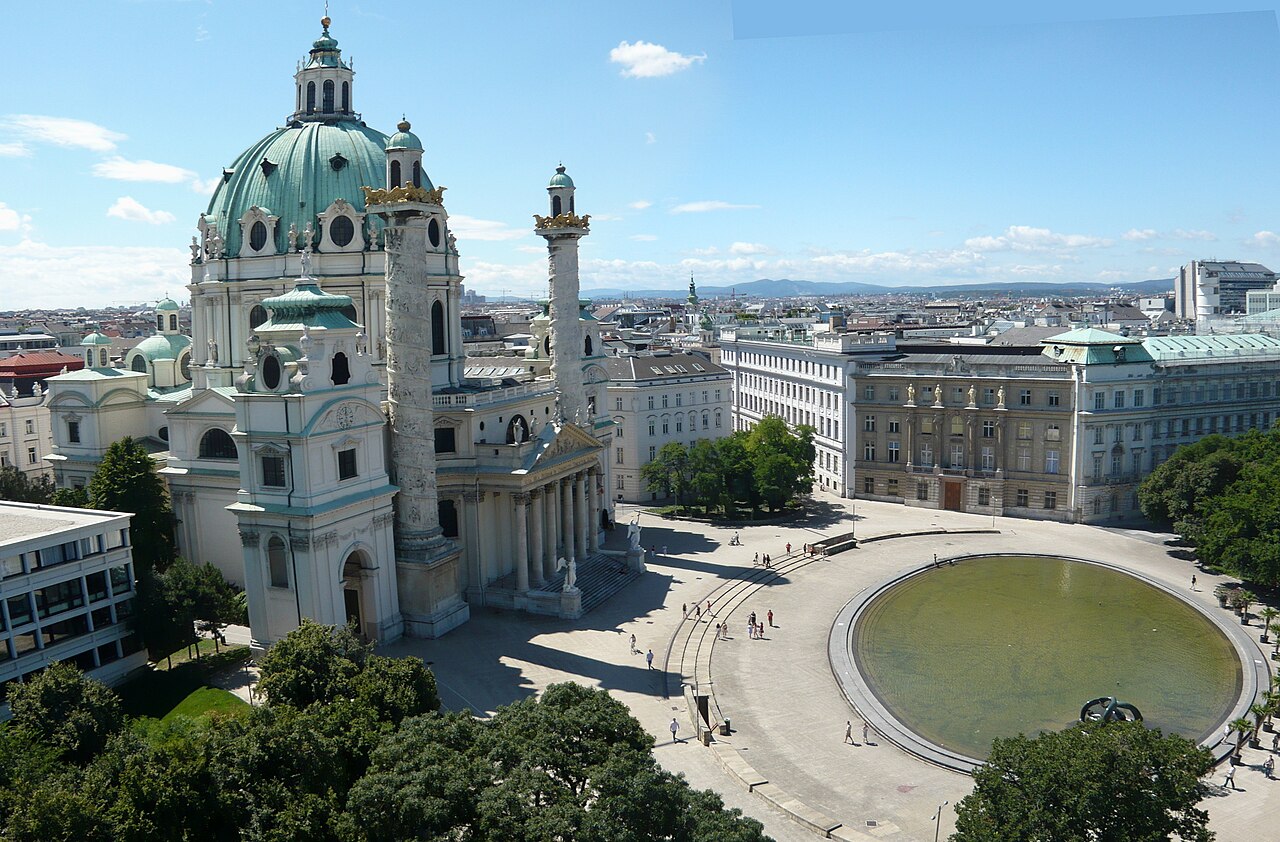
Karlsplatz is a square in Vienna, Austria. Named for Emperor Charles the Sixth after the 1713 plague. Otto Wagner's pavilions built 1898 for the stadtbahn railway. Most visitors spend 20-30 min here. The free Lokali audio guide runs 4 minutes.
✓ Verified October 2026 · how we write these guides
Visitor facts
| Time needed | 20-30 min |
|---|---|
| Lokali audio guide | 4 min · free |
| Type | Square |
| Best for | Photography |
| Location | Vienna, Austria |
| Coordinates | 48.201, 16.3691 |
| Languages | 45, in the Lokali app |
The story
Stand at the centre of Karlsplatz and you feel the city breathing. Trams glide past on steel rails, their bells chiming above the hum of traffic. Beneath your feet, one of Europe's busiest metro interchanges tunnels through bedrock. Above, the twin pavilions of the old stadtbahn station gleam like green-and-gold jewellery boxes, their copper domes weathered to verdigris.
This square has no single architect, no founding decree. It grew in layers across three centuries, shaped by plague, empire, and the relentless churn of modern transit. The name honours Emperor Charles the Sixth, who vowed to build a church if Vienna survived the plague of 1713. The city survived. The church rose. Karlsplatz became the threshold between the old walled city and the southern suburbs.
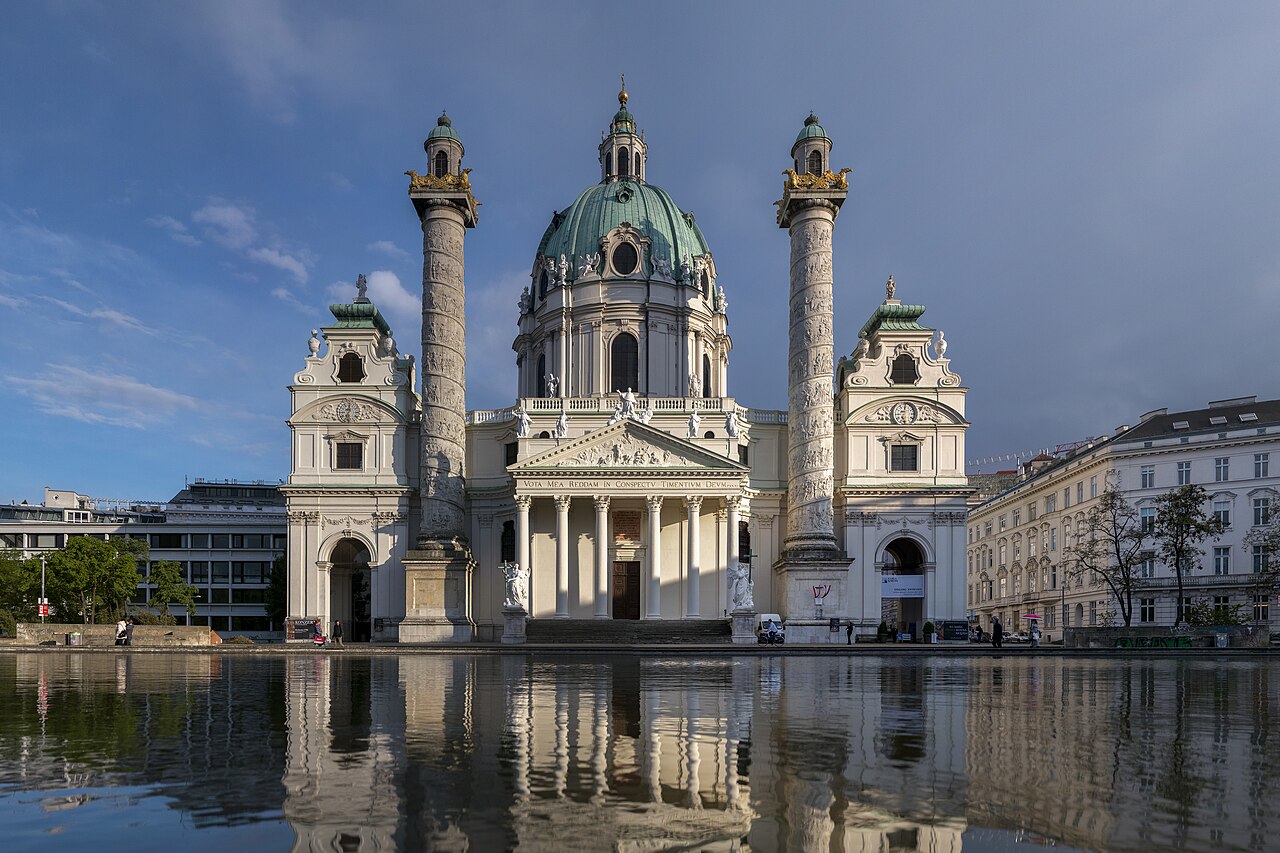
The Karlskirche dominates the western edge — a baroque dome flanked by two freestanding columns modelled on Trajan's column in Rome. Fischer von Erlach designed it as a visual argument, blending Roman grandeur with Byzantine curves and a Viennese love of theatricality. The columns carry spiralling reliefs that tell the life of Saint Charles Borromeo, patron saint of plague victims. Step closer and you see how the stone shifts colour in afternoon light, cream to honey to pale rose.
Across the square, Otto Wagner's twin pavilions mark a different era. Built in 1898 for the stadtbahn railway, they are masterworks of Jugendstil — Vienna's answer to Art Nouveau. Wagner clad them in white marble slabs held by visible copper bolts, then crowned them with gilded ornament. The message was radical for its time: structure and decoration could be honest partners, not adversaries. One pavilion now houses a small café, the other a modest exhibition space. Both still carry the faint smell of old stone and metal.
Between church and pavilions stretches a sunken plaza, added in the nineteen-seventies when the metro was cut through. It was controversial then — critics said it gutted the square's unity. Today it functions as an open-air room, sheltered from wind, dotted with benches and shallow reflecting pools. Skateboarders claim the smooth concrete in the evenings. Office workers eat lunch on the steps. The space has found its own rhythm.
The Resselpark, a sliver of green along the southern flank, honours Josef Ressel, the forester who invented the screw propeller. A statue of him stands among plane trees, largely ignored. But the park matters — it softens the hard geometry of the square, offers shade in summer, and frames views of the Technical University's long neoclassical facade.
Karlsplatz is a hinge. The Ringstrasse curves just north, carrying tourists toward the opera and the museums. The Naschmarkt sprawls to the west, Vienna's oldest and most aromatic food market. The Wien River, long ago paved over, runs beneath the square in a concrete channel. You can still see it through grates near the pavilions — a dark ribbon of water that once defined the city's southern boundary.
The square changes character with the hour. Early morning brings commuters streaming from the metro, faces set, coffee cups in hand. Midday sun floods the plaza, turning the Karlskirche's dome into a white blaze. Late afternoon, when light slants low, the pavilions glow like lanterns. After dark, the church is floodlit, its columns rising pale against the sky.
This is not a postcard square. It is a working junction, a place the city passes through daily. But pause long enough and the layers reveal themselves — the baroque confidence of the church, the modernist clarity of the pavilions, the metro's invisible hum below. Each era left its mark without erasing what came before.
Stand near the reflecting pool and watch the dome's reflection ripple when a tram passes. Notice how the pavilions' copper bolts have turned the same green as the domes. Listen for the faint echo of footsteps in the underpass. Karlsplatz does not demand attention. It rewards it.
As you leave, glance back once. The square holds its contradictions lightly — sacred and secular, old and new, monument and thoroughfare. That balance is Vienna's particular gift, and Karlsplatz is one of its clearest expressions.
Key facts
What to look for
Practical tips
Common questions
How long do you need at Karlsplatz?
Plan 20-30 min. That is the time most visitors spend at Karlsplatz. The free Lokali audio guide runs 4 minutes and is made to listen to while you walk.
Is there a free audio guide to Karlsplatz?
Yes — the Lokali app narrates Karlsplatz free of charge in 50+ languages. No ticket, tour group or subscription, and it works offline once downloaded.
Where is Karlsplatz?
Karlsplatz is in Vienna, Austria, at 48.201, 16.3691. Tap the map link on this page for directions.
What should you know before visiting Karlsplatz?
Visit late afternoon when light gilds the pavilions
What is Karlsplatz known for?
Named for Emperor Charles the Sixth after the 1713 plague
What is the best time to visit Karlsplatz?
Visit late afternoon when light gilds the pavilions
On the map
Opens directions to Karlsplatz from your location.
More to see in Vienna



Hear Karlsplatz in your language
The full story, narrated, in 50+ languages. Download it before you go and it plays offline, at your own pace, with no ticket and no tour group.