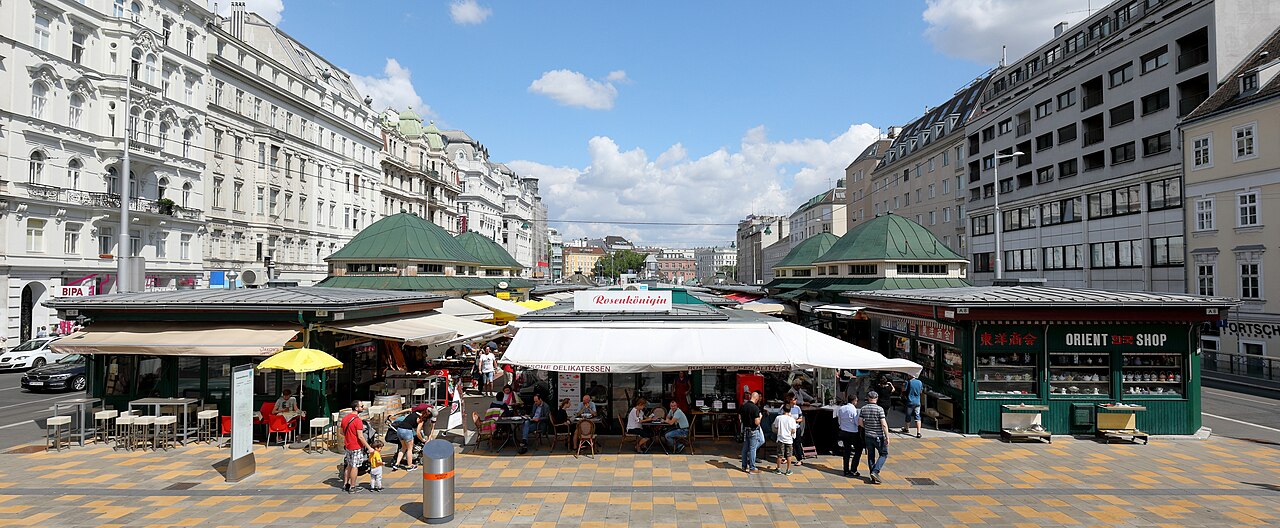
Naschmarkt is a food market in Vienna, Austria. Market has operated for over two centuries. Wien River now flows beneath the market in culverts. Most visitors spend 1-2 hours here. The free Lokali audio guide runs 5 minutes.
✓ Verified October 2026 · how we write these guides
Visitor facts
| Time needed | 1-2 hours |
|---|---|
| Lokali audio guide | 5 min · free |
| Type | Food Market |
| Best for | Authentic finds |
| Location | Vienna, Austria |
| Coordinates | 48.1958, 16.3591 |
| Languages | 45, in the Lokali app |
The story
The air here smells like a collision — roasted coffee and grilled fish, cardamom and wet stone, ripe peaches and the faint diesel of delivery vans idling at the curb. You are standing in the Naschmarkt, Vienna's sprawling open-air market, a half-kilometre ribbon of stalls and cafés that runs along the Wienzeile between Karlsplatz and Kettenbrückengasse. The ground underfoot is uneven cobblestone in some stretches, smooth asphalt in others, and everywhere the light filters through canvas awnings in stripes of green and white.
This market has fed Vienna for more than two centuries. It began in the late seventeen hundreds as a small cluster of milk sellers near the Karlskirche, then grew along the route of the Wien River — now buried beneath the street you walked to get here. By the mid-eighteen hundreds, the Naschmarkt had become the city's central produce hub, drawing farmers from the countryside and merchants from across the empire. The name itself is debated: some say it comes from the Ash trees that once lined the riverbank, others claim it derives from the word for snacking, a nod to the market's role as a place to graze and taste.
Walk the central aisle and you will pass stalls selling Turkish olives, Iranian saffron, Croatian truffles, Greek honey, Pakistani spices. This is not a folkloric reconstruction of old Vienna — it is a working market, and the diversity of goods reflects the city's long history as a crossroads. After the Second World War, guest workers from Turkey, the Balkans, and the Middle East settled in Vienna and brought their food traditions with them. The Naschmarkt absorbed those flavours, and today you can buy za'atar and schnitzel from neighbouring vendors.
Saturday mornings bring the flea market, which sprawls westward from Kettenbrückengasse into a chaotic maze of second-hand books, Soviet-era cameras, chipped porcelain, vintage posters, and questionable antiques. Locals arrive early to hunt for Biedermeier furniture or first-edition sheet music. Tourists arrive late and pay too much for enamel coffee pots. The boundary between the food stalls and the flea market is porous — you might find a cheese monger next to a man selling Tyrolean hiking boots from the nineteen sixties.
The architecture framing the market is worth a glance. On the southern side, Otto Wagner's Jugendstil apartment buildings rise in elegant curves, their facades decorated with gold leaf and ceramic tiles. Wagner designed them in the early nineteen hundreds as part of his vision for a modern Vienna, and they still look startlingly fresh. On the northern side, the buildings are more restrained, late-nineteenth-century blocks with stucco and wrought iron. The contrast is sharp, and it reminds you that Vienna has always been a city of layers, old and new pressed together.
The food here is not cheap, but it is real. You can eat standing at a counter — oysters and white wine, grilled octopus, börek stuffed with spinach, falafel wrapped in flatbread, Vietnamese pho, Italian antipasti. The quality varies stall to stall, and the vendors know their regulars by name. If you want to sit, there are cafés with outdoor tables where you can watch the flow of shoppers and argue over coffee that costs more than it should.
One detail most visitors miss: the small bronze plaques set into the pavement at intervals along the market. They mark the course of the old Wien River, which once ran open through this valley before it was covered over in the late eighteen hundreds to make room for the market and the U-Bahn line below. The river still flows beneath your feet, invisible, and on rainy days you can sometimes hear it rushing through the culverts.
The Naschmarkt is busiest on Saturday mornings, quieter on weekday afternoons. If you come early — before nine — you will see the vendors setting up, unloading crates of produce, arranging pyramids of pomegranates and persimmons. The light is softer then, the crowd thinner, and you can move through the aisles without elbowing through tourists.
This is not a museum. The Naschmarkt is a place where Viennese people still do their shopping, where restaurants send their cooks to buy fish for the evening service, where pensioners argue with butchers over the price of lamb. It has survived wars, floods, urban planning schemes, and the rise of supermarkets. It survives because it remains useful, because it feeds people, because it changes.
As you walk back toward the U-Bahn, notice the small details — the hand-lettered signs in three languages, the wooden crates stamped with growers' names, the smell of roasting chestnuts in autumn, the way the light catches the glass jars of pickled vegetables. The Naschmarkt is not grand or monumental. It is daily, necessary, alive.
Key facts
What to look for
Practical tips
Common questions
How long do you need at Naschmarkt?
Plan 1-2 hours. That is the time most visitors spend at Naschmarkt. The free Lokali audio guide runs 5 minutes and is made to listen to while you walk.
Is there a free audio guide to Naschmarkt?
Yes — the Lokali app narrates Naschmarkt free of charge in 50+ languages. No ticket, tour group or subscription, and it works offline once downloaded.
Where is Naschmarkt?
Naschmarkt is in Vienna, Austria, at 48.1958, 16.3591. Tap the map link on this page for directions.
What should you know before visiting Naschmarkt?
Arrive before nine on weekdays for smaller crowds
What is Naschmarkt known for?
Market has operated for over two centuries
What is the best time to visit Naschmarkt?
Arrive before nine on weekdays for smaller crowds
On the map
Opens directions to Naschmarkt from your location.
More to see in Vienna




Hear Naschmarkt in your language
The full story, narrated, in 50+ languages. Download it before you go and it plays offline, at your own pace, with no ticket and no tour group.