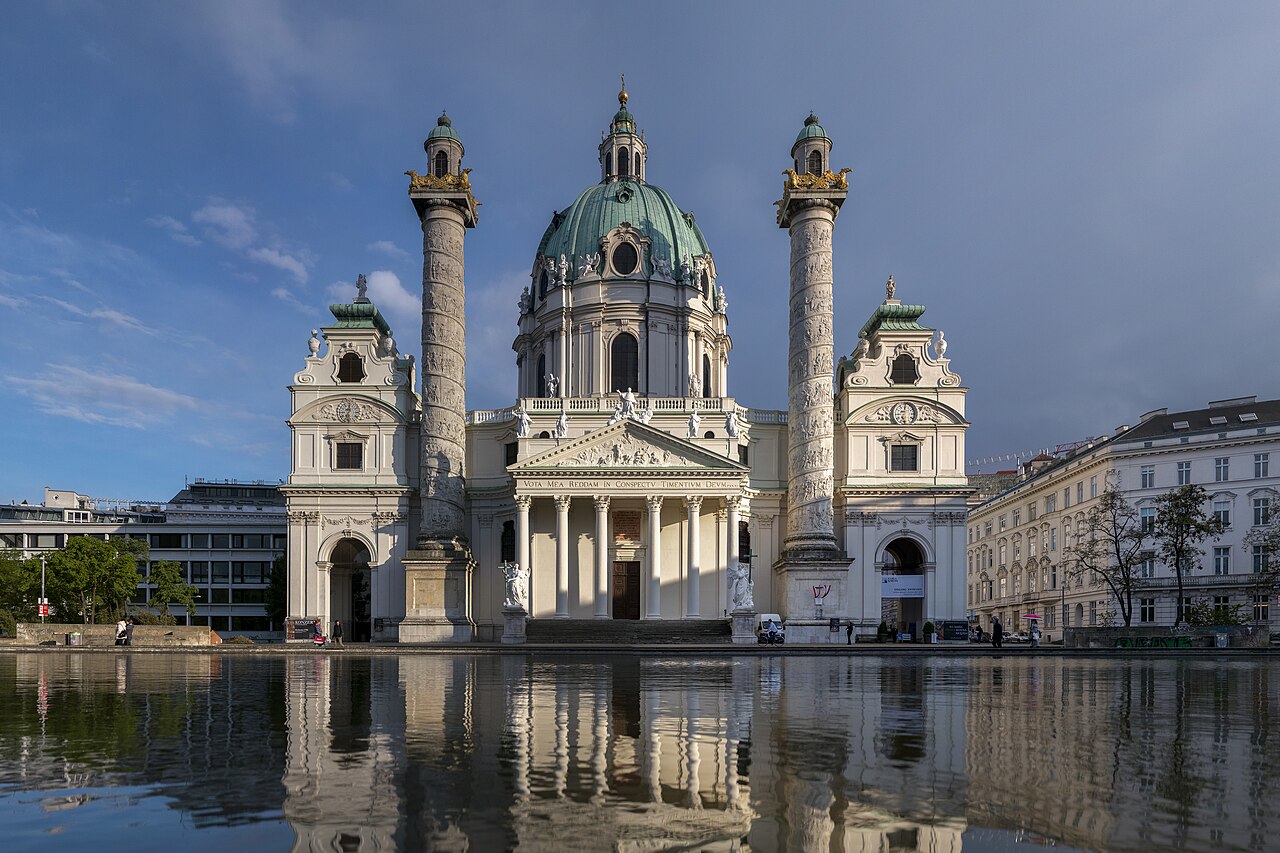
Karlskirche is a baroque church in Vienna, Austria. Built 1716 to 1737 after a plague vow. Designed by Fischer von Erlach, father and son. Most visitors spend 45-75 min here. The free Lokali audio guide runs 5 minutes.
✓ Verified October 2026 · how we write these guides
Visitor facts
| Time needed | 45-75 min |
|---|---|
| Lokali audio guide | 5 min · free |
| Type | Baroque Church |
| Best for | History |
| Location | Vienna, Austria |
| Coordinates | 48.1983, 16.3719 |
| Languages | 45, in the Lokali app |
The story
Stand at the edge of Karlsplatz and look up. The twin columns rise like sentinels — forty metres tall, wrapped in spiralling reliefs that climb toward the sky. Between them, a dome swells above a portico of white stone, and the whole composition floats against the backdrop of Vienna's roofline. This is Karlskirche, the Church of Saint Charles Borromeo, and it is unlike any other church in the city.
The building was born from plague. In 1713, Vienna was in the grip of its last great epidemic. Emperor Charles the Sixth made a vow — if the city survived, he would raise a church to his patron saint, Charles Borromeo, the Italian cardinal who had tended to plague victims in Milan a century earlier. The epidemic lifted. The emperor kept his word. Construction began in 1716, and the church was consecrated in 1737, a year after the architect Johann Bernhard Fischer von Erlach died. His son, Joseph Emanuel, finished the work.
The twin columns are the first thing people ask about. They echo Trajan's Column in Rome, those ancient monuments of imperial triumph. Here, they are Christianized — the spiralling bands depict scenes from the life of Saint Charles Borromeo, carved in low relief. One column represents steadfastness, the other mercy. Stand close and you can make out figures in robes, the sick being tended, the cardinal kneeling in prayer. The columns frame the entrance but do not support it — they are freestanding sculptures, pure theatre.
The portico borrows from the Pantheon in Rome, with its six Corinthian columns and triangular pediment. Above it, the dome rises — a green copper shell over an inner fresco. The architect wanted to synthesize the grandeur of Rome with the verticality of northern Europe. The result is a building that feels both ancient and inventive, a fusion of temple, basilica, and baroque drama.
Step inside and the light changes. The interior is oval, not rectangular, and the walls curve gently inward. The dome overhead is painted with a fresco by Johann Michael Rottmayr — it shows Saint Charles Borromeo being received into heaven, surrounded by swirling clouds and angels. The colours are soft, the brushwork loose. In summer, light pours through the lantern at the dome's peak and the whole space glows.
For a small fee, you can take a lift inside the dome and ride up to a viewing platform that circles the fresco. You stand at eye level with the painted figures, close enough to see the brushstrokes and the cracks in the plaster. It is a rare chance to inspect a baroque ceiling from the inside out, and the perspective is disorienting — the angels loom large, the architecture reveals itself as illusion.
The altar is a sculptural mass of white and gold, with columns that twist like barley sugar and a sunburst of gilded rays behind the tabernacle. To either side, smaller chapels open off the main space, each with its own altarpiece and votive candles. The acoustics are excellent — the church hosts concerts several evenings a week, and the music fills the oval without echo.
Outside, the reflecting pool in front of the church doubles the image — columns, dome, portico, all mirrored in still water. On calm days, the reflection is nearly perfect, and photographers line the edge of the pool to catch the symmetry. In winter, the pool is drained and the stone basin sits empty, but the view from the far side of Karlsplatz remains one of the finest in Vienna.
The church sits at the edge of the old city, where the Ringstrasse begins its sweep around the centre. To the west, the Vienna Secession building crouches low and golden. To the east, the Musikverein and the Künstlerhaus line the boulevard. Karlskirche anchors this corner of the city, a baroque monument in a neighbourhood that later embraced Art Nouveau and modernism.
The name of the church honours both Saint Charles Borromeo and Emperor Charles the Sixth, a doubling of devotion and politics. The emperor wanted a monument that would outlast him, a statement of Habsburg piety and power. He got it. The church has survived wars, occupations, and the collapse of the empire itself. It stands now as it did in 1737 — a fusion of Roman ambition and Viennese craft, a building that refuses to belong to a single tradition.
As you walk away, glance back once more. The columns catch the light differently depending on the hour — gold at sunrise, shadowed at noon, glowing at dusk. The dome shifts colour with the sky. The church is a clock of sorts, marking time not in hours but in the slow movement of stone and copper through the seasons.
Key facts
What to look for
Practical tips
Common questions
How long do you need at Karlskirche?
Plan 45-75 min. That is the time most visitors spend at Karlskirche. The free Lokali audio guide runs 5 minutes and is made to listen to while you walk.
Is there a free audio guide to Karlskirche?
Yes — the Lokali app narrates Karlskirche free of charge in 50+ languages. No ticket, tour group or subscription, and it works offline once downloaded.
Where is Karlskirche?
Karlskirche is in Vienna, Austria, at 48.1983, 16.3719. Tap the map link on this page for directions.
What should you know before visiting Karlskirche?
Take the lift inside the dome for close fresco views
What is Karlskirche known for?
Built 1716 to 1737 after a plague vow
On the map
Opens directions to Karlskirche from your location.
More to see in Vienna



Hear Karlskirche in your language
The full story, narrated, in 50+ languages. Download it before you go and it plays offline, at your own pace, with no ticket and no tour group.