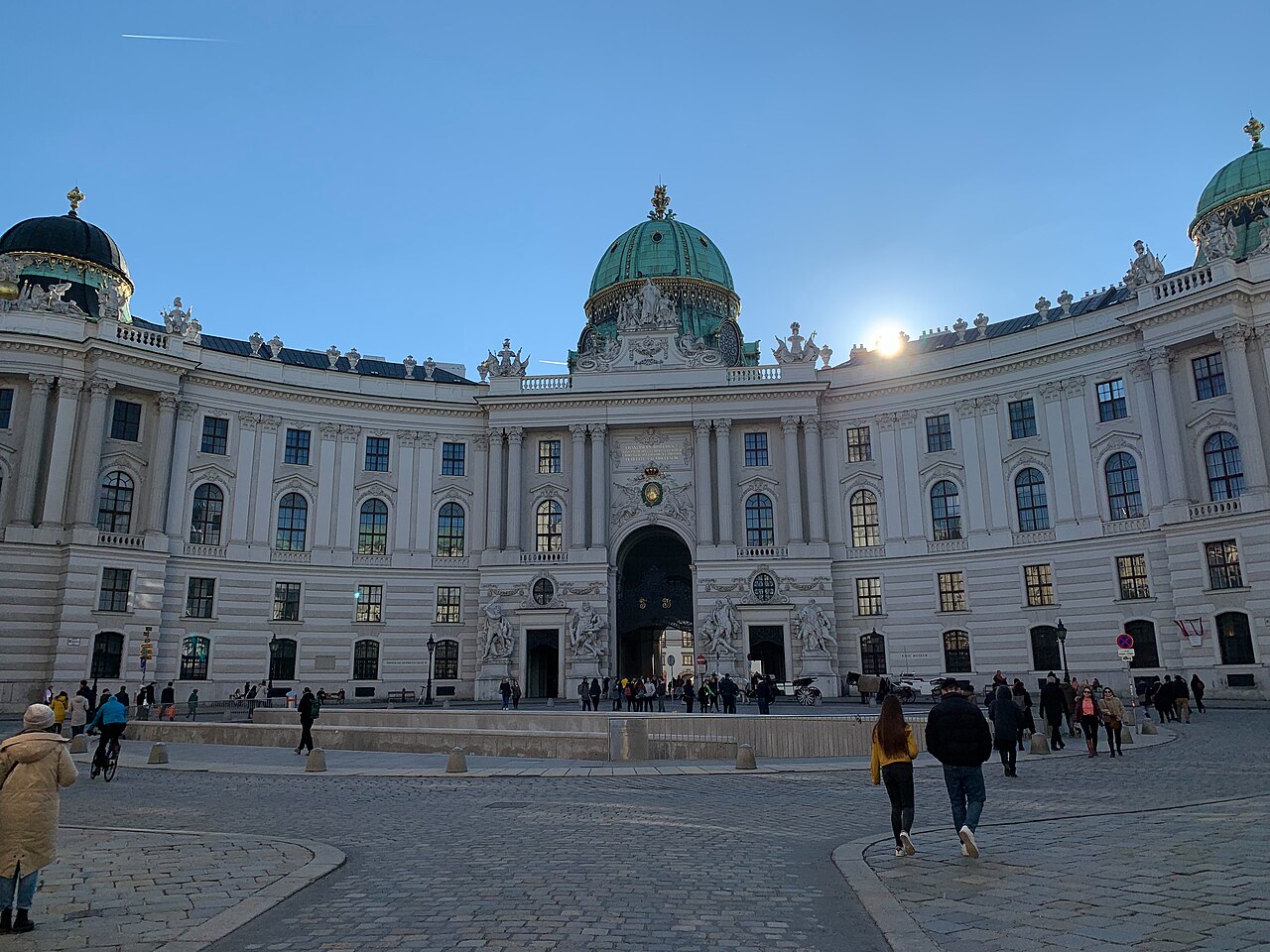
Michaelerplatz is a square in Vienna, Austria. Roman military barracks from Vindobona lie beneath the square. Michaelertrakt facade completed in 1910 after two centuries delay. Most visitors spend 15-20 min here. The free Lokali audio guide runs 5 minutes.
✓ Verified October 2026 · how we write these guides
Visitor facts
| Time needed | 15-20 min |
|---|---|
| Lokali audio guide | 5 min · free |
| Type | Square |
| Best for | History |
| Location | Vienna, Austria |
| Coordinates | 48.208, 16.3662 |
| Languages | 45, in the Lokali app |
The story
Stand in the centre of this square and look down. Beneath your feet, under protective glass panels set into the cobblestones, lie the excavated foundations of Roman military barracks — brick channels, stone footings, fragments of a settlement that predates Vienna by name. The city has always layered itself here, each century building atop the last without fully erasing what came before.
Michaelerplatz sits at the threshold of the Hofburg Palace, the sprawling complex that housed the Habsburg emperors for more than six centuries. The square itself is small, almost intimate for such a grand address, but it functions as a hinge — the old medieval city to one side, the imperial precinct to the other. For much of Vienna's history, this was the formal entrance to power. Ambassadors, petitioners, and courtiers passed through here on their way to audience chambers deeper inside the palace.
The building that dominates the square is the Michaelertrakt, the pale green wing of the Hofburg completed in the early twentieth century. Its design caused a scandal. The architect Joseph Emanuel Fischer von Erlach had sketched plans for a grand Baroque facade in the seventeen hundreds, but the project stalled for nearly two centuries. When it was finally built in 1910, the result was a restrained neo-Baroque structure that many Viennese found too sober, too plain for an imperial gateway. By then, the empire had less than a decade left.
Directly across from the Michaelertrakt stands the Loos Haus, a stark modernist commercial building finished in 1911. Its flat, unornamented facade — smooth white plaster, green marble columns at ground level, rows of identical windows above — provoked outrage. Emperor Franz Joseph reportedly refused to use the Michaelerplatz entrance after the building went up, calling it an eyesore. Critics dubbed it the "house without eyebrows" because the windows lacked decorative lintels. Today, the contrast between the two buildings reads as a compressed argument about the twentieth century, frozen in stone and plaster on opposite sides of a cobbled square.
The Church of Saint Michael anchors the northern edge of the square. Its origins stretch back to the thirteenth century, though the current facade dates from the seventeen-seventies. The church served as the parish for the imperial court, and its crypt holds the bodies of minor nobility, court officials, and wealthy merchants. The crypt is unusual — the cool, dry air naturally mummified many of the remains, and some coffins were left open for centuries as a memento mori, a reminder of mortality for the living. Visitors can tour the crypt on certain days, though it is not for the squeamish.
The Roman ruins visible through the glass panels were uncovered in the nineteen-nineties during construction work. Archaeologists found the remains of officers' quarters from the Roman fortress of Vindobona, which garrisoned the Danube frontier in the first and second centuries. The decision to leave the ruins exposed rather than rebury them was deliberate — a choice to make the city's deep past visible in daily life. Commuters cross the square each morning, glancing down at walls that Roman soldiers once leaned against.
The square is also a working space. Fiakers — the horse-drawn carriages that carry tourists through the old city — queue along the western edge, their drivers in grey felt hats waiting for fares. The smell of horses mingles with exhaust from the buses that circle the square. Street musicians sometimes set up near the church steps, their sound bouncing off the surrounding stone. It is a square that refuses to be purely monumental — too much movement, too many functions layered on top of one another.
On a clear afternoon, the light hits the Michaelertrakt at an angle that picks out every detail of its sculptural program — allegorical figures representing the power of the empire, now just decoration on a building that houses government offices. The Loos Haus, by contrast, absorbs light flatly, its surfaces offering no shadow or relief. The two buildings never quite resolve into a harmonious composition. They sit in permanent, polite disagreement.
If you walk to the edge of the square nearest the Hofburg, you will see the archway that leads into the palace complex — the passage through which emperors rode in gilded carriages, and through which tourists now stream with cameras and guidebooks. The square itself remains a threshold, a place defined by what lies just beyond it. But the layers beneath your feet, the Roman brick and medieval foundations, suggest that thresholds have always been here, long before any empire claimed them.
Key facts
What to look for
Practical tips
Common questions
How long do you need at Michaelerplatz?
Plan 15-20 min. That is the time most visitors spend at Michaelerplatz. The free Lokali audio guide runs 5 minutes and is made to listen to while you walk.
Is there a free audio guide to Michaelerplatz?
Yes — the Lokali app narrates Michaelerplatz free of charge in 50+ languages. No ticket, tour group or subscription, and it works offline once downloaded.
Where is Michaelerplatz?
Michaelerplatz is in Vienna, Austria, at 48.208, 16.3662. Tap the map link on this page for directions.
What should you know before visiting Michaelerplatz?
Look through glass panels in cobblestones for Roman ruins
What is Michaelerplatz known for?
Roman military barracks from Vindobona lie beneath the square
What is the best time to visit Michaelerplatz?
Visit early morning to avoid fiaker queues and tour groups
On the map
Opens directions to Michaelerplatz from your location.
More to see in Vienna




Hear Michaelerplatz in your language
The full story, narrated, in 50+ languages. Download it before you go and it plays offline, at your own pace, with no ticket and no tour group.