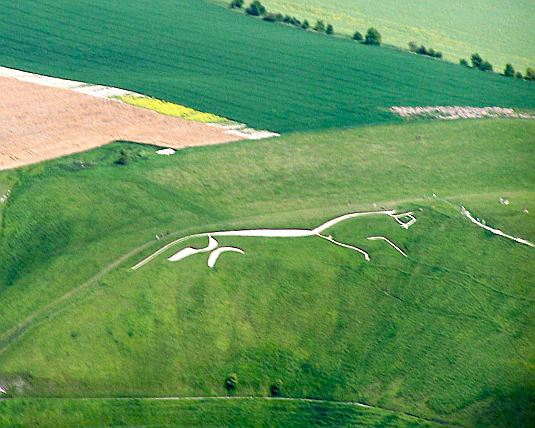
Uffington White Horse
51.5777° N · 1.5668° W · Archaeological Site
Photo: Dan Huby · Public domain · Wikimedia Commons
Uffington White Horse is a prehistoric carving in Uffington, England. About 110 metres long from nose to tail. The free Lokali audio guide runs 7 minutes.
✓ Published October 2026 · how we write these guides
Visitor facts
| Lokali audio guide | 7 min · free |
|---|---|
| Type | Archaeological Site |
| Location | Wantage, United Kingdom |
| Coordinates | 51.5777, -1.5668 |
| Official website | english-heritage.org.uk |
| Languages | 50+, in the Lokali app |
The story
Listen first. Up here on the chalk downs, the wind moves across the short grass. Somewhere above you, a skylark is probably singing, high and invisible. The ground under your boots is springy turf over pale chalk, and the land falls away to the north in a long green drop. Below, the Vale of the White Horse spreads out in hedges and fields. You are standing near one of the oldest drawings in Britain.
The Uffington White Horse sits on the steep upper slope of White Horse Hill, a few miles west of the market town of Wantage. It is a hill figure, which means a picture made on the hillside itself. The builders removed the turf, dug down, and filled the shape with bright chalk. The result is a long, flowing horse, about 110 metres from nose to tail. It is made of only a few sweeping lines.
That simplicity is the first surprise. Many visitors expect a realistic horse, like the later Victorian white horses found elsewhere in southern England. This one is different. It has a beaked head, a single eye, a slender body, and thin, separated legs that seem to stretch out in motion. Some people see a dragon in it, or a big cat. The style looks surprisingly modern, almost like a logo. Yet it is very old.
For centuries, nobody knew how old. Local tradition linked the horse to King Alfred the Great, who was born in Wantage. According to one popular tale, Alfred cut the figure to celebrate a victory over the Danes in the ninth century. It was a good story. Then, in the 1990s, archaeologists from Oxford excavated parts of the figure and used a scientific dating method on the soil inside it. The results pointed much further back, to the Late Bronze Age or Early Iron Age, roughly three thousand years ago.
The excavations also showed how the horse was made. It is not just a scrape in the grass. The lines are trenches, cut into the hillside and packed with chalk. Over time, the shape has shifted a little, as soil slips downhill and the edges grow back. That is why the horse looks so fluid today. It has been redrawn, again and again, by many generations of hands.
This is the second surprise. A chalk figure on open grassland does not survive on its own. Left alone for even a few decades, the grass would cover it, and the horse would disappear. So the people of the Vale kept it clean. For hundreds of years, local communities gathered to scour the horse, scraping away the turf and refreshing the chalk. The work became a festival, with fairs, games, and wrestling on the hilltop.
One of the most famous games happened just below you, in the steep dry valley called the Manger. Locals say the horse comes down to graze there at night. During the old scouring fairs, people rolled cheeses down the slope and chased them to the bottom. In the nineteenth century, the writer Thomas Hughes, best known for Tom Brown's School Days, wrote a whole book about these celebrations. Today, the National Trust looks after the site, and volunteers still gather on chalking days with hammers and buckets of fresh chalk.
Now look down towards the small, flat-topped hill at the foot of the slope. This is Dragon Hill. Its top looks almost cut off, as if someone sliced it with a knife. Legend has it that Saint George killed the dragon right here. The story says the dragon's blood poured onto the summit, and that is why a bare patch of white chalk shows through the grass, where nothing will grow. It is folklore, of course... but stand on that patch, and the story feels close.
Above the horse, on the very top of the hill, you can find the banks and ditch of Uffington Castle. This is an Iron Age hillfort, an enclosure surrounded by a large earth rampart. It is not a castle with stone towers. Instead, it is a broad grassy ring, and you can walk along its bank. From there, on a clear day, the views run for many miles across several counties. The fort and the horse probably belonged to the same ancient landscape.
Running along the ridge is the Ridgeway, often described as one of the oldest roads in Britain. People, animals, and traders have moved along this chalk track for thousands of years. If you follow it west for a short distance, you reach Wayland's Smithy, a Neolithic burial mound shaded by beech trees. It is older than the horse. Legend has it that if you left your horse there overnight with a coin, an invisible smith would shoe it by morning.
There is one practical truth about this place that many visitors only discover after the climb. The horse is hard to see when you are standing beside it. Up close, you see only white lines and curves in the grass. The full figure appears from a distance, or from the air. Some believe it was made to be seen from the sky, or from the vale below. Nobody knows its purpose for certain. It may have been a tribal symbol, a sacred image, or a sign of a sun god.
The horse has also needed protection from more recent events. During the Second World War, the figure was covered over, so enemy pilots could not use it as a landmark. After the war, it was uncovered and scoured again. Today, visitors are asked not to walk on the chalk lines, because feet wear away the edges. One old superstition says that standing on the eye and turning around brings luck. The kinder wish, now, is to leave it untouched.
So take a moment before you go. Feel the wind on your face, and notice how quiet the hill is beneath it. Look at the white lines, curving across the slope. Think of all the people who climbed here with tools, generation after generation, so that this horse would still be running. As you walk back down, turn around once or twice. The figure will change shape with every step... and slowly, from a distance, the whole horse will come back into view.
Key facts
What to look for
Practical tips
Common questions
Is there a free audio guide to Uffington White Horse?
Yes — the Lokali app narrates Uffington White Horse free of charge in 50+ languages. The guide runs about 7 minutes, covers the history, what to look for on site and practical tips, and works offline once downloaded.
Where is Uffington White Horse?
Uffington White Horse is near Wantage, United Kingdom, at 51.5777, -1.5668. Tap the map link on this page for directions from where you are.
What is Uffington White Horse known for?
About 110 metres long from nose to tail. Dated to the Late Bronze or Early Iron Age.
What should you look for at Uffington White Horse?
The single round eye on the beaked head. Bare chalk patch on top of Dragon Hill. Ridged slopes of the Manger dry valley.
What should you know before visiting Uffington White Horse?
View the whole figure from the vale below. Wear sturdy shoes for the steep, slippery chalk slopes.
On the map
Opens directions to Uffington White Horse from your location.
More to see near Uffington White Horse


Hear Uffington White Horse in your language
The full story, narrated, in 50+ languages. Download it before you go and it plays offline, at your own pace, with no ticket and no tour group.