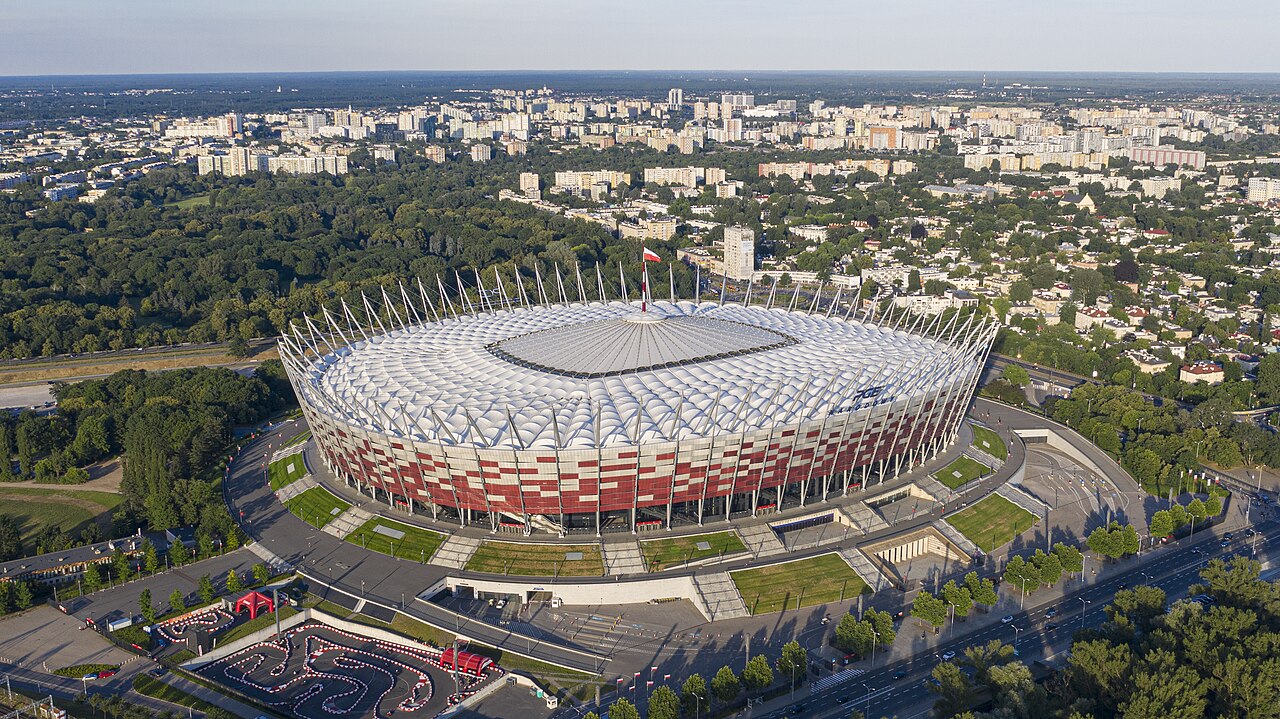
PGE Narodowy is a stadium in Warsaw, Poland. Opened in 2012 for the European Football Championship. Capacity of 58,000 makes it Poland's largest stadium. Most visitors spend 1-2 hours here. The free Lokali audio guide runs 6 minutes.
✓ Verified October 2026 · how we write these guides
Visitor facts
| Time needed | 1-2 hours |
|---|---|
| Lokali audio guide | 6 min · free |
| Type | Stadium |
| Best for | Editors’ pick |
| Location | Warsaw, Poland |
| Coordinates | 52.2397, 21.0458 |
| Languages | 45, in the Lokali app |
The story
The ground beneath your feet once held a very different kind of gathering. Before this sleek bowl of white lattice and glass rose here, this site was home to Warsaw's Tenth-Anniversary Stadium — a massive concrete oval built in 1955 to celebrate a decade of postwar rebuilding. That earlier structure, constructed partly from rubble cleared after the war, hosted everything from football matches to Pope John Paul II's open-air masses. The old stadium stood for half a century before it was demolished to make way for what you see now.
PGE Narodowy — the National Stadium — opened in 2012, just in time for Poland to co-host the European Football Championship with Ukraine. The design came from a consortium led by German architects GMP, and the brief was clear: create a modern arena that could anchor Warsaw's east bank and signal Poland's arrival as a major sporting nation. The result is a structure wrapped in a tensile membrane of red and white panels — the national colours — that glows at night like a lantern visible across the Vistula River.
The stadium holds just over 58,000 spectators, making it the largest arena in Poland. The roof is a retractable steel lattice that can open or close depending on the weather, though most events happen with it sealed. The seating bowl is steep and close to the pitch, designed to amplify crowd noise and create the kind of atmosphere that turns a football match into theatre. During Euro 2012, this place hosted the opening match and several knockout rounds, including a semi-final that drew nearly sixty thousand fans.
But football is only part of the story. The stadium was built with flexibility in mind. The pitch can be covered with a platform, transforming the arena into a concert venue. Over the past decade, acts from Metallica to Beyoncé have played here, and the acoustics — surprisingly warm for a structure this size — have made it a favourite stop on European tours. The building also houses a small museum dedicated to Polish football, tucked into the north stand, though it is rarely crowded.
The location itself carries weight. This stretch of the Vistula's eastern bank, the Praga district, was historically the scrappier, more industrial side of Warsaw. While the western bank — the old town, the royal palaces — was meticulously rebuilt after the war, Praga retained more of its prewar bones, including tenements scarred by bullets and unpolished cobblestones. Dropping a gleaming national stadium here was a deliberate choice, part of a broader effort to knit the two halves of the city together and bring investment to a neighbourhood long overlooked.
Stand near the main entrance on the western side and look across the river. On a clear day, you can see the spire of the Palace of Culture and Science rising above the skyline, a Stalinist tower that once dominated Warsaw's silhouette. The contrast is sharp: Soviet-era monumentalism on one bank, sleek twenty-first-century engineering on the other. The stadium's architects were conscious of this dialogue. The red-and-white facade was meant to be bold but not aggressive, a structure that could hold its own without shouting.
The lattice skin is worth a closer look. Each panel is perforated, allowing daylight to filter into the concourses inside and giving the facade a textile quality — it reads almost like woven fabric from a distance. At night, LED lights embedded in the membrane can shift the building's colour to match the occasion: green for a concert, blue for a charity event, the national red and white for a Poland match. The effect is theatrical, and locals often gather on the river embankment to watch the stadium glow.
Inside, the concourses are wide and functional, lined with concession stands and merchandise kiosks that spring to life on match days. The design prioritizes flow — getting tens of thousands of people in and out quickly — and it shows. There is little ornamentation, few grand gestures. The architecture is efficient, almost austere, which feels fitting for a building that had to be delivered on time and on budget for an international tournament.
The legacy of Euro 2012 is mixed. The tournament was a success, and the stadium proved it could handle the pressure of a global event. But in the years since, filling the seats has been harder. Poland's national team draws decent crowds, but club football in Warsaw has struggled to sustain the kind of attendance a stadium this size demands. Legia Warsaw, the city's main club, plays its home matches at a smaller ground across town. PGE Narodowy is too big, too expensive to operate for weekly league games. So it sits, waiting for the next big occasion — a concert, an international friendly, a cup final.
Yet the building has become a landmark. Locals call it simply "the Narodowy," and it serves as a reference point when giving directions or describing the city's layout. It is visible from the metro, from the river trams, from the bridges that cross the Vistula. In that sense, it has done what it was meant to do: anchor a skyline, mark a place, give Warsaw a structure that registers at a distance.
As you stand here, consider what this site has witnessed. A postwar stadium built from ruins. Papal masses attended by hundreds of thousands. The roar of a continent watching a football tournament. The bass thump of a rock concert. And now, on quieter days, joggers circling the perimeter, kids kicking a ball on the plaza, the hum of the city rolling past. The building is still young, still finding its role. But it is already woven into the rhythm of Warsaw, a monument not to the past but to the city's ongoing reinvention.
Key facts
What to look for
Practical tips
Common questions
How long do you need at PGE Narodowy?
Plan 1-2 hours. That is the time most visitors spend at PGE Narodowy. The free Lokali audio guide runs 6 minutes and is made to listen to while you walk.
Is there a free audio guide to PGE Narodowy?
Yes — the Lokali app narrates PGE Narodowy free of charge in 50+ languages. No ticket, tour group or subscription, and it works offline once downloaded.
Where is PGE Narodowy?
PGE Narodowy is in Warsaw, Poland, at 52.2397, 21.0458. Tap the map link on this page for directions.
What should you know before visiting PGE Narodowy?
Walk the riverside embankment for the best exterior views
What is PGE Narodowy known for?
Opened in 2012 for the European Football Championship
On the map
Opens directions to PGE Narodowy from your location.
Hear PGE Narodowy in your language
The full story, narrated, in 50+ languages. Download it before you go and it plays offline, at your own pace, with no ticket and no tour group.