
National Museum of American History
38.8911° N · 77.0300° W · Museum
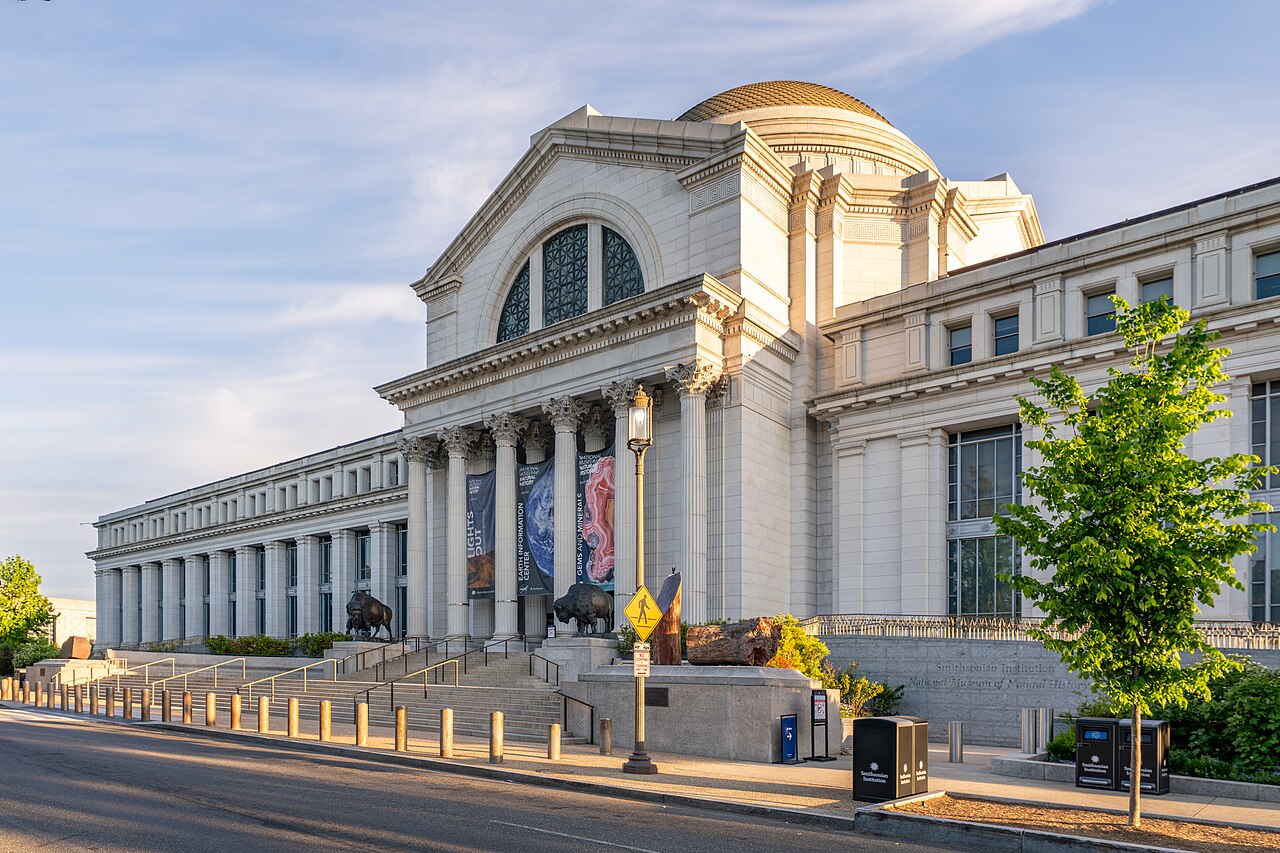
Photo: G. Edward Johnson · CC BY 4.0 · Wikimedia Commons
National Museum of American History is a history museum in Washington, D.C., a division of the Smithsonian Institution. Opened in 1964 as the Museum of History and Technology. The free Lokali audio guide runs 7 minutes.
✓ Published October 2026 · how we write these guides
Visitor facts
| Lokali audio guide | 7 min · free |
|---|---|
| Type | Museum |
| Location | Washington, United States |
| Coordinates | 38.8911, -77.0300 |
| Official website | americanhistory.si.edu |
| Languages | 50+, in the Lokali app |
The story
Stand still for a moment outside on the National Mall. Gravel crunches under passing feet, and somewhere a school group is counting heads. In front of you rises a long, low building of pale stone. It has very few windows and clean horizontal lines. It does not look like the temples and domes around it. That difference is deliberate, and it tells you something about the kind of museum you are about to enter.
This is the National Museum of American History, part of the Smithsonian Institution. It opened in 1964 under a different name, the Museum of History and Technology. Back then the focus fell heavily on machines, inventions and engineering. In 1980 it took its current name, and the emphasis widened. Today it tries to hold the whole American story under one roof: the famous moments, and also the ordinary lives that sit around them.
The building came from the architecture firm McKim, Mead and White, the same firm that shaped many public buildings across the country. Look at the stone panels and the flat roofline. This is mid-twentieth-century modernism, adapted to stand politely beside older classical neighbours. The style is calm and orderly, almost like a filing cabinet for the nation. The real drama is kept inside.
And the heart of that drama sits at the centre of the building. It is the Star-Spangled Banner — the actual flag that flew over Fort McHenry in Baltimore in 1814, during a war with Britain. When the fort survived a night of bombardment, a lawyer named Francis Scott Key saw this flag still flying at dawn. He wrote the poem that later became the national anthem. You are not looking at a copy. This is the cloth itself.
Here is the first thing many visitors miss. The flag is shown in a dim, carefully controlled chamber, lying at a gentle angle rather than hanging straight. Wool and cotton this old are fragile, and light and gravity both damage them. So the room is kept low and quiet on purpose. Over its long life the flag also lost pieces. In the nineteenth century, the family that owned it cut off fragments as keepsakes and gifts. Its uneven edges carry that history.
From that solemn room, the museum spreads outward across several floors. Walking here feels a bit like moving through a giant family attic. One corridor holds objects tied to presidents and national power. Another shows trains, cars and the long story of how Americans moved across their land. Another turns to food, money, music, sport and the screen. The mix is the point. Politics and pop culture sit side by side, because both shaped how people live.
Some of the most loved objects are small. Look for the ruby slippers worn by Judy Garland in the 1939 film The Wizard of Oz. Several pairs were made for the production, and this is one of them. Their red sequins have faded with age, so conservators watch the light around them closely. People often expect them to be bigger. Standing in front of them, many visitors go quiet, as if they have met an old friend.
Then there is a kitchen. It belonged to Julia Child, the cook who taught millions of Americans to make French food on television. The whole room was moved here from her home in Massachusetts, with her pots, pans and tools hanging on pegboard walls. The counters are built higher than usual, because she was very tall. It is a second surprise: one of the most visited rooms in a national museum is simply a well-used home kitchen.
Some objects carry heavier weight. The museum holds a section of the lunch counter from a Woolworth's store in Greensboro, North Carolina. In 1960, four young Black students sat down there and asked to be served, in a place that served only white customers. Their peaceful sit-in spread to other cities and became a turning point in the civil rights movement. The stools and the counter look ordinary. That is exactly why they matter.
The presidency is here too, in objects that make large figures feel human. Among the best known is a tall black top hat worn by Abraham Lincoln. Nearby galleries show how presidents have worked, campaigned and been remembered. And somewhere in the building you may meet a large marble statue of George Washington, seated and bare-chested like a Greek god. It was made in the nineteenth century, and many people at the time found it so strange that it was moved around for years before finding a home.
It helps to know that you will not see everything in one visit, and you should not try. The collection runs to millions of objects, and only a small share is on display at any time. Exhibitions change and rotate. Some favourites go into storage to rest, and others come out. So pick two or three themes that pull at you. Let the rest be a reason to come back.
As you move between floors, notice the visitors as much as the objects. Grandparents point at a toy or a radio they remember. Teenagers take photos beside a guitar or a sports jersey. Families from other countries stop to read about immigration and work. The museum is a mirror of the crowd inside it. Its quietest lesson may be that history is not only made by famous people. It is also kept in the things people use every day.
When you step back out onto the Mall, pause again by the doors. To one side, the Washington Monument rises against the sky. Across the grass are other Smithsonian museums, and the Capitol sits at the far end. You have just walked through the objects of a nation's memory. Now look at the people around you — the joggers, the families, the tourists with maps. One day, some of what they carry may end up behind glass too.
Key facts
What to look for
Practical tips
Common questions
Is there a free audio guide to National Museum of American History?
Yes — the Lokali app narrates National Museum of American History free of charge in 50+ languages. The guide runs about 7 minutes, covers the history, what to look for on site and practical tips, and works offline once downloaded.
Where is National Museum of American History?
National Museum of American History is in Washington, United States, at 38.8911, -77.0300. Tap the map link on this page for directions from where you are.
What is National Museum of American History known for?
Opened in 1964 as the Museum of History and Technology. Renamed National Museum of American History in 1980.
What should you look for at National Museum of American History?
The flag's uneven edges where fragments were once cut away. Faded red sequins on Dorothy's ruby slippers. Raised countertops in Julia Child's kitchen, built for her height.
What should you know before visiting National Museum of American History?
Choose two or three themes instead of trying everything. Head to the Star-Spangled Banner chamber first, before crowds build.
When is the best time to visit National Museum of American History?
Head to the Star-Spangled Banner chamber first, before crowds build.
On the map
Opens directions to National Museum of American History from your location.
More to see in Washington



Hear National Museum of American History in your language
The full story, narrated, in 50+ languages. Download it before you go and it plays offline, at your own pace, with no ticket and no tour group.