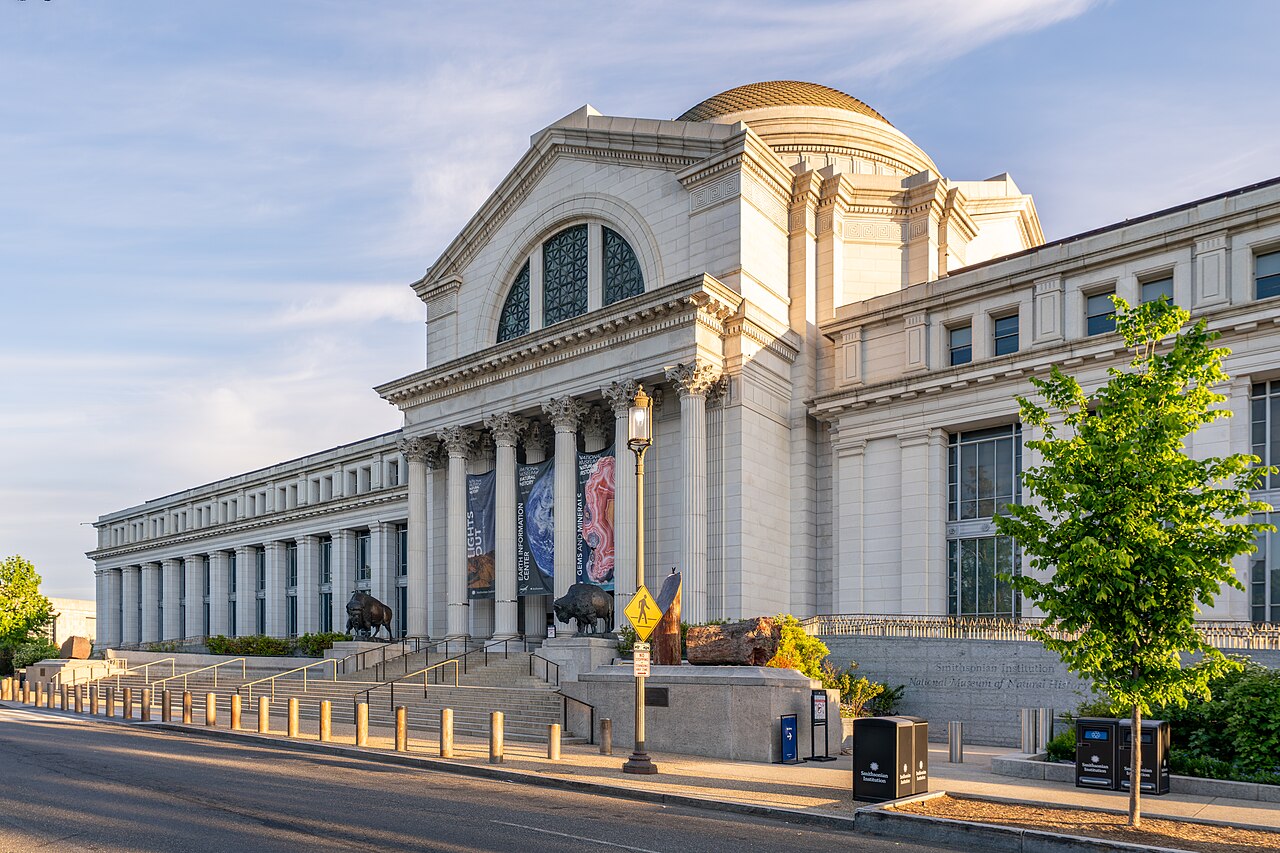
Smithsonian National Museum of Natural History
38.8914° N · 77.0265° W · Museum
Smithsonian National Museum of Natural History is a museum in Washington, United States. One of the world's largest natural history museums, housing over 145 million specimens across geology, paleontology, anthropology, botany, and zoology. Most visitors spend 2–4 hours here. The free Lokali audio guide runs 3 minutes.
✓ Verified August 2026 · how we write these guides
Visitor facts
| Time needed | 2–4 hours |
|---|---|
| Lokali audio guide | 3 min · free |
| Type | Museum |
| Best for | Editors' pick |
| Location | Washington, United States |
| Coordinates | 38.8914, -77.0265 |
| Languages | 45, in the Lokali app |
The story
The Smithsonian National Museum of Natural History opened in 1910 on the National Mall. Its official factsheet describes it as one of the most visited natural history museums in the world and home to the world's largest collection of natural history specimens and artifacts.
Use collection numbers with care, because they change as research collections grow. Smithsonian fellowship information describes more than 148 million specimens and cultural objects documenting Earth formation, biodiversity, evolution, and human heritage.
This is not only a display museum. It is a research institution. The public halls are the visible face of a much larger scientific system: collections, loans, laboratories, digitization, fieldwork, and specialists studying geology, paleontology, biology, anthropology, and related fields.
The best guide language should make that research visible. A fossil is not just old, a mineral is not just beautiful, and an animal mount is not just dramatic. Each object is evidence in a continuing scientific conversation about the planet and our place in it.
This museum is best introduced as both a public museum and a scientific infrastructure. The exhibitions are only the visible part. Behind them are collections, laboratories, field research, conservation, digitization, loans, and specialists who use specimens and cultural objects as evidence.
The scale is central to the facts. Smithsonian sources describe more than 148 million specimens and artifacts connected to the museum's research collections. That number matters because natural history depends on comparison: one fossil, insect, mineral, bone, or cultural object becomes more meaningful when it can be studied beside many others.
The public halls translate that research into stories about the Earth, life, evolution, oceans, minerals, human origins, and cultural history. A good guide should keep the scientific method present: classification, dating, sampling, revision, and uncertainty are part of what visitors are seeing.
Avoid making the museum sound like a cabinet of curiosities. Its mission is not only wonder, although wonder is everywhere. It is also evidence: how scientists reconstruct vanished environments, identify species, track change, and preserve material for future questions that may not yet exist.
Key facts
What to look for
Practical tips
Common questions
How long do you need at Smithsonian National Museum of Natural History?
Plan 2–4 hours. That is the time most visitors spend at Smithsonian National Museum of Natural History. The free Lokali audio guide adds about 3 minutes of narration you can listen to as you walk, so it fits inside your visit rather than adding to it.
Is there a free audio guide to Smithsonian National Museum of Natural History?
Yes — the Lokali app narrates Smithsonian National Museum of Natural History free of charge in 50+ languages. It covers the history, what to look for on site and practical tips, and it works offline once downloaded.
Where is Smithsonian National Museum of Natural History?
Smithsonian National Museum of Natural History is in Washington, United States, at 38.8914, -77.0265. Tap the map link on this page for directions from where you are.
What should you know before visiting Smithsonian National Museum of Natural History?
Do not describe casts as originals unless the label confirms it.
What is Smithsonian National Museum of Natural History known for?
The museum opened in 1910.
What is the best time to visit Smithsonian National Museum of Natural History?
The fossil halls occupy the entire west wing; arrive early to see the T.
On the map
Opens directions to Smithsonian National Museum of Natural History from your location.
Reference
More to see in Washington


Hear Smithsonian National Museum of Natural History in your language
The full story, narrated, in 50+ languages. Download it before you go and it plays offline, at your own pace, with no ticket and no tour group.