
Smithsonian American Art Museum
38.8978° N · 77.0233° W · Museum
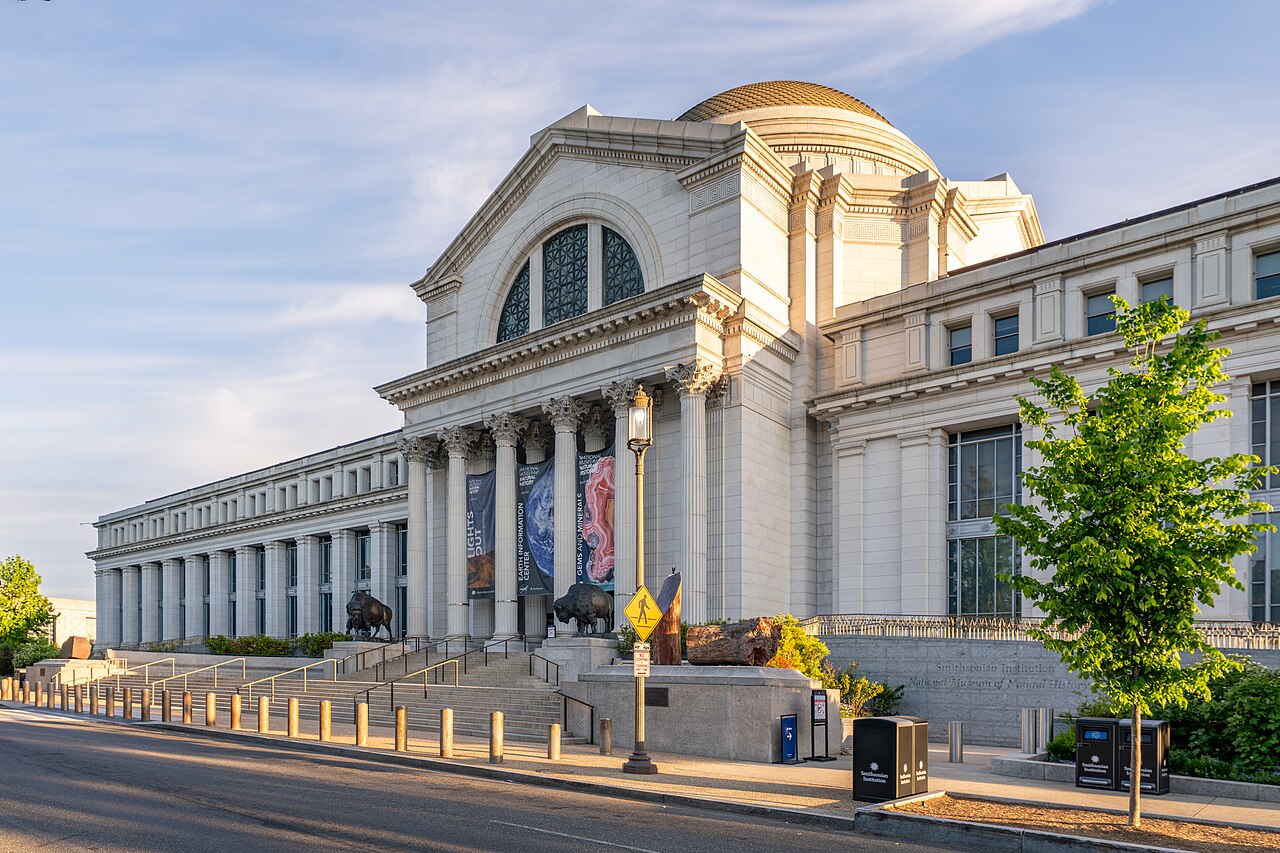
Photo: Bobak Ha'Eri · CC BY 3.0 · Wikimedia Commons
Smithsonian American Art Museum is a fine arts museum in Washington, D.C., a division of the Smithsonian Institution. Building began life as the United States Patent Office. The free Lokali audio guide runs 7 minutes.
✓ Published October 2026 · how we write these guides
Visitor facts
| Lokali audio guide | 7 min · free |
|---|---|
| Type | Museum |
| Location | Washington, United States |
| Coordinates | 38.8978, -77.0233 |
| Official website | americanart.si.edu |
| Languages | 50+, in the Lokali app |
The story
Start in the courtyard, if you can. Light falls through a high glass canopy that curves like a wave. Under your feet the stone floor stays cool, and somewhere a thin sheet of water slides across the paving. Small trees stand in large planters. People sit at tables with coffee and laptops, and the noise of the city outside fades to a low hum. Then look up at the walls around you. They are old, pale, and formal. This is where your visit really begins.
You are standing inside the Smithsonian American Art Museum. It shares this building with the National Portrait Gallery, and together the two museums fill one of the oldest public buildings in Washington. The art inside is American. It covers several centuries, from early portraits and landscapes to neon, video, and sculpture made from everyday materials. But before the art, the building deserves attention. It has had a long and surprising life.
This was once the Patent Office. Construction began in the 1830s, and the architect Robert Mills, who also designed the Washington Monument, played a major role in its design. The style is Greek Revival. That means it borrows from the temples of ancient Greece — heavy columns, triangular pediments, and clean, symmetrical lines. In a young republic, this style sent a clear message. America wanted to look like a democracy with deep roots, even though it was only a few decades old.
Inside, the Patent Office did something unusual. It displayed patent models — small working versions of new inventions that inventors sent to Washington. Visitors came to look at them in glass cases, the way people now come to look at paintings. In a sense, the building was a museum of American ideas long before it held American art. Engines, ploughs, tools, and odd machines once filled the halls where canvases hang today.
Here is a detail many visitors miss. During the Civil War, parts of this building served as a hospital for wounded soldiers. Cots stood between the display cases. The poet Walt Whitman came here to visit the wounded and to sit with them. And Clara Barton, who later founded the American Red Cross, had earlier worked in the Patent Office as a clerk. In 1865, the building also hosted the ball for Abraham Lincoln's second inauguration — only weeks before his assassination.
In 1877, a fire damaged part of the building. The rebuilding brought a more decorative style to the upper floor. If you climb to the top, you will find a grand hall with a richly coloured tile floor, ornate railings, and a bright, airy ceiling. It feels very different from the calm stone of the ground floor. Walking from one to the other is like moving between two ideas of what a public building should be.
Now for the second surprise. In the 1950s, this building came close to being torn down. There were plans to replace it with a parking structure. Preservationists argued against it, and Congress gave the building to the Smithsonian instead. The two museums opened here in the late 1960s. Much later, the building closed for a long renovation and reopened in 2006. The glass canopy above the courtyard, designed by the firm of the British architect Norman Foster, came soon after.
The art collection is older than the building's life as a museum. Its roots go back to the early nineteenth century, and the museum describes it as the nation's first federal collection of art. Today it holds many thousands of works. You can move from colonial portraits to paintings of the American West, then to folk art, photography, and modern abstraction. The galleries are arranged so that you can follow the country's story through the eyes of its artists.
One work stops almost everyone. It is a large map of the United States made of neon tubes and dozens of television screens, all playing at once. This is "Electronic Superhighway" by Nam June Paik, a Korean-born artist often called a pioneer of video art. Each state has its own glowing outline and its own flickering images. Stand back to see the whole map, then step closer. The hum of the screens and the colour of the neon change the feeling of the room.
Nearby in spirit, though very different in mood, is a work made in secret. James Hampton was a janitor here in Washington. Over many years, in a rented garage, he built an altar-like installation from old furniture, cardboard, light bulbs, and glass, all wrapped in gold and silver foil. He called it "The Throne of the Third Heaven of the Nations' Millennium General Assembly." It was found only after his death. It glitters quietly, and it is hard to look away.
If you enjoy seeing how a museum works, look for two special spaces. In the Luce Foundation Center, thousands of objects stand in tall glass cases, packed together like a great open storeroom. You can browse at your own pace. And in the Lunder Conservation Center, large windows let you watch conservators at work. On a good day, you may see someone cleaning a frame or studying a painting under strong light.
The museum also has a smaller sister building, the Renwick Gallery, a short walk away near the White House. It focuses on craft and decorative art. Here, around this building, you are in Penn Quarter, close to Chinatown. When you step outside, you will hear traffic, street music, and voices from the restaurants nearby. The contrast is part of the pleasure. Inside, quiet galleries; outside, a working city.
Before you leave, stop once more in the courtyard. Look at the old stone walls under the modern glass. Think of the inventors who sent their models here, the soldiers who rested between the cases, and the people who refused to let this place become a car park. Then walk out through the columns into the street. Notice how the light changes. You are carrying a little of this building's long story with you.
Key facts
What to look for
Practical tips
Common questions
Is there a free audio guide to Smithsonian American Art Museum?
Yes — the Lokali app narrates Smithsonian American Art Museum free of charge in 50+ languages. The guide runs about 7 minutes, covers the history, what to look for on site and practical tips, and works offline once downloaded.
Where is Smithsonian American Art Museum?
Smithsonian American Art Museum is in Washington, United States, at 38.8978, -77.0233. Tap the map link on this page for directions from where you are.
What is Smithsonian American Art Museum known for?
Building began life as the United States Patent Office. Construction started in the 1830s in Greek Revival style.
What should you look for at Smithsonian American Art Museum?
Neon outlines of every state in Paik's video map. Gold and silver foil covering Hampton's handmade throne. Colourful patterned tile floor in the top-floor hall.
What should you know before visiting Smithsonian American Art Museum?
Begin in the Kogod Courtyard to rest and get your bearings. Use the nearby Gallery Place Metro station to arrive easily.
On the map
Opens directions to Smithsonian American Art Museum from your location.
More to see in Washington


Hear Smithsonian American Art Museum in your language
The full story, narrated, in 50+ languages. Download it before you go and it plays offline, at your own pace, with no ticket and no tour group.