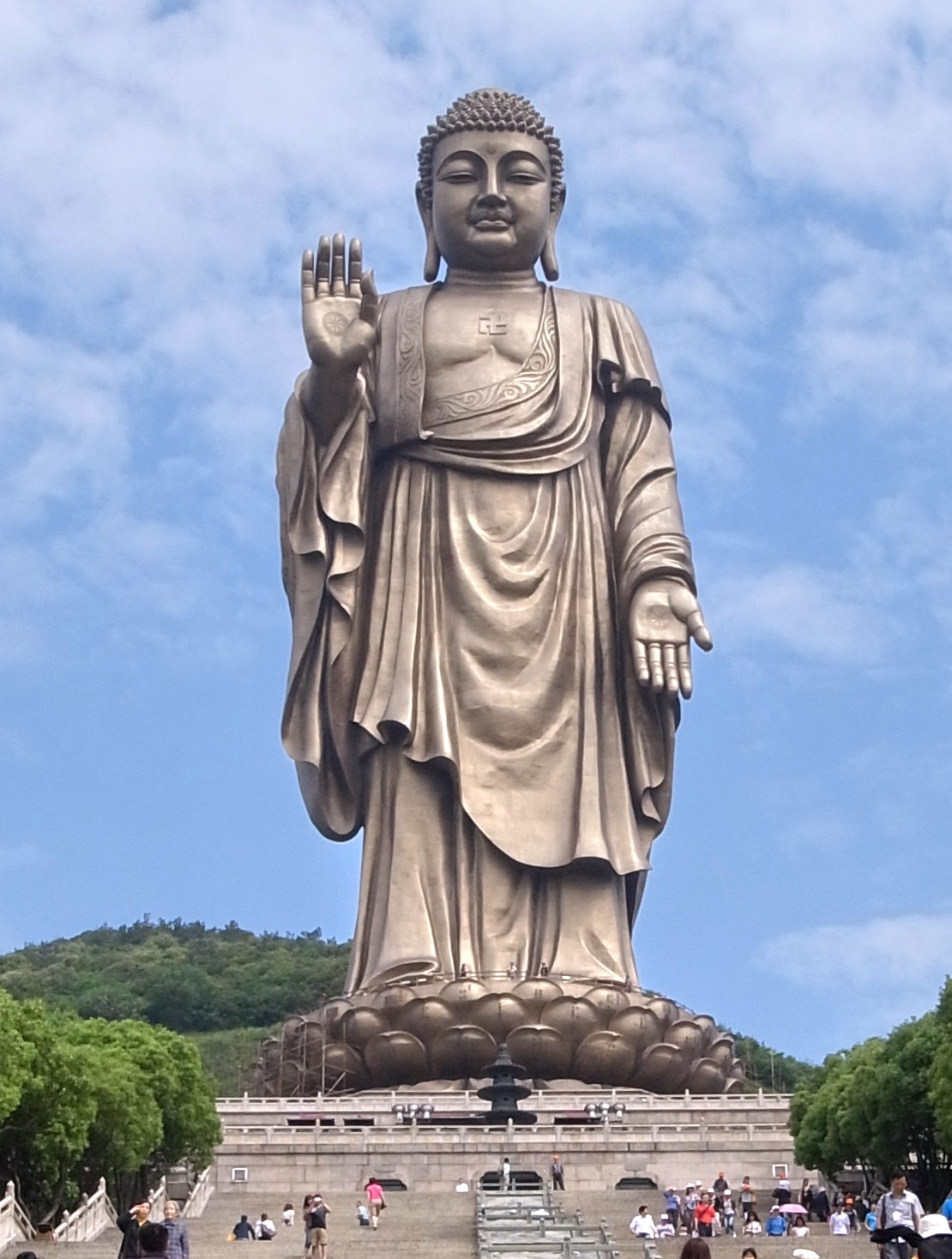
Grand Buddha at Ling Shan
31.4319° N · 120.0914° E · Monument
Photo: gdczjkk · CC BY 3.0 · Wikimedia Commons
Grand Buddha at Ling Shan is a statue in Jiangsu, China. The statue depicts Shakyamuni, the historical Buddha. The free Lokali audio guide runs 7 minutes.
✓ Published October 2026 · how we write these guides
Visitor facts
| Lokali audio guide | 7 min · free |
|---|---|
| Type | Monument |
| Location | Wuxi, China |
| Coordinates | 31.4319, 120.0914 |
| Languages | 50+, in the Lokali app |
The story
Listen first. Somewhere ahead of you, a bell is being struck. The sound rolls slowly across the hillside and fades into the trees. The air smells of incense smoke and wet pine. The paving under your feet is wide and smooth, polished by countless shoes. And then you lift your eyes. Above the forest, a bronze figure stands against the sky. One hand is raised toward you, palm open. This is the Grand Buddha at Ling Shan, on the hills above Lake Tai, just outside the city of Wuxi.
The statue shows Shakyamuni Buddha. Shakyamuni is the historical teacher whose life and words became the foundation of Buddhism. Here he stands upright on a lotus base, facing out over the lake. The figure is commonly given as 88 metres tall, including its base. That number was not an accident. In Chinese, the word for eight sounds close to the word for prosperity, so a double eight carries a strong sense of good fortune. Visitors often hear this and smile. It is a very Chinese way to honour a teacher.
The statue is a modern work. It was completed in the 1990s, built from bronze panels joined over an inner frame. From a distance it looks like a single smooth casting. Up close, you may notice the subtle seams where sections meet. The bronze has a warm, golden brown tone that changes with the weather. On a bright morning it glows. On a grey, misty day it turns darker and softer, and the edges of the figure seem to melt into the clouds above the lake.
Why here, on this particular hill? The answer reaches back much further than the statue. At the foot of the slope stands Xiangfu Temple, a Buddhist site with a long history in this area. According to a popular tradition, the famous Tang dynasty monk Xuanzang came to this place. Xuanzang is the pilgrim who travelled to India for Buddhist scriptures. Locals say he felt the hill looked like Vulture Peak in India, where the Buddha once taught. So the hill took the name Ling Shan, meaning Spirit Mountain.
That story is a legend, and it is told with affection rather than proof. But it explains the mood of the whole site. The builders wanted a place that felt like a pilgrimage, not only a monument. So the visit is arranged as a journey. You pass through gateways, along a long axis, past ponds and smaller shrines. Each stage brings you a little closer to the figure on the hill. By the time you reach its feet, you have walked slowly enough to arrive in a calmer state.
Look carefully at the hands. The right hand is raised, palm facing outward. In Buddhist art, this gesture means fearlessness and protection. It says, in effect, do not be afraid. The left hand is lowered, palm open, in a gesture of giving and granting wishes. Together they make a gentle message for anyone walking up the path. The face above is calm, with half-closed eyes and long earlobes. Long earlobes are a traditional sign of the Buddha's former life as a prince who wore heavy jewellery.
Here is something many visitors miss. Along the route, you will often find a giant bronze replica of a Buddha hand placed near ground level. People queue to touch it, rubbing the fingers and palm for luck. Watch the colour of the metal. Where hands touch it every day, the bronze shines bright gold. Where nobody reaches, it stays dark and dull. You can read the habits of millions of visitors simply by looking at where the metal is polished.
A climb of stone steps leads up toward the statue's base. Take it slowly. The stairs are long, and the view opens behind you with every flight. When you turn around near the top, you see the whole valley laid out below. The rooftops of the temple sit among the trees. Further away, the flat silver surface of Lake Tai stretches toward the horizon. Lake Tai is one of the largest freshwater lakes in China, and on hazy days its far shore simply disappears.
At the lower end of the site, there is a very different kind of experience. It is a large fountain show called Nine Dragons Bathing the Infant Buddha. It retells a story from the Buddha's birth. According to Buddhist tradition, when the baby was born, dragons appeared and poured water to bathe him. In the show, music swells, a giant bronze lotus slowly opens, and a small golden figure of the infant rises from inside. Then jets of water spray from the mouths of nine dragons.
The show is theatrical, loud, and quite joyful. Children often press against the railings to catch the mist. Some visitors find it a surprise, because it feels so different from the quiet temple halls. But it fits a long Chinese tradition of making religious stories vivid and public. Festivals, processions, and painted temple walls have always been part of how people learn these tales. Stand toward the side, rather than the centre, if you want to stay a little drier.
The site kept growing after the statue was finished. A grand hall called the Ling Shan Brahma Palace opened later, in the 2000s. Its interior is heavy with gold, carved wood, painted ceilings, and coloured glass. In 2009 it hosted the World Buddhist Forum, a meeting of Buddhist leaders and scholars from many countries. Nearby, you may also find a Tibetan-style complex, with whitewashed walls and bright prayer colours. Together these buildings show how modern China presents Buddhism to the world.
It is worth pausing on that idea for a moment. The Grand Buddha is new, but the faith around it is old. You will see tour groups with flags and cameras. You will also see grandparents lighting incense, and monks in brown or saffron robes walking calmly through the crowds. Some people come to pray, and some people come to look. The site makes room for both. That mix of devotion and tourism is part of what makes Ling Shan feel so alive.
Before you leave, find a quiet spot where you can see the statue clearly. Notice how small the people at its feet appear. Notice the way the wind moves the trees on the hillside, while the bronze figure stays completely still. Listen again for the bell, or the soft murmur of chanting from a hall nearby. As you walk back down toward the gates, turn around once more. The raised hand is still there, open toward you, over the hills and the wide grey water of the lake.
Key facts
What to look for
Practical tips
Common questions
Is there a free audio guide to Grand Buddha at Ling Shan?
Yes — the Lokali app narrates Grand Buddha at Ling Shan free of charge in 50+ languages. The guide runs about 7 minutes, covers the history, what to look for on site and practical tips, and works offline once downloaded.
Where is Grand Buddha at Ling Shan?
Grand Buddha at Ling Shan is near Wuxi, China, at 31.4319, 120.0914. Tap the map link on this page for directions from where you are.
What is Grand Buddha at Ling Shan known for?
The statue depicts Shakyamuni, the historical Buddha. Commonly cited height is 88 metres including base.
What should you look for at Grand Buddha at Ling Shan?
Raised right hand in the gesture of fearlessness. Polished gold patches on the bronze hand replica. Faint seams between the statue's bronze panels.
What should you know before visiting Grand Buddha at Ling Shan?
Arrive early to climb the steps before tour groups. Wear comfortable shoes for the long stone stairway.
When is the best time to visit Grand Buddha at Ling Shan?
Arrive early to climb the steps before tour groups.
On the map
Opens directions to Grand Buddha at Ling Shan from your location.
More to see near Grand Buddha at Ling Shan


Hear Grand Buddha at Ling Shan in your language
The full story, narrated, in 50+ languages. Download it before you go and it plays offline, at your own pace, with no ticket and no tour group.