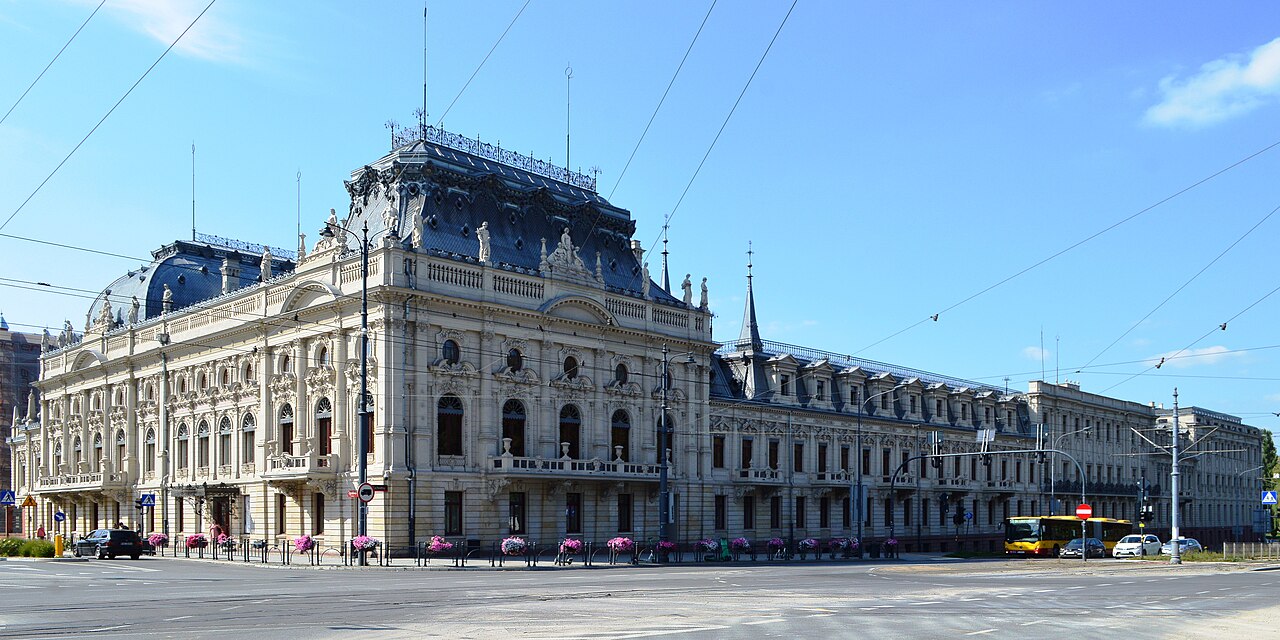
Poznański Palace is an opulent Neo-Renaissance mansion built by textile magnate Izrael Poznański in the 1880s. It is in Łódź, Poland. Most visitors spend 1–1.5 hours here. The free Lokali audio guide runs 5 minutes.
✓ Verified August 2026 · how we write these guides
Visitor facts
| Time needed | 1–1.5 hours |
|---|---|
| Lokali audio guide | 5 min · free |
| Type | Palace |
| Best for | History |
| Location | Łódź, Poland |
| Coordinates | 51.7658, 19.4478 |
| Languages | 45, in the Lokali app |
The story
A factory owner's house should not look like this. Domes swell above the roofline. Sculpted figures pose along the cornice. A glass-roofed garden clings to one wing, and windows the size of doors run in ranks along two streets. People in Łódź call this building the Louvre of Łódź, half in pride and half in irony. It was the home of one man: Izrael Poznański.
Poznański was born in 1833 into a Jewish merchant family. He inherited a modest trading business from his father and spent a lifetime turning it into a cotton empire of spinning mills, weaving halls, warehouses, and workers' quarters. By the end of the nineteenth century, his factory next door employed thousands of people, and his cloth traveled across the Russian Empire.
The palace grew as the fortune grew. It began as a far simpler house on the corner. Architects enlarged and rebuilt it in stages through the 1880s and 1890s, and it reached its present form around 1903, after the owner's death. The result mixes neo-baroque and neo-renaissance forms, with a dozen kinds of ornament layered one over another until the walls seem to move.
A story follows this building. When an architect asked Poznański which style he preferred, he is said to have answered that he could afford them all. No document proves the exchange, and it is best treated as legend. But stand before the facade for a minute, count the columns, garlands, and crowns, and you will understand why the city keeps telling it.
Notice how the palace and the factory touch. The residence was built directly against the mill, so that business and life formed one block of the city. From his windows, Poznański could see his spinning halls at work. From the factory yard, workers could see the glow of his chandeliers. Few buildings state the nineteenth century's contrasts so plainly.
Step inside, and the noise of the street falls away. A grand staircase climbs beneath gilded stucco. The ballroom glitters with mirrors, moldings, and chandeliers, and its parquet floor still hosts concerts and city ceremonies. In the great dining room, carved wood rises dark along the walls, stained glass filters the daylight into warm colors, and portraits look down on the visitors. Every surface announces that its owner had arrived.
Look for the winter garden, a conservatory under glass where palms grew through the Polish winter. In a city of coal smoke and clattering looms, a private indoor garden may have been the loudest luxury of all.
As you move from room to room, listen to the floors. Parquet creaks under every step, and the sound carries down long corridors. Guides here like to point out how quickly it all happened: within the memory of one family, a village became a metropolis, and a trader's son built himself a palace.
Poznański died in 1900, before the palace reached its final shape. His heirs finished the work, but the family fortune faded through the wars and crises that followed. The building later served as offices, and under German occupation it was seized by the wartime administration.
Since 1975 the palace has housed the Museum of the City of Łódź. Restorers returned the state rooms to their old shine, and the museum fills the remaining floors with the city's story: a town of four cultures, Polish, Jewish, German, and Russian, that grew faster in the nineteenth century than almost any other city in Europe. Photographs and everyday objects trace how a settlement of weavers became the Polish Manchester.
The museum also honors the people Łódź gave to the world. Rooms recall pianist Artur Rubinstein, poet Julian Tuwim, and Jan Karski, the underground courier who carried eyewitness news of the Holocaust to Allied leaders. Among the Rubinstein exhibits, look for photographs, concert posters, and personal objects from a stage career that lasted nearly eight decades.
Take your time by the ballroom windows. Below lies the old factory, now the Manufaktura center, its brick halls full of shops, museums, and cafes. The view has changed less than you might think: the same walls, the same ranks of windows, the same city built on cotton thread.
Palaces usually celebrate old bloodlines. This one celebrates work, risk, and appetite: a fortune spun from thread within a single lifetime, and spent without shame on marble and gold. Walk out past the gates and look back once. The domes still perform for the street, long after the applause of money has gone quiet.
Key facts
What to look for
Practical tips
Common questions
How long do you need at Poznański Palace?
Plan 1–1.5 hours. That is the time most visitors spend at Poznański Palace. The free Lokali audio guide adds about 5 minutes of narration you can listen to as you walk, so it fits inside your visit rather than adding to it.
Is there a free audio guide to Poznański Palace?
Yes — the Lokali app narrates Poznański Palace free of charge in 50+ languages. It covers the history, what to look for on site and practical tips, and it works offline once downloaded.
Where is Poznański Palace?
Poznański Palace is in Łódź, Poland, at 51.7658, 19.4478. Tap the map link on this page for directions from where you are.
What should you know before visiting Poznański Palace?
Buy the museum ticket to enter the state rooms.
What is Poznański Palace known for?
Izrael Poznański lived from 1833 to 1900.
What is the best time to visit Poznański Palace?
The ballroom on the first floor, with its original chandeliers and parquet, conveys the lavish entertainments once held here.
On the map
Opens directions to Poznański Palace from your location.
More to see in Łódź


Hear Poznański Palace in your language
The full story, narrated, in 50+ languages. Download it before you go and it plays offline, at your own pace, with no ticket and no tour group.