
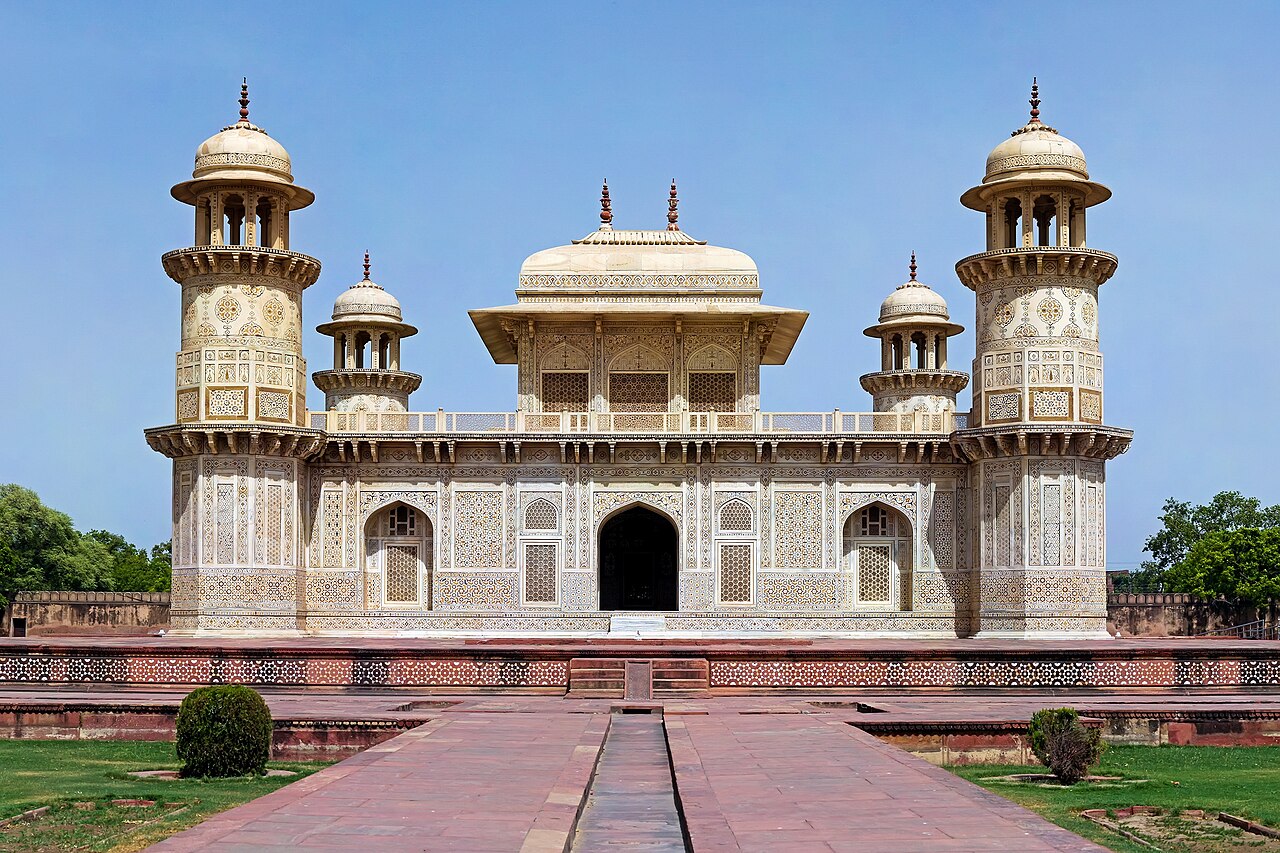
Photo: Muhammad Mahdi Karim · GFDL 1.2 · Wikimedia Commons
Itmad-ud-Daulah is a building in India. It is in Agra, India. Tomb of Mirza Ghiyas Beg, father of empress Nur Jahan. The free Lokali audio guide runs 7 minutes.
✓ Published October 2026 · how we write these guides
Visitor facts
| Lokali audio guide | 7 min · free |
|---|---|
| Type | Memorial |
| Location | Agra, India |
| Coordinates | 27.1925, 78.0314 |
| Languages | 50+, in the Lokali app |
The story
Slip off your shoes, and feel the marble under your feet. In the morning it is cool and smooth. By midday it holds the heat of the sun. Around you, the garden is quiet. You may hear parakeets in the trees, the scrape of a broom on stone, and somewhere beyond the wall, the slow movement of the Yamuna River. Ahead of you stands a small white tomb, covered almost entirely in coloured stone. Welcome to Itmad-ud-Daulah.
Many people call this place the Baby Taj. The name is easy to remember, but it is a little unfair. This tomb came first. It was finished several years before work began on the Taj Mahal, across the river and downstream. So when you look at these white walls and their inlaid flowers, you are looking at an early version of an idea. Here, Mughal builders tested a way of decorating a building that would later shape the most famous tomb in India.
So who is buried here? The man is Mirza Ghiyas Beg. He was a Persian who came to India and entered the service of the Mughal court during the reign of the emperor Akbar. He rose steadily through the administration. Under Akbar's son, the emperor Jahangir, he became a senior minister and received a title. That title was Itimad-ud-Daulah, which means roughly 'Pillar of the State'. The tomb carries his title, not his personal name.
His rise is linked to his daughter. She married the emperor Jahangir and became known as Nur Jahan, which means 'Light of the World'. Nur Jahan was one of the most powerful women in Mughal history. Coins were struck in her name, and she took an active part in the affairs of the court. Locals and storytellers like to repeat a legend about her birth. According to one popular tale, the family was so poor on the road to India that they almost left the newborn girl behind. Treat that as legend, not record.
Ghiyas Beg died in 1622. His wife, Asmat Begum, had died shortly before him. Nur Jahan then commissioned this tomb for her parents, and it was completed around 1628. That makes it unusual. Most great Mughal tombs were ordered by emperors. This one was built at the wish of a woman, for her own mother and father. As you walk toward it, keep that in mind. It is a monument of family loyalty as much as of power.
Now look at the layout around you. The tomb sits at the centre of a square garden. Raised walkways and narrow water channels divide the garden into four parts. This plan is called a charbagh, a Persian word meaning 'four gardens'. In Islamic tradition, this kind of garden was linked to the idea of paradise, with rivers flowing through it. The water channels here are often dry today, but you can still follow their lines in the stone, all leading toward the tomb.
Here is the first detail many visitors miss. Earlier Mughal tombs, such as Humayun's Tomb in Delhi or Akbar's Tomb at Sikandra near Agra, were built mainly in red sandstone, with white marble used as trim. At Itmad-ud-Daulah, the balance flips. White marble becomes the main material. This tomb is widely described as one of the first major Mughal buildings to be faced almost entirely in white marble. The Taj Mahal later took that choice to its full scale.
Now walk closer, and bring your eyes right up to the wall. Almost every surface carries inlay. Craftsmen cut shallow shapes into the marble, then fitted pieces of coloured stone into them. You will see shades of yellow, brown, black, green and deep red. Some of these are semi-precious stones. The joints are so tight that the patterns look painted from a distance. Up close, you can see that each petal and each leaf is a separate piece of stone.
Look at what the patterns show. There are geometric stars and interlocking shapes. But there are also images taken from Persian art. Look for tall, slim cypress trees, a symbol of eternity in Persian tradition. Look for vases with flowers, bowls of fruit, and small vessels that look like wine cups or flasks. These motifs remind us that the family buried here came from Persia. In a way, the walls carry the memory of the homeland Ghiyas Beg left behind.
The building itself is low and square. It does not have a large central dome. Instead, a small pavilion sits on the roof, with a curved canopy on top. At each of the four corners stands a short, eight-sided tower, topped by a small domed kiosk. These towers are an early form of the minarets that stand at the corners of the Taj Mahal. Here, they are joined to the building and kept low, so the whole tomb feels compact, almost like a jewel box set on a platform.
Step inside, if the interior is open. Light comes through screens of carved marble lattice, called jali. Each screen breaks the sunlight into small points and soft shadows on the floor. In the central chamber lie the cenotaphs of Ghiyas Beg and his wife. They are made in a warm, yellow-brown stone, which stands out against the white. Here is the second surprise: these are memorial markers. In Mughal tradition, the actual burials usually lie in a chamber below. The walls inside also carry painted decoration, faded but still visible.
Now walk around to the western side, toward the river. A pavilion stands on the bank, and from here you can look out over the Yamuna. On a clear day, try to find the white shape of the Taj Mahal downstream. Seeing the two buildings in one view helps you understand the story of Mughal architecture in Agra. The river was once lined with gardens and tombs of the nobility. Many are now gone or in ruins, but this one survived in remarkable condition.
Before you leave, stand still for a moment near the gateway and look back. Notice how small the tomb is compared with the Taj. That small size is part of its charm. You can see the whole building at once and still walk close enough to touch the inlay. Notice the quiet as well. Fewer people come here, so you can hear the birds and the river. As you walk out, take one last look at the cypress trees on the walls. They have stood there for four centuries.
Key facts
What to look for
Practical tips
Common questions
Is there a free audio guide to Itmad-ud-Daulah?
Yes — the Lokali app narrates Itmad-ud-Daulah free of charge in 50+ languages. The guide runs about 7 minutes, covers the history, what to look for on site and practical tips, and works offline once downloaded.
Where is Itmad-ud-Daulah?
Itmad-ud-Daulah is in Agra, India, at 27.1925, 78.0314. Tap the map link on this page for directions from where you are.
What is Itmad-ud-Daulah known for?
Tomb of Mirza Ghiyas Beg, father of empress Nur Jahan. Itimad-ud-Daulah means roughly 'Pillar of the State'.
What should you look for at Itmad-ud-Daulah?
Inlaid cypress trees, a Persian symbol of eternity. Wine cups and flower vases set in coloured stone. Short eight-sided towers at each corner of the tomb.
What should you know before visiting Itmad-ud-Daulah?
Come early morning, when the marble is cool underfoot. Bring socks, since shoes come off on the marble platform.
When is the best time to visit Itmad-ud-Daulah?
Come early morning, when the marble is cool underfoot.
On the map
Opens directions to Itmad-ud-Daulah from your location.
More to see in Agra


Hear Itmad-ud-Daulah in your language
The full story, narrated, in 50+ languages. Download it before you go and it plays offline, at your own pace, with no ticket and no tour group.