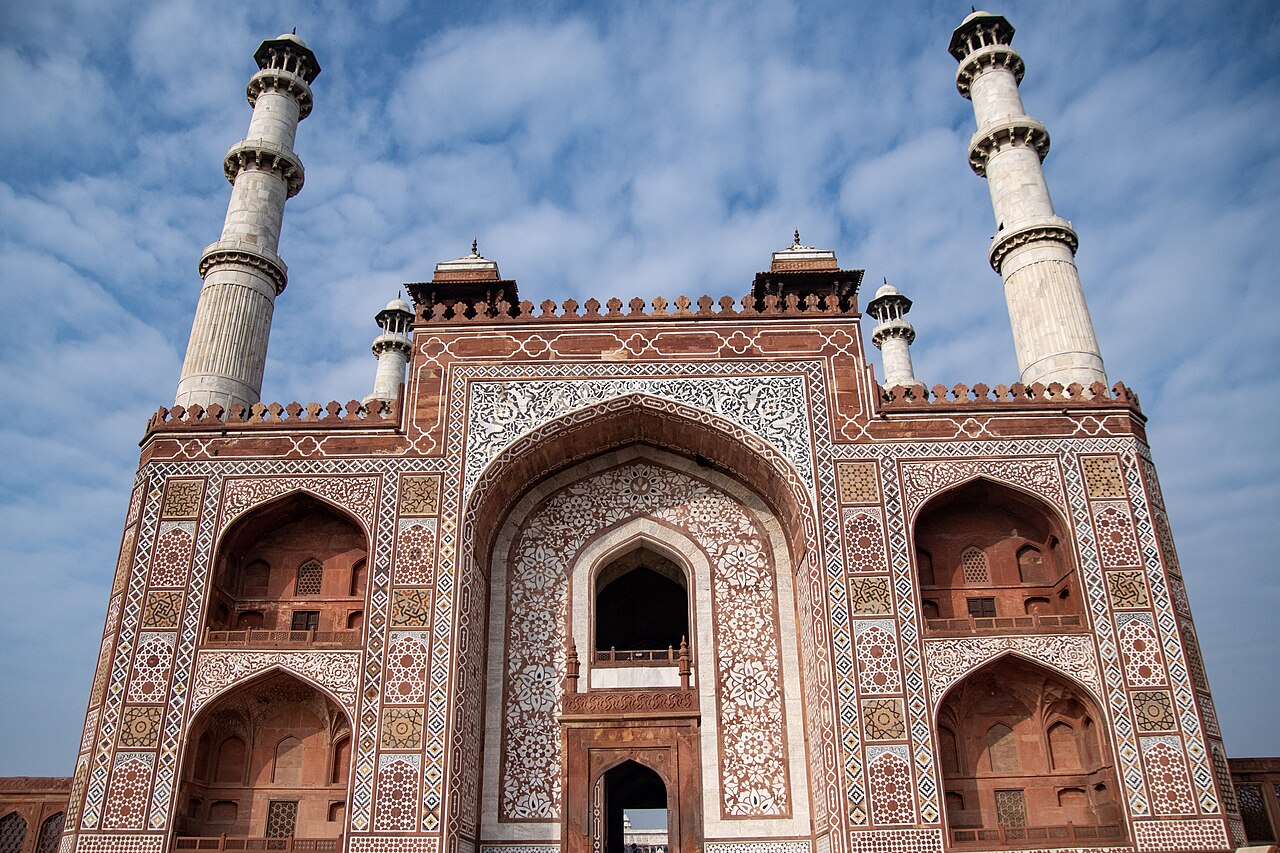
Tomb of Akbar is a mausoleum in Agra, India. Located in Sikandara, 10 kilometres north of Agra, this red sandstone mausoleum was built by Akbar's son Jahangir in 1613. Most visitors spend 60–90 min here. The free Lokali audio guide runs 6 minutes.
✓ Verified August 2026 · how we write these guides
Visitor facts
| Time needed | 60–90 min |
|---|---|
| Lokali audio guide | 6 min · free |
| Type | Mausoleum |
| Best for | History |
| Location | Agra, India |
| Languages | 45, in the Lokali app |
The story
Listen for the call of peacocks as you pass through the gate. The air smells of dry grass and warm sandstone. Deer move slowly across the wide lawns, lifting their heads as you walk by. You are standing at the resting place of Akbar, the third Mughal emperor. This is Sikandra, on the northern edge of Agra. The noise of the road fades behind the high red walls, and the space ahead opens out, green and still.
Akbar ruled for almost fifty years. He died in 1605. He was a soldier, a builder, and a careful manager of a huge empire. He chose this site himself and began the tomb during his own lifetime. His son, Jahangir, completed the work around 1613. So the building you see was finished by a son for his father. Keep that in mind as you walk. It shapes the feeling of the place.
Walk toward the great southern gateway first. It is built of red sandstone and faced with white marble. Look up at its four slender towers, one rising from each corner. These are among the early examples of marble minarets in Mughal building. Some believe they pointed the way toward the design of the Taj Mahal, raised later in the same city. Stand below them and let your eyes climb to the top.
The gateway is covered in patterns. You will see stars, flowers, and winding shapes worked in colored stone. White marble, dark slate, and other stones are cut and set into the red surface. This method is called inlay. Each piece was shaped by hand and fitted like a tile. Step closer and follow one pattern with your eyes. The lines do not stop. They flow from shape to shape across the whole face of the wall.
Pass through the gate and the garden opens before you. It is divided into four equal parts by raised walkways and shallow water channels. This plan is called the char-bagh, the four-fold garden. For the Mughals, such a garden was an image of paradise on earth. The tomb sits at the center, where the four paths meet. Long straight lines carry your eye toward it from every direction.
The main building rises in stages, like a low stepped pyramid. Each level is smaller than the one below. The lower floors are red sandstone, carved with arches and open galleries. The upper level is white marble, open to the sky. This mixing of stone and style was a choice, not an accident. Akbar welcomed ideas from many faiths and many lands, and the building seems to speak in several voices at once.
Climb the steps and enter the dim hall at the base. Your eyes will need a moment to adjust. The air grows cool and close. A single sloping passage leads downward into the heart of the building. At its end lies the simple grave of the emperor. There is no gold here, and no crowd of carvings. There is only smooth stone, low light, and quiet.
Speak softly here, or do not speak at all. The walls return every sound, folding it back on itself. Visitors often fall silent without deciding to. The plain grave of so powerful a ruler tells its own story. In life he commanded a vast empire and a great army. In death he asked for a chamber of bare stone, deep below the ground.
Back outside, look up at the top terrace if you can reach it. There stands a second marker, carved in white marble and open to the sun, the wind, and the rain. This is not the true grave. It is a symbol, placed where the sky can touch it. The carving around its edges is fine and shallow, like lace cut into stone. Trace it with your eyes in the open light.
Now turn your attention back to the gardens. Blackbuck and spotted deer graze among the trees. Monkeys move along the tops of the walls. Birds call from the high gates and answer one another across the lawns. The Mughals filled these spaces with life on purpose. A tomb, for them, was not only a place of death. It was meant to stay green, planted, and alive.
Find a bench in the shade and look back at the whole structure. Notice how the red stone and the white marble balance each other. Notice how the garden frames the building cleanly from every side. The straight paths, the still water, and the careful spacing of the trees all work together. The design wants you to slow your steps. It was made to be walked, not hurried through.
Think for a moment about the man inside. Akbar could not read, yet he gathered scholars, artists, and teachers of every religion at his court. He tried to find what was true across many faiths. The building over his grave carries that same open spirit in stone, borrowing freely and joining its parts into one calm whole.
When you leave, walk out through the same tall gate. Turn once more before the sound of the road returns. A father chose this ground. A son finished the work. The red stone and white marble have held them both for four hundred years. Carry that quiet with you a little way down the road, past the deer and the long shadows of the trees.
Key facts
What to look for
Practical tips
Common questions
How long do you need at Tomb of Akbar?
Plan 60–90 min. That is the time most visitors spend at Tomb of Akbar. The free Lokali audio guide adds about 6 minutes of narration you can listen to as you walk, so it fits inside your visit rather than adding to it.
Is there a free audio guide to Tomb of Akbar?
Yes — the Lokali app narrates Tomb of Akbar free of charge in 50+ languages. It covers the history, what to look for on site and practical tips, and it works offline once downloaded.
What should you know before visiting Tomb of Akbar?
Arrive early morning to avoid the midday heat and crowds.
What is Tomb of Akbar known for?
Akbar, the third Mughal emperor, died in 1605.
What is the best time to visit Tomb of Akbar?
The marble cenotaph inside is surprisingly plain—Akbar's actual tomb is in a lower chamber not open to visitors.
More to see in Agra


Hear Tomb of Akbar in your language
The full story, narrated, in 50+ languages. Download it before you go and it plays offline, at your own pace, with no ticket and no tour group.