
Abu al-Abbas al-Mursi Mosque
31.2056° N · 29.8822° E · Mosque
Photo: D-Stanley · CC BY 2.0 · Wikimedia Commons
Abu al-Abbas al-Mursi Mosque is a mosque in Egypt. Al-Mursi was born in Murcia, in Muslim Spain. The free Lokali audio guide runs 7 minutes.
✓ Published October 2026 · how we write these guides
Visitor facts
| Lokali audio guide | 7 min · free |
|---|---|
| Type | Mosque |
| Location | Alexandria, Egypt |
| Coordinates | 31.2056, 29.8822 |
| Languages | 50+, in the Lokali app |
The story
Start with your feet. Before you enter, you will slip off your shoes, and the cool stone and soft carpet will meet your soles. Outside, the air carries salt from the harbour, gull cries, and car horns along the waterfront. Inside, the noise falls away. Light comes down from above, filtered through carved openings, and settles in pale patterns on the floor. This is the Abu al-Abbas al-Mursi Mosque, in the old seaside quarter of Alexandria. For many people in this city, it is the spiritual heart of the waterfront.
The man behind the name came from far away. Abu al-Abbas al-Mursi was born in the thirteenth century in Murcia, in Muslim Spain, a land Arabic speakers called al-Andalus. His name says so directly. Al-Mursi simply means "the one from Murcia." So the building that stands over his tomb holds a small piece of Spain, carried across the Mediterranean more than seven hundred years ago, and planted on the Egyptian coast.
How did he get here? Here we enter the territory of tradition. According to a popular account, his family set out by sea, perhaps toward Mecca for the pilgrimage, and their ship was wrecked. Some versions say his parents drowned, and the young man survived. The details vary from teller to teller, so treat them as story rather than record. What is clear is that he travelled east and found his way, in time, to Egypt.
In Egypt he met the teacher who shaped his life. That teacher was Abu al-Hasan al-Shadhili, the founder of the Shadhiliyya, one of the great Sufi orders. Sufism is the mystical path within Islam, focused on the inner life, remembrance of God, and a close bond between master and student. Al-Mursi became al-Shadhili's chief disciple and, after the master's death, his successor. He spent decades in Alexandria, teaching and guiding followers, until his own death late in the thirteenth century.
Here is a detail many visitors miss. One of al-Mursi's students was Ibn Ata Allah of Alexandria. He wrote a short book of spiritual sayings known as the Hikam, or Aphorisms. That small book is still read, memorised, and studied across the Muslim world today, from Morocco to Indonesia. So when you stand here, you are standing at the tomb of the teacher behind one of the most loved texts in Sufi literature.
The building around you is far younger than the saint. A shrine and mosque have stood over his grave for centuries, and the structure was rebuilt more than once. The mosque you see now dates from the 1940s. It was designed by Mario Rossi, an Italian architect who worked for the Egyptian authority in charge of religious buildings. It is a curious and pleasing fact: an Italian architect created one of Alexandria's best-loved Islamic monuments, in a city that has always mixed peoples from across the sea.
Step back outside, if you can, and look at the overall shape. The plan is built around an octagon, an eight-sided form. Above it rise domes, and one tall slender minaret climbs over the square. The stone is pale, a warm cream that turns golden in late afternoon and almost white at noon. Every surface carries carving: arches inside arches, interlaced geometric bands, and delicate stonework that looks almost like lace from a distance.
Rossi drew on the style of medieval Cairo, especially the Mamluk period. The Mamluks were a dynasty of soldier-sultans who ruled Egypt for more than two centuries and left the capital full of carved domes and tall minarets. You can see that influence in the stepped minaret and the rich surface decoration. Yet the building feels lighter than many older mosques. It has a twentieth-century clarity, with clean lines and generous light, built for a modern city facing the sea.
Inside, look up. Tall columns rise to support the roof and the central dome. The space feels open and airy, and the eye moves upward almost by itself. The tomb of the saint lies within the complex, and you may see people pausing there. Some stand quietly. Some pray. Some touch the screen around the tomb. For many visitors, this is not a museum. It is a place of living devotion, and the atmosphere is calm and personal.
The mosque is the centre of a larger sacred neighbourhood. Close by is the shrine of al-Busiri, another Sufi figure linked to this circle. He is remembered as the author of the Burda, a famous poem in praise of the Prophet Muhammad. The Burda is still recited and sung at gatherings and celebrations across the Islamic world. Several smaller tombs of holy men also sit in these streets, so the whole quarter carries a sense of memory.
Once a year, the area comes alive for the saint's mawlid, a festival honouring his memory. Crowds gather, food stalls appear, chanting and music fill the evening, and families come from across Alexandria and beyond. It is loud, joyful, and very human. On an ordinary day, you will see a quieter version of the same life: men chatting on the steps, children chasing pigeons in the square, and vendors selling snacks and prayer beads nearby.
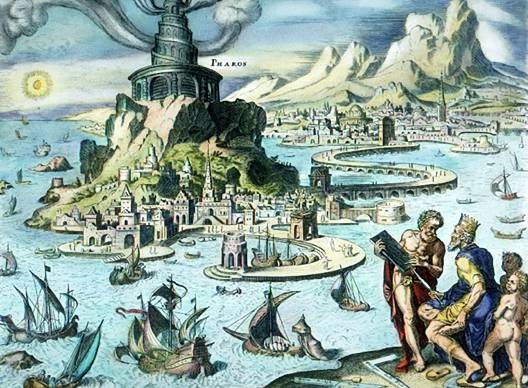
Take a moment to place yourself on the map. This is the Anfushi and Bahary area, the old maritime quarter on the western side of the Eastern Harbour. Walk along the seafront corniche and you reach the Citadel of Qaitbay, the fifteenth-century fortress that stands near the site of the ancient Pharos lighthouse. Fishing boats sit in the harbour. Fish restaurants line the side streets. Few mosques anywhere sit this close to such a strong smell of the sea.
So before you leave, stand still in the square for a minute. Look up at the minaret against the sky, and follow the carved bands of stone with your eyes. Listen to the traffic, the gulls, and perhaps the call to prayer rising over the rooftops. A young man from Spain survived a long journey to arrive on this coast. Seven centuries later, people still come to his door, and the sea is still just a short walk away.
Key facts
What to look for
Practical tips
Common questions
Is there a free audio guide to Abu al-Abbas al-Mursi Mosque?
Yes — the Lokali app narrates Abu al-Abbas al-Mursi Mosque free of charge in 50+ languages. The guide runs about 7 minutes, covers the history, what to look for on site and practical tips, and works offline once downloaded.
Where is Abu al-Abbas al-Mursi Mosque?
Abu al-Abbas al-Mursi Mosque is near Alexandria, Egypt, at 31.2056, 29.8822. Tap the map link on this page for directions from where you are.
What is Abu al-Abbas al-Mursi Mosque known for?
Al-Mursi was born in Murcia, in Muslim Spain. He succeeded al-Shadhili as head of the Shadhiliyya.
What should you look for at Abu al-Abbas al-Mursi Mosque?
The eight-sided plan visible from the square. The tall stepped minaret in Mamluk style. Lace-like carved stone bands on the outer walls.
What should you know before visiting Abu al-Abbas al-Mursi Mosque?
Dress modestly, covering shoulders and knees. Women should bring a scarf to cover their hair.
On the map
Opens directions to Abu al-Abbas al-Mursi Mosque from your location.
More to see in Alexandria



Hear Abu al-Abbas al-Mursi Mosque in your language
The full story, narrated, in 50+ languages. Download it before you go and it plays offline, at your own pace, with no ticket and no tour group.