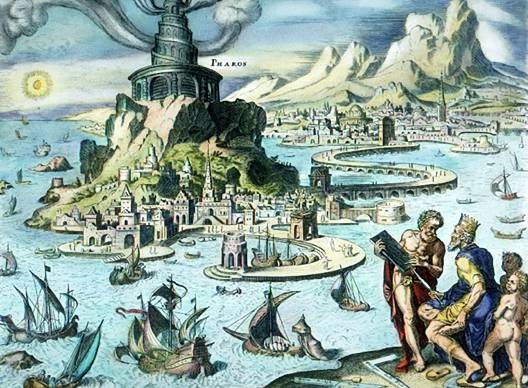
Pharos of Alexandria
31.2142° N · 29.8850° E · Archaeological Site
Photo: Maarten van Heemskerck · Public domain · Wikimedia Commons
Pharos of Alexandria is an island in Egypt. Completed under Ptolemy the Second in the third century BCE. The free Lokali audio guide runs 8 minutes.
✓ Published October 2026 · how we write these guides
Visitor facts
| Lokali audio guide | 8 min · free |
|---|---|
| Type | Archaeological Site |
| Location | Alexandria, Egypt |
| Coordinates | 31.2142, 29.8850 |
| Languages | 50+, in the Lokali app |
The story
Listen first. Waves break against the rocks below you, a steady rush and pull, again and again. The wind comes off the Mediterranean carrying salt and the faint smell of fish from the harbour boats. Under your feet is pale limestone, worn smooth by centuries of weather. You are standing at the tip of a narrow point of land, with the sea on almost every side. More than two thousand years ago, one of the tallest buildings in the ancient world stood on this ground.
That building was the Pharos, the great lighthouse of Alexandria. Today you will not see it. What rises in front of you is a fortress with thick walls and small, watchful windows. That is the Citadel of Qaitbay, built in the fifteenth century. But the citadel sits on the same spot, and parts of it were built from the lighthouse itself. So in a quiet way, the Pharos is still here. You just have to know where to look.
Let us go back to the beginning. Alexander the Great founded this city in the fourth century before Christ. After his death, one of his generals, Ptolemy, took control of Egypt and started a new royal line. The Ptolemies wanted Alexandria to be the greatest port in the Mediterranean. The coast here is flat and low, with dangerous reefs and sandbanks. Ships needed a clear marker to find the harbour safely. The answer was a tower that could be seen from far out at sea.
Work began under Ptolemy the First and was finished under his son, Ptolemy the Second, in the early third century before Christ. The tower stood on a small island called Pharos, just off the mainland. A long causeway, called the Heptastadion, linked the island to the city. Its name means seven stadia, an old Greek unit of distance. Over the centuries, silt built up along that causeway. The island slowly joined the mainland, and that is why you can walk here today.
Here is the first surprise. The name of this island travelled across the world. In Greek, Latin and many later languages, the word pharos came to mean lighthouse itself. In French, a lighthouse is a phare. In Italian and Spanish, it is a faro. Sailors and writers used the island's name for every lighthouse they built afterwards. So every time someone in those languages talks about a lighthouse, they are naming this exact spot.
What did the tower look like? No complete drawing from the ancient period survives, so historians rely on written descriptions and images on old coins. Most accounts describe three stages. At the bottom was a broad square base. Above it rose an eight-sided middle section. At the top sat a round tower, where a fire was kept burning. Modern estimates place the full height at well over a hundred metres. For many centuries, few human-made structures on Earth were taller.
The ancient Greeks counted the Pharos among the Seven Wonders of the World. It stood in that list beside the pyramids at Giza, the Hanging Gardens of Babylon, and the great statue of Zeus at Olympia. Of those seven, only the pyramids survive today. The others are gone, known only from stones, texts and stories. The Pharos was special among them. It was not a tomb or a temple. It was a working building, with a practical job to do every single night.
The builder's name has also come down to us. Ancient writers connect the tower with Sostratus of Cnidus, a Greek from the coast of what is now Turkey. And there is a well-known story about him. According to the Greek writer Lucian, Sostratus carved his own name into the stone, then covered it with plaster bearing the king's name. Over time, the plaster would wear away, and only the builder's name would remain. It is a good tale... but treat it as a tale, not as proven history.
Other legends grew around the light at the top. Some medieval writers claimed a giant mirror there could reflect sunlight for great distances, or even set enemy ships on fire. Historians do not accept the burning ships. What is reasonable is simpler. A fire burned at the summit at night, and sunlight or polished surfaces may have helped by day. The real achievement needs no exaggeration. Keeping a flame alive at that height, in sea wind, was hard work.
The tower lasted an extraordinary time. It stood for well over a thousand years, through Greek, Roman and early Islamic rule. Travellers wrote about it, and some climbed inside. Then a series of strong earthquakes struck the region across the medieval centuries. Each one damaged the structure further. The famous Moroccan traveller Ibn Battuta came to Alexandria in the fourteenth century. On a later visit, he found the lighthouse in ruins, and could no longer enter it.
In the fifteenth century, the Mamluk sultan Qaitbay, a ruler of Egypt, built the fortress you see now. The Mamluks were a dynasty of soldier-sultans who governed Egypt for about two and a half centuries. Qaitbay needed to defend this harbour against attack from the sea. He chose the old lighthouse site, and his builders used fallen stone from the ruins. Look closely at the lower walls. Some of the large blocks there are thought to come from the Pharos.
Here is the second surprise. Much of the lighthouse never left this place. It simply fell into the sea. From the 1990s, divers and archaeologists explored the water of the Eastern Harbour, close to where you stand. They found thousands of stone pieces on the seabed — huge granite blocks, column fragments, and broken statues. Some of these may belong to the lighthouse. Several large statues were lifted out and are now on display in the city.
When you walk around the citadel, think about scale. The fortress feels solid and heavy, but the tower that once stood here rose far, far higher. Look out to sea and imagine its fire burning on a dark night. A sailor many kilometres away could see that point of light and know exactly where Alexandria was. For centuries, this one flame said: the harbour is here, and you are almost home.
Before you leave, stand still for a moment by the sea wall. Feel the spray, and watch the small fishing boats move across the harbour. Turn and look along the curve of the shoreline, back towards the modern city. Then look down at the water near the rocks. Somewhere beneath those waves lie the stones of an ancient wonder. The lighthouse is gone... but its place, its name, and its view of the sea are still yours today.
Key facts
What to look for
Practical tips
Common questions
Is there a free audio guide to Pharos of Alexandria?
Yes — the Lokali app narrates Pharos of Alexandria free of charge in 50+ languages. The guide runs about 8 minutes, covers the history, what to look for on site and practical tips, and works offline once downloaded.
Where is Pharos of Alexandria?
Pharos of Alexandria is in Alexandria, Egypt, at 31.2142, 29.8850. Tap the map link on this page for directions from where you are.
What is Pharos of Alexandria known for?
Completed under Ptolemy the Second in the third century BCE. One of the Seven Wonders of the Ancient World.
What should you look for at Pharos of Alexandria?
Oversized granite blocks reused in the citadel's lower walls. Narrow arrow-slit windows facing out to open sea. Rocks along the shore where ancient stones lie underwater.
What should you know before visiting Pharos of Alexandria?
Visit late afternoon when the sea light softens the stone. Walk the outer sea wall to see both harbours.
When is the best time to visit Pharos of Alexandria?
Visit late afternoon when the sea light softens the stone.
On the map
Opens directions to Pharos of Alexandria from your location.
More to see in Alexandria


Hear Pharos of Alexandria in your language
The full story, narrated, in 50+ languages. Download it before you go and it plays offline, at your own pace, with no ticket and no tour group.