
Photo: Unknown authorUnknown author · CC BY-SA 3.0 de · Wikimedia Commons
Ras El Tin Palace is a palace in Alexandria, Egypt. Ras El Tin means Cape of Figs in Arabic. The free Lokali audio guide runs 7 minutes.
✓ Published October 2026 · how we write these guides
Visitor facts
| Lokali audio guide | 7 min · free |
|---|---|
| Type | Palace |
| Location | Alexandria, Egypt |
| Coordinates | 31.1996, 29.8688 |
| Languages | 50+, in the Lokali app |
The story
Listen first. Somewhere beyond the walls, gulls are calling over the water. Ropes creak against the hulls of fishing boats. The air carries salt, diesel, and the faint smell of grilled fish from the streets of Anfoushi behind you. Ahead, past the guarded gates and the high walls, stands a long, pale palace on the very tip of the Alexandrian headland. This is Ras El Tin. It is one of the oldest royal residences in modern Egypt, and some of the most important days in the country's story took place inside it.
Start with the name, because it tells you what was here before the palace. Ras El Tin means "Cape of Figs" in Arabic. Long ago, fig trees grew on this point of land, where the old peninsula reaches out between the harbours. The fig groves are gone now. The name stayed. Today you stand where farmers once picked fruit, and later where kings received ambassadors and signed papers that changed Egypt.
The palace began with Muhammad Ali Pasha, the Ottoman commander who took power in Egypt in the early nineteenth century. Historians often call him the founder of modern Egypt. He built factories, schools, canals, and a new army and navy. Alexandria sat at the centre of his plans, because the sea connected Egypt to Europe and to the wider Ottoman world. Work on Ras El Tin started in the 1830s. The palace was finished in the following decade, and it became his summer seat by the sea.
Think about why he chose this exact spot. From here, a ruler could watch the western harbour. That was the working harbour, where Muhammad Ali developed his naval yards and his fleet. Ships came and went under the palace windows. A residence on this headland was a home, but it was also a statement. It told visitors arriving by sea that Egypt had a strong and modern government, and that this government was watching the water.
Now look at the building itself, as far as the walls and the gates allow. The palace is long and low against the sky, with pale facades and tall windows facing the sea. What you see today is not exactly what Muhammad Ali built. In the 1920s, King Fuad the First rebuilt and enlarged the palace. He gave it a grander, more European style, close to the palaces of Italy and France of that time. So the building carries two eras at once: the old foundations of the pasha and the polished face of a twentieth-century king.
Here is a detail many visitors miss. This palace was more than a summer house. For generations, Egypt's rulers moved their court to Alexandria in the hot months. Cairo became heavy and dusty, and the sea breeze here was cooler. Ministers, diplomats, and officials followed the royal family north. For part of each year, the real centre of Egyptian politics was not in Cairo at all. It was here, on this windy point above the harbour.
And now the most famous moment. In July 1952, a group of army officers took power in Egypt. They called themselves the Free Officers. King Farouk, the son of Fuad, was in Alexandria at the time. Inside Ras El Tin Palace, he signed his abdication. The monarchy that began with Muhammad Ali's family was coming to an end. Within a few years, Egypt became a republic.
The second surprise is how the king left. Farouk did not leave by road or by plane. He sailed away from the palace harbour on the royal yacht, the Mahrousa, an elegant ship from the nineteenth century. The officers allowed him to go into exile with dignity, and the guns of the navy saluted him as he departed. Picture it: the last king of Egypt standing on the deck, watching this same pale palace grow smaller on the horizon. The yacht still exists today and is still in Egyptian service.
After the revolution, the palace did not become a public museum, as many royal buildings did. It stayed an official state property. It is linked to the presidency and to the navy, which has a strong presence in this part of the harbour. This is why the walls are high and the guards are serious. For most visitors, Ras El Tin is a place to look at from the outside. That is not a failure of your visit. It is part of the story. This building still works for the state.
So use the city around it. Walk through Anfoushi, one of Alexandria's oldest neighbourhoods. The streets are narrow and full of everyday life. You will see cafes with men playing backgammon, small shops selling nets and hooks, and boats painted blue, red, and yellow along the shore. Fishermen mend their nets by hand. Nearby, the great sweep of the Corniche runs along the Eastern Harbour toward the Citadel of Qaitbay, the fifteenth-century fort built near the site of the ancient lighthouse.
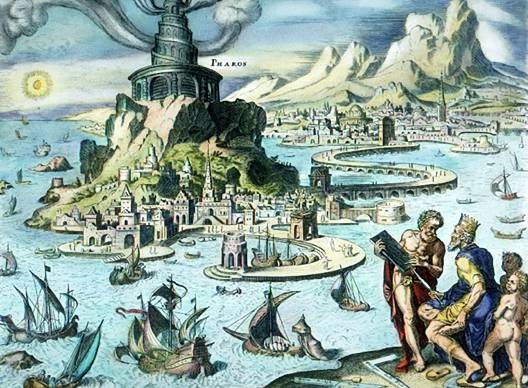
That lighthouse is worth one more thought. In ancient times, the island of Pharos lay just off the coast here, and its lighthouse was one of the Seven Wonders of the ancient world. Over the centuries, land and silt joined the island to the mainland, and the old island became part of this headland. So Ras El Tin stands on ground with a very long memory. Greek kings, Roman sailors, Arab traders, and Ottoman pashas all knew this coastline.
If you get the chance, see the palace from the water. Small boats sometimes take visitors around the harbour, and from the sea the building makes the most sense. You see it as the arriving ships once saw it: a long, bright line of royal power at the edge of the land. In the late afternoon, the light turns warm on the facade, and the water goes from blue to silver.
Before you move on, stand still for a moment. Feel the wind coming off the Mediterranean. Hear the gulls again, and the engines of the fishing boats returning. Behind those walls, a pasha planned a new Egypt, kings spent their summers, and a monarchy ended with a signature and a ship. Out here, the city keeps living its ordinary day. As you walk back through Anfoushi, look once over your shoulder... at the pale palace on the Cape of Figs.
Key facts
What to look for
Practical tips
Common questions
Is there a free audio guide to Ras El Tin Palace?
Yes — the Lokali app narrates Ras El Tin Palace free of charge in 50+ languages. The guide runs about 7 minutes, covers the history, what to look for on site and practical tips, and works offline once downloaded.
Where is Ras El Tin Palace?
Ras El Tin Palace is in Alexandria, Egypt, at 31.1996, 29.8688. Tap the map link on this page for directions from where you are.
What is Ras El Tin Palace known for?
Ras El Tin means Cape of Figs in Arabic. Muhammad Ali Pasha began the palace in the 1830s.
What should you look for at Ras El Tin Palace?
Tall rows of windows facing out over the sea. Pale, European-style facades from King Fuad's 1920s rebuild. Colourful painted fishing boats moored along the Anfoushi shore.
What should you know before visiting Ras El Tin Palace?
Plan to view the palace from outside; interiors are generally closed. Do not photograph guards, gates, or naval areas nearby.
When is the best time to visit Ras El Tin Palace?
Come in late afternoon for warmer light on the building.
On the map
Opens directions to Ras El Tin Palace from your location.
More to see in Alexandria



Hear Ras El Tin Palace in your language
The full story, narrated, in 50+ languages. Download it before you go and it plays offline, at your own pace, with no ticket and no tour group.