
Photo: Vlahos Vaggelis · CC BY 2.5 · Wikimedia Commons
Amphipolis is an ancient city of Macedonia, Greece. Athenian colony founded by Hagnon in 437 BC. The free Lokali audio guide runs 6 minutes.
✓ Published October 2026 · how we write these guides
Visitor facts
| Lokali audio guide | 6 min · free |
|---|---|
| Type | Archaeological Site |
| Location | Amphipolis, Greece |
| Coordinates | 40.8238, 23.8478 |
| Languages | 50+, in the Lokali app |
The story
Listen first. On a still day here, you can hear the wind move through dry grass and low pines. Somewhere below, the River Strymon slides toward the sea, slow and brown. The ground underfoot is a mix of packed earth, loose stones, and scattered marble. Some of those stones were cut by hands more than two thousand years ago. Welcome to Amphipolis, a city that once sat at the centre of the ancient Greek world's arguments.
The name gives you the first clue. In ancient Greek, Amphipolis means something close to the city on both sides, or the city surrounded. The Strymon curves around this hill, so water once protected the town on several sides. Look at the land around you and imagine the river as a moat. That bend gave the site its strength. It also made the place a prize that empires kept fighting over.
Before the Greeks built a city here, the spot had another name: Ennea Hodoi, which means Nine Roads. It was a Thracian crossroads. The Thracians were the tribal peoples of this northern region. Routes for timber, gold, and silver met here, because the nearby mountains held forests and mines. Athens wanted that wealth badly. An early Athenian attempt to settle the area ended in disaster, when Thracian forces destroyed the colonists inland.
Athens tried again, and in 437 BC a leader named Hagnon founded Amphipolis as an Athenian colony. Ancient writers describe long walls that ran around the hill and down toward the river. Archaeologists have traced parts of these walls, and some stretches still stand. As you walk the site, watch for heavy, fitted blocks at the edge of the paths. Those are the bones of a fortress city, built to hold the crossing at all costs.
Now comes a surprise that most visitors miss. One of history's first great historians lost his career here. Thucydides, the Athenian who wrote the history of the long war between Athens and Sparta, was an Athenian general in this region. In 424 BC, the Spartan commander Brasidas captured Amphipolis before Thucydides could arrive with his ships. Athens punished him with exile. That exile gave him the time and distance to write his famous history.
Two years later, the Athenians came back to retake the city. Their leader was Cleon, a forceful politician from Athens. The battle of Amphipolis followed, outside these walls, in 422 BC. Both commanders died, Cleon and Brasidas alike. With the two strongest voices for war gone, Athens and Sparta soon agreed to a peace. The people of Amphipolis honoured Brasidas as a hero and as the new founder of their city, and set aside Hagnon's memory.
The next chapter belongs to Macedonia. In 357 BC, King Philip the Second, the father of Alexander the Great, took Amphipolis. The city became one of the most important places in the Macedonian kingdom. It had a mint that produced coins, and it controlled the wealth of the river valley. Several of Alexander's senior officers are linked with the city, including his admiral Nearchus. From here, Macedonian power looked east toward Asia.
Amphipolis also holds one of the darkest moments of that era. After Alexander died, his generals fought over his empire. Alexander's widow, Roxana, and their young son were held here under guard. Around the end of the fourth century before Christ, the ruler Cassander had them both killed. With that act, Alexander's direct family line came to an end. It is a quiet thought to carry as you stand on this hill.
A short distance from the ancient town, near the old bridge over the river, stands the Lion of Amphipolis. It is a huge marble lion, seated on a tall base. Its pieces were found in the early twentieth century, partly by soldiers during the Balkan Wars and the First World War. Experts reassembled it in the 1930s. Scholars still debate whom the lion honoured, though many link it to a leading figure from Alexander's circle.
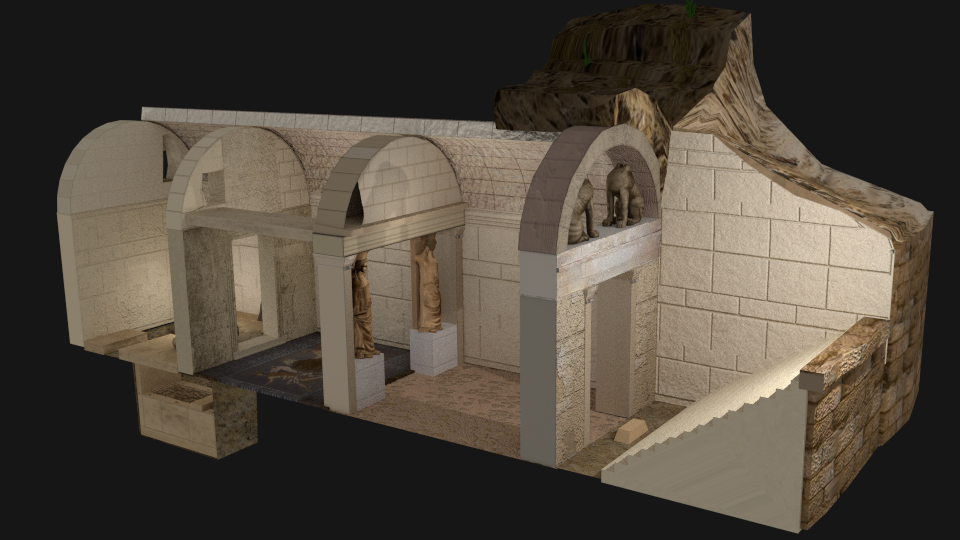
The most dramatic discovery came recently. Between 2012 and 2014, archaeologists led by Katerina Peristeri excavated the Kasta Tumulus, a large burial mound on a nearby hill. Inside, they found a grand tomb. Two marble sphinxes guarded the entrance. Two female figures, called caryatids, stood as columns. A floor mosaic showed the god Hermes leading a chariot that carries Persephone, the goddess of the underworld, away. The true identity of the person buried here is still uncertain.
The Romans arrived later and kept the city alive. Amphipolis lay on the Via Egnatia, the great Roman road that crossed the Balkans from the Adriatic Sea toward Constantinople. The Bible records that the apostle Paul passed through Amphipolis on his travels. In the early Christian centuries, the townspeople built several large churches, called basilicas. Some of their mosaic floors survive. Look for the patterns of birds and geometric shapes under protective covers.
One more thing deserves your attention. The ancient bridge over the Strymon is mentioned by Thucydides, and archaeologists later found the remains of its wooden supports in the riverbed. Wood rarely survives so long, so this find was unusual. In the Archaeological Museum of Amphipolis, you can see objects from across these layers of history. There are coins, pottery, gold jewellery, and pieces of sculpture. They bring the scattered ruins outside into sharp focus.
Before you leave, pause on the hill for a moment. Look at the line of the river and the low hills of the valley. Trace in your mind the walls that once ran across this ground. Generals, kings, and historians all saw this same bend of water. Their stories are now quiet in the stones around your feet. As you walk away, listen again for the wind in the grass... and the slow movement of the Strymon toward the sea.
Key facts
What to look for
Practical tips
Common questions
Is there a free audio guide to Amphipolis?
Yes — the Lokali app narrates Amphipolis free of charge in 50+ languages. The guide runs about 6 minutes, covers the history, what to look for on site and practical tips, and works offline once downloaded.
Where is Amphipolis?
Amphipolis is in Amphipolis, Greece, at 40.8238, 23.8478. Tap the map link on this page for directions from where you are.
What is Amphipolis known for?
Athenian colony founded by Hagnon in 437 BC. Earlier Thracian crossroads site was called Nine Roads.
What should you look for at Amphipolis?
Heavy fitted blocks of the ancient city walls. Seated marble lion on its tall stone base. Bird and geometric mosaics in the early Christian basilicas.
What should you know before visiting Amphipolis?
Visit the museum first to understand the scattered ruins. Bring water and a hat for exposed hillside walks.
When is the best time to visit Amphipolis?
Come early morning for cooler air and softer light.
On the map
Opens directions to Amphipolis from your location.
More to see near Amphipolis


Hear Amphipolis in your language
The full story, narrated, in 50+ languages. Download it before you go and it plays offline, at your own pace, with no ticket and no tour group.