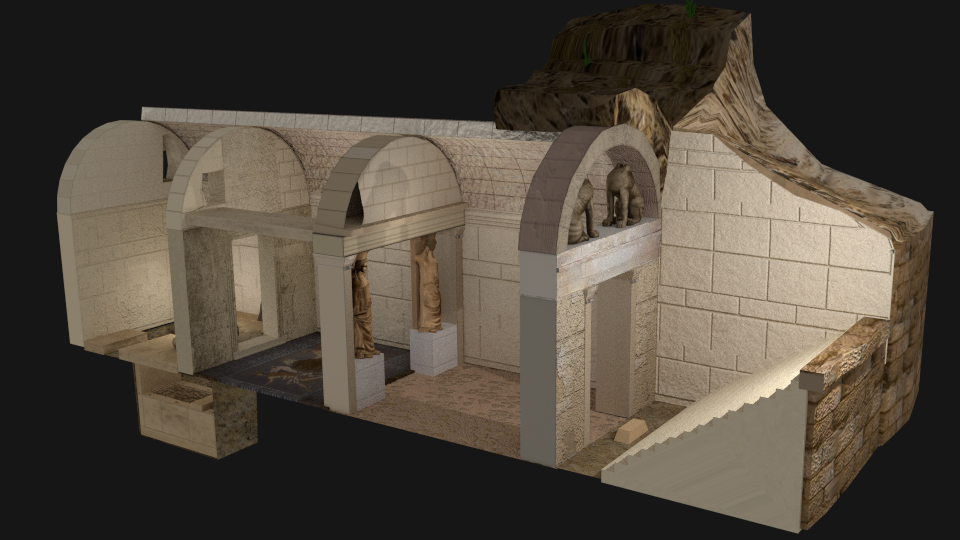
Photo: Magikos fakos http://greektoys.org/ · CC BY-SA 4.0 · Wikimedia Commons
Kasta Tomb is an ancient Macedonian tomb in Amfipoli, Macedonia, Greece. Largest burial monument ever discovered in Greece. The free Lokali audio guide runs 7 minutes.
✓ Published October 2026 · how we write these guides
Visitor facts
| Lokali audio guide | 7 min · free |
|---|---|
| Type | Archaeological Site |
| Location | Amphipolis, Greece |
| Coordinates | 40.8394, 23.8628 |
| Languages | 50+, in the Lokali app |
The story
Listen first. On Kasta Hill, the wind moves through dry grass and low pines, and the ground underfoot feels chalky and loose. Below, the plain of the Strymon River spreads out toward the sea. Somewhere in the distance, a tractor hums, or a goat bell rings once and goes quiet. It is an ordinary hillside in northern Greece. And yet, under this soil, archaeologists found the largest burial monument ever uncovered in the country.
You are standing near the ancient city of Amphipolis, in the region of Central Macedonia. In antiquity, this was an important place. Amphipolis controlled a crossing of the Strymon and sat close to the gold and timber of the surrounding hills. Athenians and Spartans fought over it. Later, it became one of the key cities of the Macedonian kingdom, the homeland of Philip the Second and his son, Alexander the Great. Several of Alexander's admirals and generals had ties to this town.
For a long time, Kasta looked like a natural hill. People farmed around it and walked across it. Then, from 2012 onward, a team led by the archaeologist Katerina Peristeri began systematic excavation. What they uncovered over the next few seasons turned a quiet dig into national news. By the summer of 2014, Greek television was reporting almost daily on each new chamber, and people across the country followed the work like a serial drama.
Start with the scale, because it is the first surprise. The mound is circled by a perimeter wall close to five hundred metres long. That makes it far larger than the famous royal tombs at Vergina, the old Macedonian capital to the west. The wall was faced with marble, and some of the original blocks still survive. Picture it when it was complete: a long, pale ring of stone, shining on a hill above the river plain, visible to anyone travelling through the valley.
The tomb itself dates to the last decades of the fourth century before the common era. That is the generation directly after Alexander's death in 323. It is a so-called Macedonian tomb — a type of underground burial building with chambers in a row, built of carefully cut stone, and then covered with earth. This style was reserved for the elite. The size and quality of Kasta tell us that whoever planned it had enormous resources and wanted the monument to be seen.
The entrance held the next surprise. Two marble sphinxes sat above the doorway, guarding the way in. Sphinxes, in Greek art, are mythical creatures with the body of a lion, wings, and a human head. They often appear as protectors of the dead. Here, the heads were missing when the excavators found them, but the bodies and parts of the wings were still in place. Small traces of colour showed that the stone was once painted.
Beyond the sphinxes, in the second chamber, the team found two caryatids. A caryatid is a column carved in the shape of a standing woman. These two figures wear long, finely folded robes, and each lifts one arm forward, as if to stop a visitor — or to welcome one. Fragments of paint survived on their sandals and clothing. Many people who saw the first photographs remember this moment best: two calm faces appearing out of the soil after more than two thousand years.
The third chamber held a mosaic floor made of small river pebbles in many colours. It shows a chariot pulled by horses. Hermes, the messenger god, leads the way. In Greek belief, Hermes also guided the souls of the dead to the underworld. The driver of the chariot is usually read as Hades, god of the underworld, carrying away the young goddess Persephone. It is a scene about death and the journey beyond it — a fitting image for a tomb.
And then the final chamber. Here, in a stone-lined grave pit, the excavators found human bones. Later study identified the remains of several people. These included an older woman, two adult men, a newborn baby, and the cremated remains of another individual. One of the men showed signs of injuries from a blade. The bones did not come with a name. That absence opened the door to the biggest question of all.
Who was this tomb built for? Over the years, many names have been proposed. Some suggested Olympias, the mother of Alexander. Others suggested his wife Roxana, or one of his generals. The excavation leader later argued for Hephaestion, Alexander's closest companion, based on inscriptions found at the site. Other scholars disagree. It is important to be honest here: there is no agreed answer. The occupant of Kasta Tomb remains an open question, and the debate continues among archaeologists.
There is one more piece to the puzzle, and it stands a short drive away. Near the old bridge over the Strymon, a huge marble lion sits on a pedestal. This is the Lion of Amphipolis, a funerary monument from roughly the same period. Its fragments were found in the area in the early twentieth century and later reassembled. Some researchers believe the lion once crowned the top of the Kasta mound. Others are not convinced. Either way, it is worth seeing the two places on the same day.
As you stand here now, remember that the work is not finished. Much of the tomb's structure was fragile when it was found, and restoration has continued for years. Access to the interior has been limited and has changed over time. What you see around you — the wall, the mound, the scaffolding or fences — is part of a long and careful process. Excavation in Greece moves slowly, and a site like this can take decades to fully understand.
Before you leave, turn toward the river plain once more. This is the view the builders chose. Somebody, more than two thousand years ago, decided that this hill deserved the largest tomb in Macedonia. We may never learn their name. But the light on the Strymon, the dry smell of the grass, and the line of the old marble wall are the same things that person's mourners saw. Take a moment with that... and then walk on slowly, past the stones.
Key facts
What to look for
Practical tips
Common questions
Is there a free audio guide to Kasta Tomb?
Yes — the Lokali app narrates Kasta Tomb free of charge in 50+ languages. The guide runs about 7 minutes, covers the history, what to look for on site and practical tips, and works offline once downloaded.
Where is Kasta Tomb?
Kasta Tomb is near Amphipolis, Greece, at 40.8394, 23.8628. Tap the map link on this page for directions from where you are.
What is Kasta Tomb known for?
Largest burial monument ever discovered in Greece. Perimeter wall runs close to five hundred metres.
What should you look for at Kasta Tomb?
Surviving marble blocks of the original perimeter wall. Curve of the mound against the Strymon River plain. Headless sphinxes guarding the tomb's entrance doorway.
What should you know before visiting Kasta Tomb?
Check current access status before visiting; restoration work is ongoing. Pair your visit with the Lion of Amphipolis nearby.
On the map
Opens directions to Kasta Tomb from your location.
More to see near Kasta Tomb


Hear Kasta Tomb in your language
The full story, narrated, in 50+ languages. Download it before you go and it plays offline, at your own pace, with no ticket and no tour group.