
Mycenae
37.7308° N · 22.7561° E · Archaeological Site
Photo: Andreas Trepte · CC BY-SA 2.5 · Wikimedia Commons
Mycenae is an ancient city, now an archaeological site in Argolis, Greece. Lion Gate dates to the thirteenth century before Christ. The free Lokali audio guide runs 7 minutes.
✓ Published October 2026 · how we write these guides
Visitor facts
| Lokali audio guide | 7 min · free |
|---|---|
| Type | Archaeological Site |
| Location | Argos-Mykines, Greece |
| Coordinates | 37.7308, 22.7561 |
| Languages | 50+, in the Lokali app |
The story
Listen first. Wind moves through dry thyme and wild olive, and somewhere below a goat bell sounds. Under your shoes the path is pale, dusty limestone, polished smooth by many feet. Ahead, huge grey blocks rise out of the hillside. Some are bigger than a car. They sit on top of one another with almost no mortar at all. This is Mycenae, and the silence here feels very old. Take a moment before you walk on. Let your eyes adjust to the glare.
Look at the setting before the stones. The citadel sits on a low, rocky hill between two higher mountains. They shelter it like a pair of shoulders. Below, the plain of Argos spreads toward the sea. It is a patchwork of orange groves and olive trees. From this height, the rulers of Mycenae could watch the roads and the farmland. They could see who was coming long before anyone arrived. Position mattered here. Power in this landscape came from control of the routes.
Mycenae was the heart of a Bronze Age civilisation. Historians named that whole world after this one hill: the Mycenaean civilisation. It flourished in the second millennium before Christ, roughly between 1600 and 1100 BCE. That is many centuries before the temples of classical Athens. The people here spoke an early form of Greek. They traded across the Mediterranean, and they built palaces, tombs and fortifications. Those works still impress engineers today.
Now walk toward the great entrance. This is the Lion Gate, built in the thirteenth century before Christ. Two massive upright stones carry a single enormous lintel across the top. Above the lintel sits a triangular slab of stone. On it, two animals stand facing each other, their front paws resting on an altar. A column rises between them. It is one of the oldest large pieces of sculpture in Europe that still stands where it was first placed.
Here is a detail many visitors miss. The animals have no heads. Look closely at the top of the slab. Their necks end in a flat, rough surface. Most scholars think the heads were carved separately, possibly from a different stone, and then attached. They were lost long ago. Nobody knows for certain what they looked like. Some researchers have even asked whether these beasts were lions at all. They may have been griffins, the winged creatures of myth.
Run your eyes along the walls beside the gate. Later Greeks looked at these giant blocks and could not believe that humans had moved them. They said the Cyclopes had built them — the one-eyed giants of legend. That is why archaeologists still call this style Cyclopean masonry. The real builders used ramps, levers, and an enormous amount of human labour. The giants belong to folklore. The skill was completely human.
Pass through the gate and look just to your right. You will see a wide ring of upright stone slabs. This is Grave Circle A, a royal burial ground. In 1876, the German businessman Heinrich Schliemann dug here. He was obsessed with the poems of Homer. Inside the shaft graves, he found gold: cups, jewellery, weapons, and several thin gold masks pressed over the faces of the dead. Homer had called Mycenae rich in gold. For Schliemann, the ground seemed to agree.
One mask became famous as the Mask of Agamemnon. Agamemnon was the legendary king of Mycenae, who led the Greeks against Troy in Homer's story. But here is the second surprise. Modern dating shows that these graves are several centuries older than any Trojan War could be. Whoever wore that mask, he was not Agamemnon. The original is now in the National Archaeological Museum in Athens. The legend is still attached to it.
Now climb the path toward the summit. The palace once stood at the top of the hill. Today you will see low walls, stone floors, and the outline of rooms. Look for the shape of the megaron. This was the great hall, with a round hearth in the centre and columns around it. Here the ruler received guests and held ceremonies. On clear days, the view from this point reaches across the plain. Stand still for a moment. Feel the breeze on this exposed ridge.
The palace also kept records. Clay tablets have been found at Mycenae, written in a script called Linear B. This was an early way of writing Greek, using signs for syllables. The tablets are mostly lists: goods, workers, and supplies. They are not poems. They tell us this was an organised, managed economy. Someone here counted sheep and measured oil. Behind the legends of heroes stood clerks and storerooms.
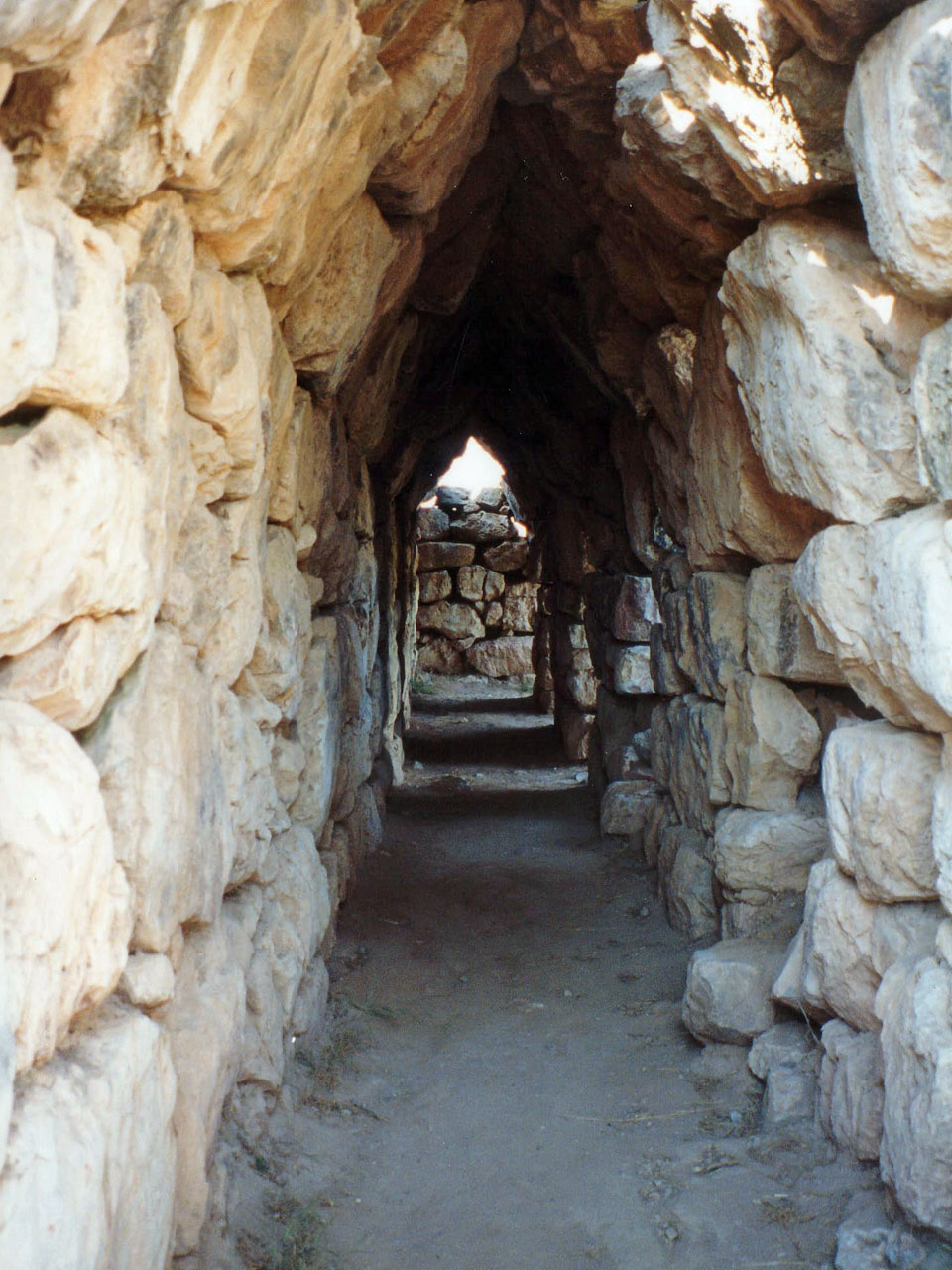
At the far eastern end of the citadel, look for a dark passage leading down into the rock. This is a secret underground route to a water cistern. It was built so that the citadel would not run out of water during a siege. The steps go down steeply into darkness. If you enter, watch your footing and bring a light. The air feels suddenly cool down there.
Outside the walls, a short walk down the road, stands the Treasury of Atreus. It is also called the Tomb of Agamemnon, although no link to him is proven. It is a beehive tomb, a tholos. A long open corridor leads to a tall doorway. Inside, the stone courses rise in rings until they close at the top. For many centuries, it was one of the largest domed spaces in the world. Speak softly inside. The echo returns your voice.
Around 1200 BCE, the palace was destroyed, and Mycenae slowly lost its power. The causes are still debated. Earthquakes, fire, unrest, and broken trade routes are all possible. Later, people came here mainly as visitors to the past. Today Mycenae shares a place on the UNESCO World Heritage List with nearby Tiryns, another Mycenaean citadel. The small site museum near the entrance shows pottery, figurines, and replicas from the excavations.
As you walk back toward the gate, look again at those headless animals. Notice the warm colour of the stone in this light. Listen to the cicadas in the trees and the wind across the hill. Kings and clerks walked here. So did poets and treasure hunters. Now it is your turn. Take one last look across the plain before you go.
Key facts
What to look for
Practical tips
Common questions
Is there a free audio guide to Mycenae?
Yes — the Lokali app narrates Mycenae free of charge in 50+ languages. The guide runs about 7 minutes, covers the history, what to look for on site and practical tips, and works offline once downloaded.
Where is Mycenae?
Mycenae is near Argos-Mykines, Greece, at 37.7308, 22.7561. Tap the map link on this page for directions from where you are.
What is Mycenae known for?
Lion Gate dates to the thirteenth century before Christ. Schliemann excavated Grave Circle A in 1876.
What should you look for at Mycenae?
Flat stumps where the lions' heads were once attached. Single massive lintel stone spanning the Lion Gate. Ring of upright slabs enclosing Grave Circle A.
What should you know before visiting Mycenae?
Arrive early to avoid midday heat on the exposed hill. Wear sturdy shoes for uneven, slippery limestone paths.
When is the best time to visit Mycenae?
Arrive early to avoid midday heat on the exposed hill.
On the map
Opens directions to Mycenae from your location.
More to see in Argos-Mykines



Hear Mycenae in your language
The full story, narrated, in 50+ languages. Download it before you go and it plays offline, at your own pace, with no ticket and no tour group.