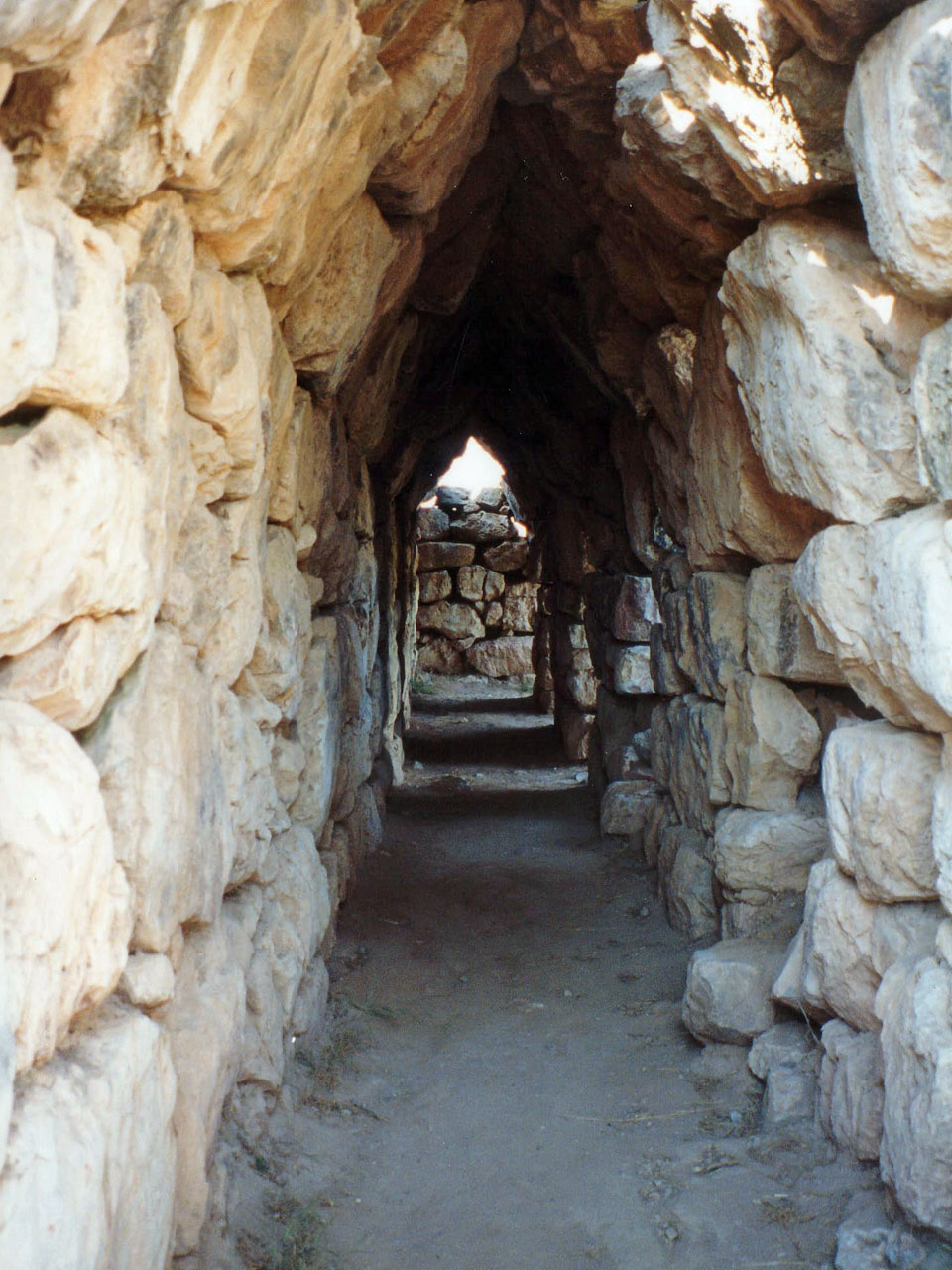
Photo: Alun Salt · CC BY-SA 2.0 · Wikimedia Commons
Tiryns is an ancient city and archaeological site in Argolis, Greece. Tiryns was a major Mycenaean citadel of the Bronze Age. The free Lokali audio guide runs 7 minutes.
✓ Published October 2026 · how we write these guides
Visitor facts
| Lokali audio guide | 7 min · free |
|---|---|
| Type | Archaeological Site |
| Location | Nafplio, Greece |
| Coordinates | 37.5994, 22.7997 |
| Official website | odysseus.culture.gr |
| Languages | 50+, in the Lokali app |
The story
Put your hand flat against the first stone you reach. It is rough, cool in the shade, and enormous: a single grey block wider than your shoulders, fitted against its neighbours with smaller stones packed into the gaps. Around you the Argolid plain spreads out green and flat, lined with orange groves. On a warm day you can smell the citrus. You are standing at the walls of Tiryns, one of the great fortresses of the Mycenaean world.
The Mycenaeans were the Bronze Age Greeks. They are the people behind the kings and heroes of Homer's poems. Their palaces flourished more than three thousand years ago, long before classical Athens and the Parthenon. Mycenae, the most famous of their strongholds, lies a short drive north of here. Tiryns is smaller. But many visitors find it more impressive up close, because its walls still stand so high and so thick.
Look again at the size of those blocks. Later Greeks could not believe that ordinary people had lifted them. Legend has it that the Cyclopes built these walls. They were one-eyed giants of myth, said to have worked for a king named Proetus. That is why archaeologists still call this kind of masonry Cyclopean. The name is a legend. The engineering is real. Huge rough boulders sit in courses, held in place by their own weight, with no mortar at all.
The ancient world knew this place well. Homer, in the Iliad, describes it with a phrase usually translated as Tiryns of the great walls. Many centuries later, the Roman-era travel writer Pausanias came here. He wrote that these walls were as worthy of wonder as the pyramids of Egypt. When you look up at the masonry, it is easy to understand him. Even in ruin, the citadel still dominates the low ground around it.
The fortress sits on a long, low ridge of rock, rising only a little above the plain. That modest height surprises people. In the Bronze Age, however, the setting was different. The sea came much closer to Tiryns than it does today. Over thousands of years, rivers carried soil down from the hills, and the coastline moved south. The bay of Nafplio, which now feels some distance away, once lay much nearer to this rock.
The site has three main parts. At the southern end, on the highest ground, is the upper citadel, where the palace stood. Below it is the middle citadel. To the north is a large lower citadel, enclosed by its own walls. Archaeologists think the lower area held workshops, storage and houses, and it may have sheltered people in times of danger. As you walk, notice how the ground steps down from south to north.
The main approach is a ramp along the eastern side. It climbs toward the gates at an angle. Military historians often point out the logic of a route like this one. An attacker coming up the ramp would have the wall on one side, with defenders standing above. It is a narrow, exposed path, and the design is deliberate. The entrance was meant to slow people down, to make them feel watched, and to make the king's power visible before they reached him.
Now comes one of the strangest places at Tiryns. Inside the thickness of the eastern and southern walls are long covered galleries. Their roofs are corbelled. The builders stacked each layer of stone slightly further inward than the one below, until the two sides met overhead. The result is a pointed passage inside solid rock. People often say the inner walls look polished because shepherds kept flocks here for centuries, and the animals rubbed against the stone. Access to these galleries can be restricted, so follow the signs.
At the top of the citadel stood the palace. Its heart was the megaron, the great hall used by Mycenaean rulers. A megaron had a porch, an anteroom, and a main hall with a round central hearth. In this one, archaeologists identified the place where a throne once stood. Today you see mostly low walls, floors and column bases. Use them like a map. Stand by the hearth area and imagine smoke rising toward an opening in the roof.
The palace was once full of colour. Its walls carried painted plaster, and fragments of these frescoes survived. One famous scene shows women in procession. Another shows a boar hunt, with hunting dogs and spears. These paintings are not on the hill today. They are kept in museums, including the National Archaeological Museum in Athens. If you have time, the archaeological museum in Nafplio also shows finds from the Argolid. Seeing them helps you put colour back onto these grey stones.
Tiryns also belongs to the world of myth. In Greek legend, it is closely linked with Heracles, the hero the Romans called Hercules. Some versions of the story say he lived here while he served King Eurystheus and performed his famous labours. These are tales, not history. But they show how much this fortress meant to later Greeks. For them, a place this old and this massive had to be the home of heroes.
The modern story begins in 1884. In that year, Heinrich Schliemann, the excavator famous for his work at Troy and Mycenae, came here with the architect Wilhelm Dörpfeld. Dörpfeld's careful plans of the palace became especially important. Excavations have continued in many campaigns since then. Archaeologists have explored the lower citadel, the settlement outside the walls, and the changes after the palace era. In 1999, Tiryns and Mycenae were listed together as a UNESCO World Heritage Site.
Like other Mycenaean centres, Tiryns faced a crisis around 1200 BC. Researchers often discuss earthquake damage, fires and broader instability across the eastern Mediterranean. The palace system collapsed, but life here did not simply stop. People continued to live around the hill for some time afterward, in a changed and smaller world. That is one of the quieter lessons of this site. A civilisation can lose its kings and still leave ordinary people behind.
Before you leave, walk back to the outer wall and touch the stone once more. Listen. You may hear traffic on the road, birds in the orange groves, or wind moving across the open hill. The walls do not have carved kings or inscriptions. Their power comes from weight, patience and human work. As you walk away, turn around once. The low ridge will look modest again, until you remember the size of the stones.
Key facts
What to look for
Practical tips
Common questions
Is there a free audio guide to Tiryns?
Yes — the Lokali app narrates Tiryns free of charge in 50+ languages. The guide runs about 7 minutes, covers the history, what to look for on site and practical tips, and works offline once downloaded.
Where is Tiryns?
Tiryns is near Nafplio, Greece, at 37.5994, 22.7997. Tap the map link on this page for directions from where you are.
What is Tiryns known for?
Tiryns was a major Mycenaean citadel of the Bronze Age. Homer called it Tiryns of the great walls.
What should you look for at Tiryns?
Small stones packed between giant blocks in the walls. Pointed corbelled roof inside the eastern gallery. Smooth wall surfaces inside the covered galleries.
What should you know before visiting Tiryns?
Come early to avoid strong midday sun on open ground. Wear sturdy shoes for uneven stone and steep ramps.
When is the best time to visit Tiryns?
Come early to avoid strong midday sun on open ground.
On the map
Opens directions to Tiryns from your location.
More to see near Tiryns


Hear Tiryns in your language
The full story, narrated, in 50+ languages. Download it before you go and it plays offline, at your own pace, with no ticket and no tour group.