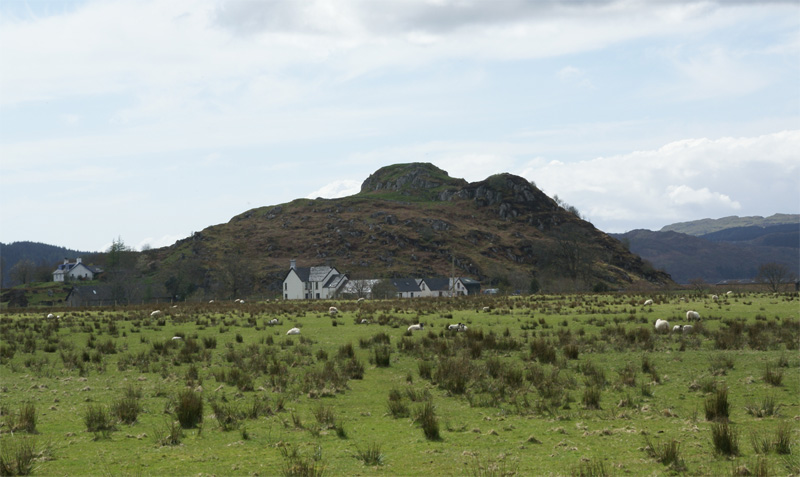
Dunadd
56.0857° N · 5.4789° W · Archaeological Site
Photo: Otter · CC BY-SA 3.0 · Wikimedia Commons
Dunadd is a Hillfort in Knapdale, Argyll and Bute, Scotland; ancient capital of the Dalriadic kingdom and former seat of the kings of Dál Riata. Dunadd was a royal centre of the Gaelic kingdom Dál Riata. The free Lokali audio guide runs 7 minutes.
✓ Published October 2026 · how we write these guides
Visitor facts
| Lokali audio guide | 7 min · free |
|---|---|
| Type | Archaeological Site |
| Location | Argyll and Bute, United Kingdom |
| Coordinates | 56.0857, -5.4789 |
| Official website | historicenvironment.scot |
| Languages | 50+, in the Lokali app |
The story
Start with the ground under your boots. Wet grass, then bare grey rock, worn smooth by many feet. The wind comes across the flat land below with almost nothing to stop it. On a quiet day you can hear sheep, a distant car, and maybe a curlew calling over the bog. This is Dunadd, a rocky hill rising out of the valley floor in Kilmartin Glen, in Argyll on the west coast of Scotland.
Look at the landscape around you. The hill stands almost alone in a wide, flat expanse of peat and rough grass. That flat land is the Moine Mhòr, which means the Great Moss in Gaelic. It is one of the largest surviving raised bogs in this part of Scotland. Close by, the River Add winds slowly towards the sea. The name of this place comes from that river. Dun Add means the fort on the Add.
Around fifteen hundred years ago, this hill was one of the most important places in northern Britain. It was a royal centre of Dál Riata, a Gaelic kingdom that stretched across the sea. Dál Riata had territory in the north of Ireland and here in Argyll. The sea was not a barrier for these people. It was their road. Boats carried kings, monks, traders, and warriors between the two coasts.
Why build a fortress on this particular hill? Stand still and turn slowly. From here you can see far up and down the glen. In the early medieval period, the bog was wetter, and the sea came closer than it does today. Boats could likely come near the foot of the hill. So Dunadd combined a natural stronghold, a view over the land, and access to the water. For a sea kingdom, that mattered.
As you climb, notice how the path passes through narrow gaps in the rock. These were gateways. The fort was built in layers, with stone walls following the natural terraces of the hill. Lower enclosures wrap around higher ones, and the summit sits at the centre. Today the walls are low, grassy lines of tumbled stone. But imagine them standing tall, with timber and thatch buildings inside, smoke rising from hearths.
The written record gives a few short glimpses. Irish chronicles, known as the annals, mention Dún Att, which scholars identify with this hill. They record a siege here in the late seventh century. In the eighth century, the annals say that Óengus, a powerful king of the Picts, captured the fort. The Picts were the people of eastern and northern Scotland. These entries are brief — just a line or two — but they show that this hill was worth fighting for.
Now for the detail most visitors come to find. Just below the summit, on a flat sheet of rock, there are carvings. The most famous is a human footprint cut into the stone. Nearby there is a small round basin, a faint inscription, and the outline of a boar. Many historians believe the footprint was used when a new king was made. The new ruler placed his foot in the print, and so joined himself to the land.
This idea has support from later Gaelic tradition. In the medieval Highlands and Islands, new lords were sometimes inaugurated by standing on a stone footprint. We cannot be completely certain how the Dunadd footprint was used. But the comparison is strong, and the setting fits. Here is a surprise many visitors miss. The carvings you see today are a careful replica. The original rock surface was covered to protect it from weather and feet. The real carvings lie underneath, safe beneath the copy.
Look closely at the inscription. It is written in ogham, an early Irish alphabet made of straight lines cut along a central edge. It looks a little like notches on a stick. Scholars have struggled to read it, and its meaning is still debated. The boar is also interesting. Its style is close to Pictish carving. Some people wonder if it was added after the Pictish capture. That is only one theory, and nobody knows for sure.
Archaeologists have excavated Dunadd more than once, including a major dig in the early twentieth century and careful work in the 1980s. They found evidence of skilled metalworking. There were clay moulds used for casting fine brooches, and crucibles for melting metal. They also found pottery and other goods brought from continental Europe, including from what is now France. So this was not only a fortress. It was a workshop and a trading centre, connected to a much wider world.
Here is a second surprise. Dunadd sits inside one of the richest prehistoric landscapes in Scotland. Long before any king climbed this hill, people in Kilmartin Glen were building burial cairns, raising standing stones, and carving cup and ring marks into rock. These are round hollows surrounded by circles, cut thousands of years ago. When the kings of Dál Riata chose Dunadd, they were choosing a valley already full of ancient monuments. Perhaps that sense of old, sacred ground added to its power.
At the summit, take a moment to rest. The rock is often slippery, so find a steady place to stand. To the north and west, the hills of Argyll fold into one another. Below, the bog stretches out in shades of brown, green, and gold, depending on the season. The light changes quickly here. A patch of sun can move across the glen while rain falls on the next hill. Clouds cast moving shadows over the ground.
Now look down again at the flat rock and the footprint. A person stood here, long ago, while a crowd watched from the slopes below. They looked out at the same river and the same wide moss. As you walk back down, feel the worn steps of rock under your feet. Listen to the wind and the birds over the bog. The walls are low now, and the kings are gone. But the hill is still here, and for a moment, you are standing where a kingdom began.
Key facts
What to look for
Practical tips
Common questions
Is there a free audio guide to Dunadd?
Yes — the Lokali app narrates Dunadd free of charge in 50+ languages. The guide runs about 7 minutes, covers the history, what to look for on site and practical tips, and works offline once downloaded.
Where is Dunadd?
Dunadd is in Argyll and Bute, United Kingdom, at 56.0857, -5.4789. Tap the map link on this page for directions from where you are.
What is Dunadd known for?
Dunadd was a royal centre of the Gaelic kingdom Dál Riata. The name means fort on the River Add.
What should you look for at Dunadd?
The carved human footprint on the flat rock below the summit. A small round basin cut beside the footprint. Faint ogham lines running along the rock surface.
What should you know before visiting Dunadd?
Wear boots with good grip for the wet summit rock. Bring a waterproof layer for fast-changing west coast weather.
On the map
Opens directions to Dunadd from your location.
More to see in Argyll and Bute


Hear Dunadd in your language
The full story, narrated, in 50+ languages. Download it before you go and it plays offline, at your own pace, with no ticket and no tour group.