
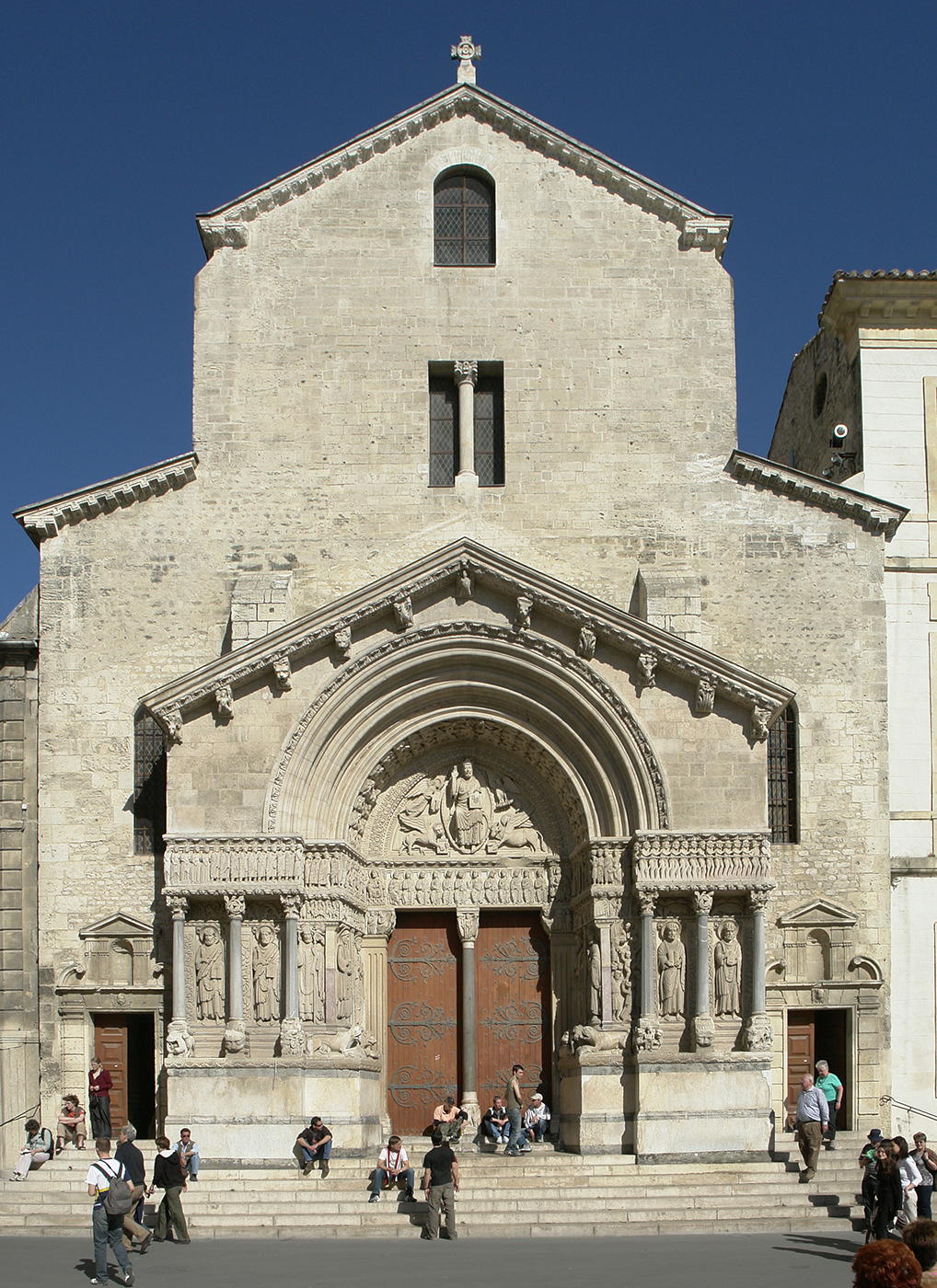
Photo: Hawobo at German Wikipedia · CC BY-SA 2.0 de · Wikimedia Commons
Alyscamps is a Gallo-Roman necropolis in Arles (Bouches-du-Rhône, France). Name comes from the Latin for Elysian Fields. The free Lokali audio guide runs 7 minutes.
✓ Published October 2026 · how we write these guides
Visitor facts
| Lokali audio guide | 7 min · free |
|---|---|
| Type | Archaeological Site |
| Location | Arles, France |
| Coordinates | 43.6714, 4.6369 |
| Languages | 50+, in the Lokali app |
The story
Listen to the gravel under your feet. It crunches softly as you walk down this long, shaded avenue. Tall trees lean in from both sides, and the light reaches you in broken patches. On either side lie rows of stone coffins, open to the sky. Many have no lids. Some hold rainwater, fallen leaves, a little moss. This is the Alyscamps, one of the oldest burial grounds in Arles. For nearly two thousand years, people have come here to walk among the dead.
The name itself is a clue. Alyscamps comes from the Latin words for the Elysian Fields. In Roman belief, the Elysian Fields were a peaceful paradise where the souls of heroes rested. Roman law did not allow burials inside a town's walls. So the people of Arles buried their dead outside the city, along the great road that led into it. That road was the Via Aurelia, which linked Italy with southern Gaul. Travellers arriving here passed tomb after tomb before they reached the gates.
Arles was an important Roman city. It sat on the Rhône River, close to the sea, and it grew rich on trade. Wealthy families wanted grand tombs, and many chose carved stone sarcophagi. A sarcophagus is a stone coffin, often decorated with sculpture. Over the centuries, this cemetery spread wider and wider. At its height, it covered a large area southeast of the old town. What you see today is only a small part of what once stood here.
Then Christianity arrived, and the meaning of this place changed. A local martyr named Saint Genesius was buried here. He was a young clerk who, according to tradition, refused to write down an order against Christians. After his burial, many believers wanted to rest near his grave. Being buried close to a saint was thought to help the soul. So the old Roman cemetery became a Christian one, and its fame grew far beyond Provence.
Legend added even more to that fame. Local tradition says that Saint Trophimus, remembered as the first bishop of Arles, blessed this ground. One popular tale claims that Christ himself appeared during the blessing, and knelt on the stone. Treat that as legend, not history. But stories like this one made the Alyscamps one of the most desired burial places in medieval Europe. People from far away wanted to lie here.
And here is a story most visitors never hear. According to a medieval tradition, families upriver placed their dead in coffins or barrels and sent them floating down the Rhône. Inside, they left a coin to pay for the burial. Men in Arles would watch the river, pull the coffins ashore, and carry them here. Historians are cautious about how often this really happened. Still, the image of the dead drifting down to Arles shows how powerful this place was in people's minds.
The Alyscamps even reached great literature. Dante, the Italian poet, mentions the tombs of Arles in his Inferno, written in the early fourteenth century. He compares the burning tombs of Hell to the uneven graves of this field near the Rhône. The Italian poet Ariosto also placed the cemetery in his long poem about Roland and the knights of Charlemagne. One legend even says that heroes who fell in battle with Roland were buried here. Again, that is poetry and legend, not documented fact.
So why do so many coffins stand empty today? The answer is quieter, and a little sad. During the Renaissance, the finest carved sarcophagi became gifts. City leaders handed them to powerful visitors and nobles as souvenirs. Stones were also taken for building. According to one often-told story, a boat carrying sarcophagi for a French king sank in the Rhône. Whatever the details, the best pieces left this avenue. Many that survived are now kept in the museum of ancient Arles.
The nineteenth century brought another blow. The railway came to Arles, and large workshops were built across part of the old cemetery. A canal also cut through the ground. Much of the ancient necropolis disappeared under industry. What remains is this single avenue, lined with stone, and the church at its end. In a way, the emptiness you feel here is part of the history. You are walking through what survived.
Now turn your attention to that church ahead of you. This is Saint-Honorat, a Romanesque church. Romanesque is a medieval building style with thick walls, round arches, and solid, heavy shapes. Look up at its tower. It rises in several levels, with open arches that let the sky through. The church was never fully finished, and parts of it stand as ruins. Inside, the stone is cool and plain, and sound carries in a soft echo.
In the autumn of 1888, two painters set up their easels here. Vincent van Gogh was living in Arles, and Paul Gauguin had come to join him. Both painted the Alyscamps. They chose the avenue of trees and the falling leaves. Van Gogh used strong orange and yellow tones, with tall trunks rising like columns. Gauguin painted the same place in a calmer, flatter way. Standing here, you can still find the angles they saw.
Today, the Alyscamps is part of a group of Roman and Romanesque monuments in Arles listed by UNESCO as World Heritage. Yet it rarely feels crowded. Many visitors go to the arena and the theatre and never walk this far. That gives the avenue its quiet. You may hear birds in the trees, a distant car, the wind moving through leaves. It is a good place to slow down.
Before you leave, stop for a moment beside one of the sarcophagi. Look at the rough edges, the worn corners, the places where carving has faded. Someone was laid here, long ago, with care and hope for peace. The Romans called this ground the Elysian Fields. As you walk back along the gravel, notice the shadows of the trees on the stones. They move gently, the way they have moved for centuries, over the people who rest here.
Key facts
What to look for
Practical tips
Common questions
Is there a free audio guide to Alyscamps?
Yes — the Lokali app narrates Alyscamps free of charge in 50+ languages. The guide runs about 7 minutes, covers the history, what to look for on site and practical tips, and works offline once downloaded.
Where is Alyscamps?
Alyscamps is in Arles, France, at 43.6714, 4.6369. Tap the map link on this page for directions from where you are.
What is Alyscamps known for?
Name comes from the Latin for Elysian Fields. Roman law banned burials inside the town walls.
What should you look for at Alyscamps?
Lidless stone sarcophagi lining both sides of the avenue. The open arched tower of Saint-Honorat church. Moss and rainwater gathered inside empty coffins.
What should you know before visiting Alyscamps?
Come in autumn for golden leaves along the avenue. Visit early morning for quiet and soft light.
When is the best time to visit Alyscamps?
Come in autumn for golden leaves along the avenue.
On the map
Opens directions to Alyscamps from your location.
More to see in Arles



Hear Alyscamps in your language
The full story, narrated, in 50+ languages. Download it before you go and it plays offline, at your own pace, with no ticket and no tour group.