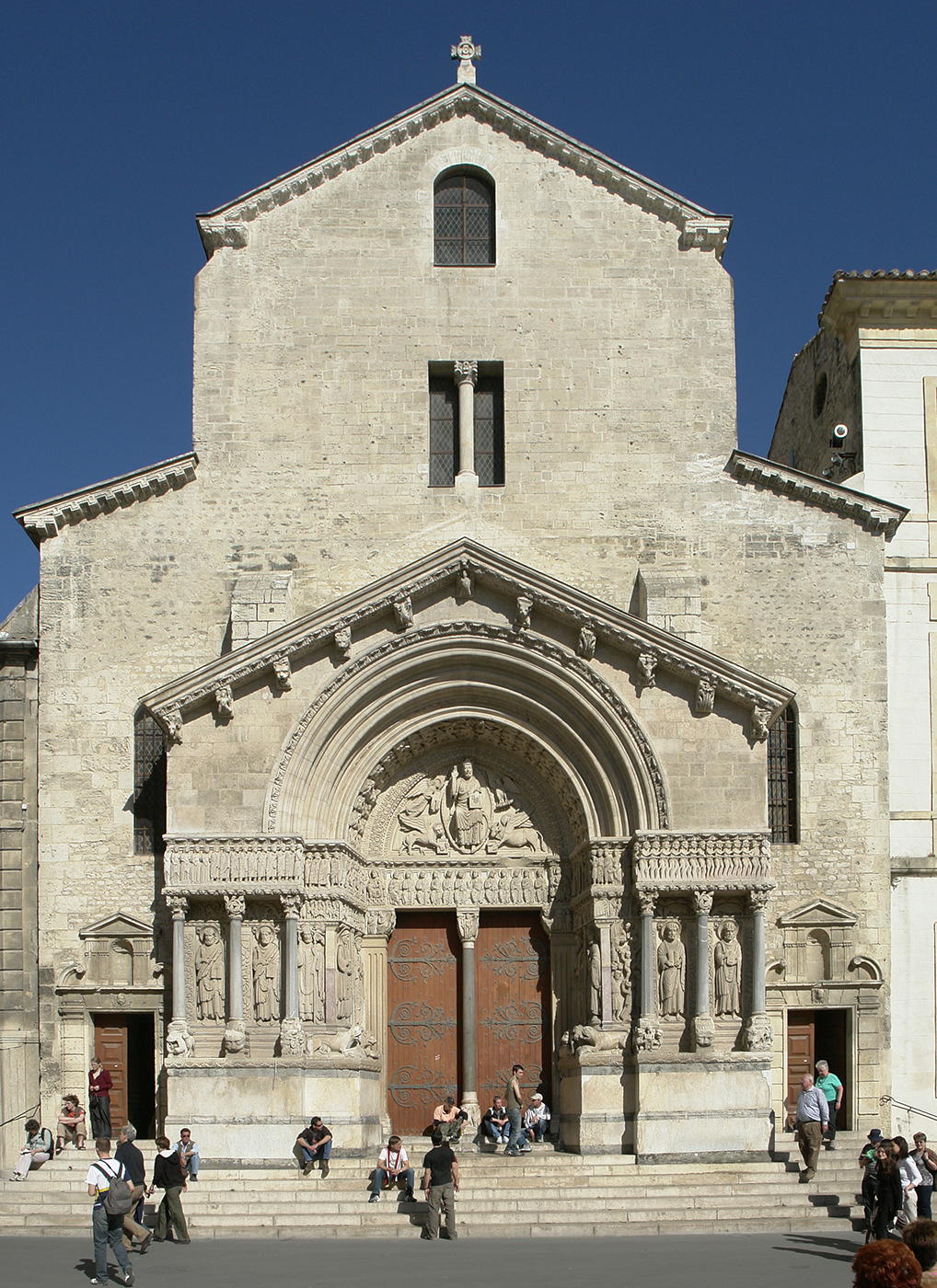
Church of Saint Trophime, Arles
43.6767° N · 4.6281° E · Cathedral
Photo: Wikimedia Commons contributor · CC BY-SA 3.0 · Wikimedia Commons
Church of Saint Trophime, Arles is a former cathedral in Arles (Bouches-du-Rhône, France), today parish church. Portal carved in the twelfth century in Romanesque style. The free Lokali audio guide runs 7 minutes.
✓ Published October 2026 · how we write these guides
Visitor facts
| Lokali audio guide | 7 min · free |
|---|---|
| Type | Cathedral |
| Location | Arles, France |
| Coordinates | 43.6767, 4.6281 |
| Languages | 50+, in the Lokali app |
The story
Stand in the square for a moment and feel the stone under your feet. It is warm, pale, and worn smooth by centuries of shoes. Behind you, an ancient obelisk rises toward the sky. In front of you, a doorway is filled with carved figures, so many that your eye does not know where to land first. This is the Church of Saint Trophime, and that doorway is the reason many people cross half of Europe to stand exactly where you are standing now.
Before the carvings, a word about the square itself. This is the Place de la République, the civic heart of Arles. The town hall sits on one side and the church on another. The obelisk in the middle is Roman. It once stood in the city's chariot-racing circus, long before any church was built here. So in one glance you can see the Roman city, the medieval city, and the modern one, all within about a hundred steps of each other.
Now look at the church's front. Most of the facade is plain, almost severe. Then, in the middle, the portal bursts into detail. It was carved in the twelfth century, in the style we call Romanesque — the round-arched, heavy-walled style of Europe before the pointed arches of Gothic arrived. The contrast is deliberate. A plain wall makes the doorway feel like a page of a book opened just for you.
Look up into the half-circle above the doors. This is the tympanum, and it shows the Last Judgment. Christ sits at the centre in majesty, one hand raised. Around him are four creatures: an angel, a lion, an ox, and an eagle. Medieval viewers knew these at once. They are the symbols of the four Gospel writers — Matthew, Mark, Luke, and John. For people who could not read, this was the Bible written in stone.
Below Christ, along the flat band of the lintel, the twelve apostles sit in a row. Now let your eyes travel sideways, along the frieze that runs across the whole portal. Here is the first surprise many visitors miss. On one side, the saved walk calmly in a procession, clothed and orderly. On the other side, the damned are chained together, naked, and led away toward flames. It is the same story told twice — once with hope, once with warning.
Follow the saved, and look for a seated figure holding small souls in the folds of his robe. This is Abraham, gathering the righteous to him. The image comes from an old phrase, the bosom of Abraham, which meant a place of rest for the faithful. It is a gentle scene, almost tender, and easy to overlook among the drama elsewhere. Take a moment to find it.
Now lower your gaze to the tall figures standing between the columns on either side of the doors. These are saints and apostles, carved almost life-size. Among them is Saint Trophimus himself, the man the church is named after. Nearby, look for Saint Stephen, the first Christian martyr, shown at the moment of his stoning. The church was first dedicated to Stephen. Only later did Trophimus take over the name.
So who was Trophimus? He is honoured as the first bishop of Arles. Legend has it that he was a disciple of Saint Paul, sent to Gaul in the very first years of Christianity. Historians are more cautious, and many place him later, in the third century. Either way, his relics were brought to this church, and his name became attached to it. The story of the legend tells you how proud Arles was of its ancient faith.
Here is the second surprise. This building was once a cathedral, and a place of real political weight. In 1178, the Holy Roman Emperor Frederick Barbarossa was crowned here as King of Arles. Imagine that ceremony: an emperor, his court, and the city's clergy, all crowding through the doorway you are looking at. For a short moment, this square sat on the map of European power. Today the church is no longer a cathedral, but the dignity of that past remains in the stone.
Step inside, and the mood changes completely. The nave is tall, narrow, and dim, with thick walls and small windows. Your eyes will need a few seconds to adjust. The air is cool, even on a hot Provençal afternoon, and sounds soften quickly. At the far end, the choir is brighter and more graceful. It was rebuilt later in the Gothic style, so you are walking from the twelfth century into the fifteenth in just a few dozen steps.
Look along the side chapels for something older still. Arles has many early Christian stone coffins, or sarcophagi, carved in the late Roman period. Some were brought here from the city's ancient burial ground, the Alyscamps. A few now serve as altars inside the church. Their carved figures are rounder and softer than the medieval saints outside. They show a Christian art that was still learning from Roman sculpture.
Then there is the cloister, reached through a separate entrance beside the church. It is a square garden surrounded by covered walkways. Two of its galleries are Romanesque, with paired columns and richly carved capitals telling Bible stories. The other two were built later, in the Gothic style, with pointed arches. Walking all four sides, you can feel the change of centuries under your hand. Together with the Roman monuments of the city, the church and cloister form part of a UNESCO World Heritage site.
In the cloister, slow down. The capitals sit at eye level, so you can study them closely, which is rare in medieval buildings. Look for animals, angels, and small faces tucked into corners. Above, the upper walkway lets you look down into the garden and across to the bell tower. The light here moves slowly through the day. In the morning, the arches throw long, sharp shadows across the stone floor.
When you step back into the square, turn once more toward the portal. Notice how the late light warms the stone, turning it from grey to honey. Listen to the café chairs, the pigeons, the conversations in French around the fountain. The saints are still standing in their rows, the apostles still seated, Christ still raising his hand. They have watched this square for nearly nine hundred years. As you walk away, they will keep watching... the next person who stops, looks up, and starts reading the stone.
Key facts
What to look for
Practical tips
Common questions
Is there a free audio guide to Church of Saint Trophime, Arles?
Yes — the Lokali app narrates Church of Saint Trophime, Arles free of charge in 50+ languages. The guide runs about 7 minutes, covers the history, what to look for on site and practical tips, and works offline once downloaded.
Where is Church of Saint Trophime, Arles?
Church of Saint Trophime, Arles is in Arles, France, at 43.6767, 4.6281. Tap the map link on this page for directions from where you are.
What is Church of Saint Trophime, Arles known for?
Portal carved in the twelfth century in Romanesque style. Frederick Barbarossa crowned King of Arles here in 1178.
What should you look for at Church of Saint Trophime, Arles?
Four Gospel symbols surrounding Christ in the tympanum. Damned souls chained together on the portal frieze. Abraham holding small souls in his robe.
What should you know before visiting Church of Saint Trophime, Arles?
Visit the portal in late afternoon for warm light. Allow time to let your eyes adjust inside.
When is the best time to visit Church of Saint Trophime, Arles?
Visit the portal in late afternoon for warm light.
On the map
Opens directions to Church of Saint Trophime, Arles from your location.
More to see in Arles


Hear Church of Saint Trophime, Arles in your language
The full story, narrated, in 50+ languages. Download it before you go and it plays offline, at your own pace, with no ticket and no tour group.