
Arles, Roman and Romanesque Monuments
43.6776° N · 4.6307° E · Archaeological Site
Photo: Wikimedia Commons contributor · CC BY-SA 3.0 · Wikimedia Commons
Arles, Roman and Romanesque Monuments is an UNESCO World Heritage Site in Arles, France. Julius Caesar settled Sixth Legion veterans in Arles. The free Lokali audio guide runs 7 minutes.
✓ Published October 2026 · how we write these guides
Visitor facts
| Lokali audio guide | 7 min · free |
|---|---|
| Type | Archaeological Site |
| Location | Arles, France |
| Coordinates | 43.6776, 4.6307 |
| Languages | 50+, in the Lokali app |
The story
Put your hand flat against the stone here. It is pale limestone, warm when the Provençal sun has been on it, and smooth in places where countless hands and shoulders have brushed past. Listen for a moment, too. There are swifts overhead, scooters on the cobbles, and the low murmur of café tables. Around you, the remains of a Roman city still stand inside a living French town. People here do not visit these ruins. They walk past them on the way to buy bread.
Arles sits on the Rhône, close to where the river splits and spreads into the wetlands of the Camargue. That position made it valuable. Boats could move goods between the Mediterranean and the interior of Gaul. In the first century before Christ, Julius Caesar settled veterans of his Sixth Legion here. Arles had backed him in the civil war, while its rival, Marseille, had backed Pompey. Caesar rewarded his friends. Marseille lost trade. Arles grew rich.
The largest survivor of that Roman city is the amphitheatre, which locals simply call the Arena. It was built around the end of the first century after Christ. Two tiers of arches rise in a long oval, and about twenty thousand spectators could once sit inside. They came for gladiator fights and animal hunts. Stand back and count the arches on one level. The rhythm is regular and calm — strangely calm, for a building made for violence.
Here is the first surprise. For hundreds of years, the Arena was not a ruin at all. It was a neighbourhood. In the early Middle Ages, people turned it into a fortress. They added towers, and they built houses, two chapels and narrow streets inside the oval. Over two hundred homes filled the seating and the arena floor. Only in the nineteenth century, from the 1820s onward, were these houses cleared away to expose the Roman structure again.
Look up at the square towers above the arches. They are not Roman. They are medieval, and three of the original four survive. They are reminders of the centuries when this oval of stone protected families from raids. Today the Arena has a new life once more. It hosts bullfighting events and the local course camarguaise, a Provençal tradition where young men try to snatch ribbons from a bull's horns. In this version, the bull is not killed.
A short walk away is the Roman theatre, which is older than the Arena. It dates to the reign of Augustus, Rome's first emperor, in the late first century before Christ. Much less of it survives. Over the centuries, its stone was carried off to build churches, houses and walls. What remains is a curved hillside of seating and a scattered stage area. Above it all stand two tall columns, alone against the sky.
People in Arles have a nickname for those two columns. They call them the two widows. They are what is left of a great decorated wall that once stood behind the stage. And here is the second surprise. In the seventeenth century, workers digging near the theatre found a marble statue of a goddess. It became known as the Venus of Arles. The town gave it to King Louis the Fourteenth, and today it stands in the Louvre in Paris.
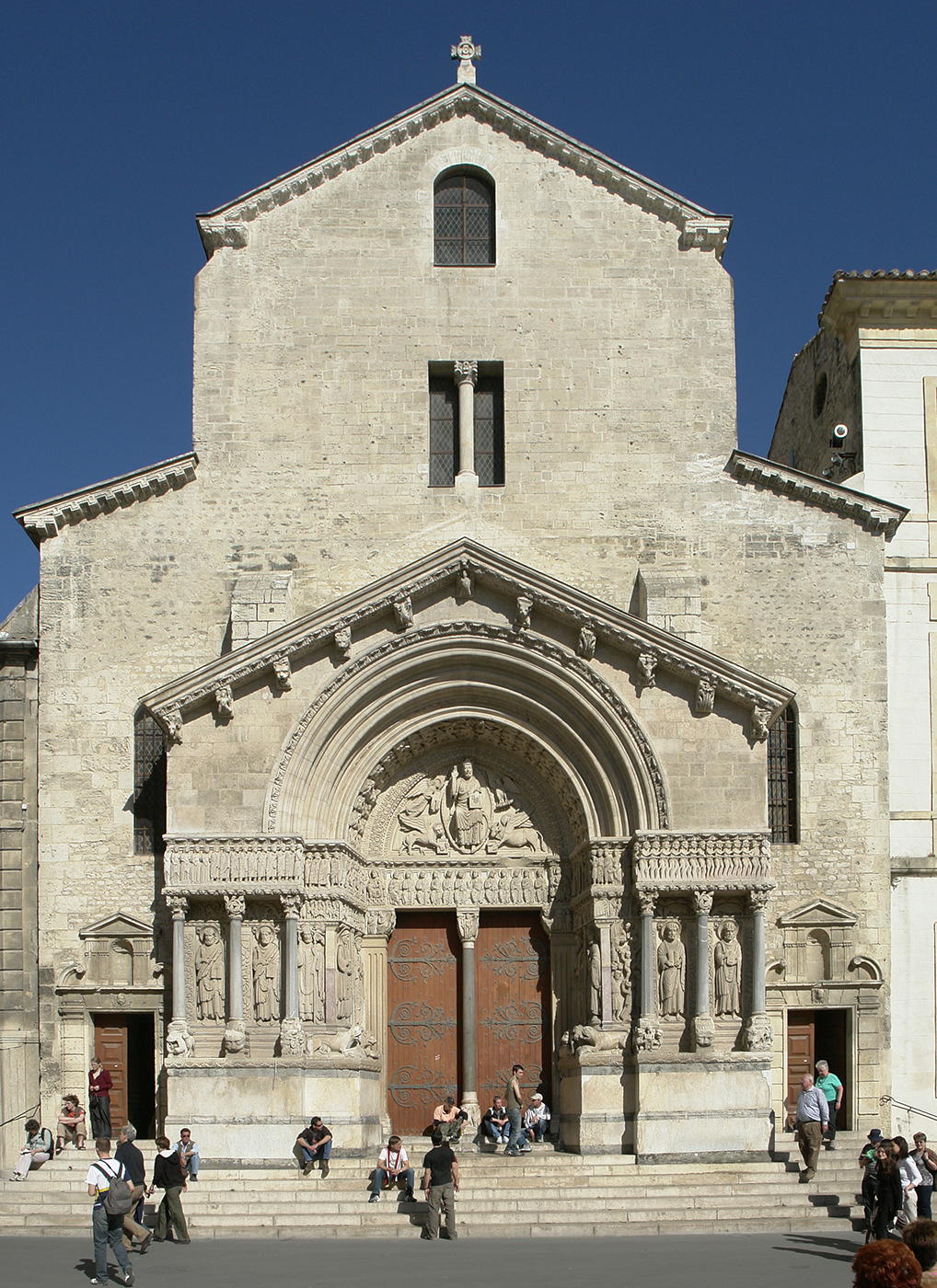
Now, turn your attention to the Middle Ages, and to the second half of this site's name. Romanesque is the style of church building that spread across Europe around the eleventh and twelfth centuries. It uses round arches, thick walls and carved stone. The finest example here is the Church of Saint Trophime, on the Place de la République. Trophime, according to tradition, was the first bishop of Arles.
Stand in front of the main doorway of Saint Trophime. This carved portal is from the twelfth century, and it is one of the great sculptures of southern France. Above the door, Christ sits in majesty, surrounded by the symbols of the four Gospel writers: an angel, a lion, an ox and an eagle. Along the band below, a procession moves in two directions. The saved walk towards heaven. On the other side, the damned are led away in chains.
The carvers here borrowed from Rome. Look at the columns, the fluting and the leaf patterns at the tops. They look much like the Roman pieces you can see in the theatre. In Arles, medieval builders had ancient models all around them, and they copied them with care. Beside the church is a cloister, a quiet square garden walk where the clergy once lived and prayed. It is cool, shaded and noticeably quieter than the square outside.
Under your feet, there is another layer. Beneath the town centre lie the cryptoporticus, long underground galleries built by the Romans. They supported the forum, the main public square above. Down there, the air is damp and cool, and the light is dim. Near the river, you can also find the remains of baths from the time of the Emperor Constantine. He spent time in Arles, and in the early fourth century the city hosted an important gathering of Christian bishops.
At the edge of the old town is the Alyscamps, a Roman and medieval burial ground. For centuries, it was one of the most famous cemeteries in Europe. People wanted to be buried here, near the graves of early saints. Many of its stone coffins were later taken away or given as gifts. What remains is an avenue of empty sarcophagi under tall trees. In 1888, Vincent van Gogh painted this avenue while he lived in Arles.
What makes this site special is not one building. It is the way the layers touch each other. A Roman obelisk stands in the square in front of a medieval church. Bits of ancient columns sit inside the walls of ordinary houses. In 1981, UNESCO listed these monuments together as a World Heritage Site. The listing recognises Arles as a place where Rome and the Middle Ages share the same streets.
Before you move on, look once more at the stone nearest to you. Notice its colour, honey in sunlight and grey in shade. Notice the small repairs, the newer blocks fitted beside the older, worn ones. Listen again to the swifts and the traffic, and to the voices at the café tables. Two thousand years of people have stood where you stand now. As you walk away, keep looking down at the walls and doorways. In Arles, Rome is often at knee height.
Key facts
What to look for
Practical tips
Common questions
Is there a free audio guide to Arles, Roman and Romanesque Monuments?
Yes — the Lokali app narrates Arles, Roman and Romanesque Monuments free of charge in 50+ languages. The guide runs about 7 minutes, covers the history, what to look for on site and practical tips, and works offline once downloaded.
Where is Arles, Roman and Romanesque Monuments?
Arles, Roman and Romanesque Monuments is in Arles, France, at 43.6776, 4.6307. Tap the map link on this page for directions from where you are.
What is Arles, Roman and Romanesque Monuments known for?
Julius Caesar settled Sixth Legion veterans in Arles. The Arena seated about twenty thousand spectators.
What should you look for at Arles, Roman and Romanesque Monuments?
Square medieval towers rising above the Arena's Roman arches. The two lone columns above the Roman theatre. Christ with angel, lion, ox and eagle on Saint Trophime.
What should you know before visiting Arles, Roman and Romanesque Monuments?
Visit the Arena early morning before the stone heats up. Bring a light layer for the cool underground cryptoporticus.
When is the best time to visit Arles, Roman and Romanesque Monuments?
Walk to the Alyscamps late afternoon for softer light.
On the map
Opens directions to Arles, Roman and Romanesque Monuments from your location.
More to see in Arles



Hear Arles, Roman and Romanesque Monuments in your language
The full story, narrated, in 50+ languages. Download it before you go and it plays offline, at your own pace, with no ticket and no tour group.