
Photo: Dodos2013 · CC BY-SA 4.0 · Wikimedia Commons
Ambracia is an ancient city in Greece. Founded by Corinthian colonists in the seventh century BCE. The free Lokali audio guide runs 6 minutes.
✓ Published October 2026 · how we write these guides
Visitor facts
| Lokali audio guide | 6 min · free |
|---|---|
| Type | Archaeological Site |
| Location | Arta, Greece |
| Coordinates | 39.1580, 20.9870 |
| Languages | 50+, in the Lokali app |
The story
Listen for a moment. A scooter passes. A café radio plays low. Somewhere a shutter rattles down. Then look at your feet, and at the pale, worn blocks of stone that sit just below the level of the modern street. Here in Arta, the old city does not stand apart behind a fence on a distant hill. It lies right under the pavements, the shops and the apartment blocks. This was Ambracia, and it is still here.
Most visitors come to Arta for its famous stone bridge over the river. Many leave without knowing that they walked across the capital of a king. The ancient city of Ambracia stood exactly where the modern town stands today. Because people never stopped living here, the ruins appear in small pieces. You find them between houses, in excavated pits beside the road, and in the halls of the local archaeological museum.
The story begins with Corinth, the powerful trading city on the isthmus that joins southern Greece to the mainland. In the seventh century BCE, Corinth sent settlers north along the western coast. Ancient writers link this colony to the family of Cypselus, the tyrant who ruled Corinth at that time. The settlers chose this place for good reasons. It had a fertile plain, a river and a short route to the sea.
That river is the Arachthos, and it still runs along the edge of the town. In antiquity it was navigable for small boats. Boats could travel from the city down to the wide Ambracian Gulf, which carries the old name to this day. From there, ships reached the Ionian Sea and the trade routes to Italy and Sicily. Ambracia was inland and protected, but it was never cut off.
The city grew rich. It built walls of large, carefully fitted stone blocks, and sections of them survive across Arta. Look for the difference in technique where you can. In some places the blocks have many angles and fit together like a puzzle. In others they are cut into neat rectangles and laid in even rows. These styles belong to different periods of building and repair.
Now the first surprise. In the very centre of town, close to traffic and shopfronts, lie the foundations of a temple to Apollo. It was built in the Doric style, the plain and sturdy order of Greek architecture with heavy columns and simple tops. Only the base remains today. But stand beside it and picture the full building rising above you, painted and roofed, with the market life of the city all around it.
The great turning point came in the early third century BCE. Pyrrhus, king of Epirus, made Ambracia his royal capital. His name may sound familiar. He is the king behind the phrase "a Pyrrhic victory" — a win that costs so much that it feels like a loss. He earned it fighting the Romans in Italy, where his armies won battles but lost too many men to continue.
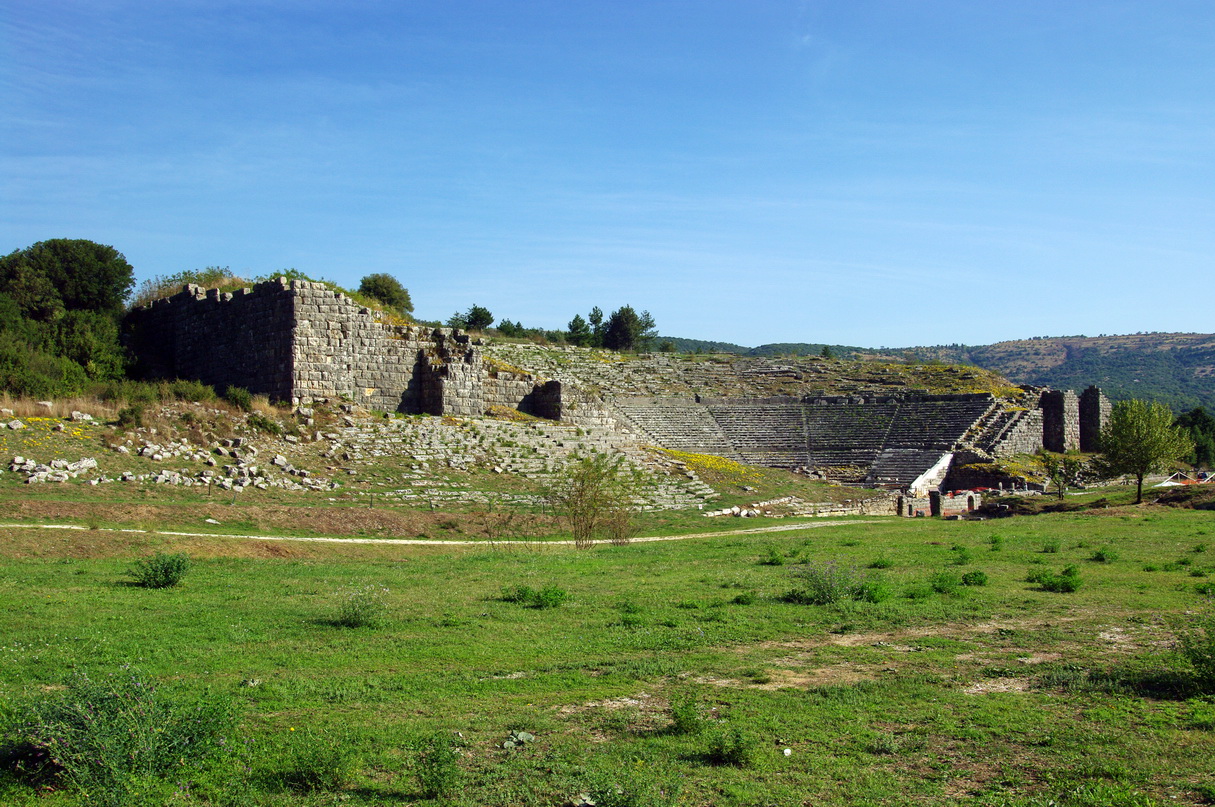
Under Pyrrhus, Ambracia changed from a colonial town into a royal city. Ancient sources describe a palace, new public buildings and many fine works of art. One of the theatres he is linked with survives in the modern town. It is a small theatre with stone seats curving up a gentle slope. It is quiet now, but it once held music, speeches and civic life. You can still sit on the stone where audiences sat over two thousand years ago.
The wealth of Pyrrhus also drew danger. In 189 BCE, a Roman army besieged the city. Ancient historians describe a long and stubborn defence. When the city finally gave in, the Romans removed a great number of statues and paintings and carried them to Rome. So some of the art of Ambracia once decorated the capital of the Roman world... far from this river plain.
The final blow came quietly. After the Battle of Actium in 31 BCE, the victorious Octavian, later the emperor Augustus, founded a new city called Nicopolis to the south. The name means "City of Victory". People from the surrounding towns, including Ambracia, were moved to fill it. The old capital shrank. For centuries it was a modest place, until the medieval town of Arta grew on top of it.
Here is the second surprise. Look up at the walls of the old castle in town, and look closely at their lowest courses. In places the medieval builders set their walls on ancient foundations. They also reused older stone. So one wall can show two thousand years of building in a single glance. Large ancient blocks sit at the bottom, and smaller, rougher medieval work rises above them.
If you want to understand what the streets hide, visit the archaeological museum of Arta. It gathers finds from excavations across the town. These include pottery, coins, sculpture and objects from the city's cemeteries. Many of these finds came to light during ordinary construction work, when builders dug foundations for new houses. In Arta, archaeology often begins with a building permit.
So take a slow walk. Notice the pale stone blocks in the excavated corners beside the road. Notice the river light to the west and the green plain that first drew settlers from Corinth. As you move on, remember that every street here rests on an older one. Under the cafés, the scooters and the evening voices, Ambracia is still holding up the town.
Key facts
What to look for
Practical tips
Common questions
Is there a free audio guide to Ambracia?
Yes — the Lokali app narrates Ambracia free of charge in 50+ languages. The guide runs about 6 minutes, covers the history, what to look for on site and practical tips, and works offline once downloaded.
Where is Ambracia?
Ambracia is near Arta, Greece, at 39.1580, 20.9870. Tap the map link on this page for directions from where you are.
What is Ambracia known for?
Founded by Corinthian colonists in the seventh century BCE. King Pyrrhus of Epirus made Ambracia his royal capital.
What should you look for at Ambracia?
Doric temple foundations of Apollo beside a busy town street. Curved stone seating rows of the small ancient theatre. Large ancient blocks under the medieval castle walls.
What should you know before visiting Ambracia?
Combine the ruins with a visit to the archaeological museum. Walk between sites to see how ruins fit modern streets.
When is the best time to visit Ambracia?
Visit the river bridge last for the evening light.
On the map
Opens directions to Ambracia from your location.
More to see near Ambracia


Hear Ambracia in your language
The full story, narrated, in 50+ languages. Download it before you go and it plays offline, at your own pace, with no ticket and no tour group.