
Jame' Asr Hassanil Bolkiah Mosque
4.8979° N · 114.9218° E · Mosque
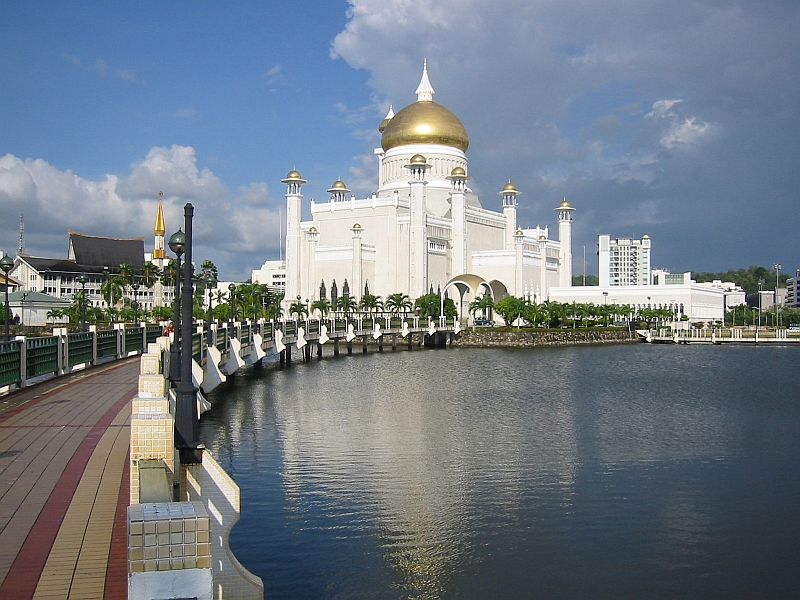
Photo: Balou46 · CC BY-SA 3.0 · Wikimedia Commons
Jame' Asr Hassanil Bolkiah Mosque is a mosque in Bandar Seri Begawan, Brunei. Largest mosque in Brunei, located in Kiarong. The free Lokali audio guide runs 7 minutes.
✓ Published October 2026 · how we write these guides
Visitor facts
| Lokali audio guide | 7 min · free |
|---|---|
| Type | Mosque |
| Location | Bandar Seri Begawan, Brunei |
| Coordinates | 4.8979, 114.9218 |
| Languages | 50+, in the Lokali app |
The story
Listen first. Water moves somewhere close by, running through fountains and channels set into the gardens. Above you, the tropical light hits a cluster of domes covered in gold mosaic, and they almost seem to hum in the heat. Underfoot, the paving is warm and smooth. Welcome to the Jame' Asr Hassanil Bolkiah Mosque, the largest mosque in Brunei and one of the clearest statements a small nation has ever made in stone and gold.
You are in Kiarong, a district a short drive from the old centre of Bandar Seri Begawan. Many people here simply call this building the Kiarong Mosque. That nickname tells you something. For residents it is not a monument on a postcard. It is the neighbourhood mosque, a place for daily prayer, Friday gatherings, weddings and quiet afternoons. Keep that in mind as you walk. You are a guest in a working house of worship.
The word Jame' in the name has a specific meaning. In Arabic it refers to a congregational mosque — the kind of large mosque where a whole community gathers for the main Friday prayer. Smaller mosques serve daily prayers. A Jame' mosque serves the city. The rest of the name honours a person: Sultan Hassanal Bolkiah, the twenty-ninth sultan of Brunei, who came to the throne in 1967 and still reigns today.
The mosque was built to mark the Sultan's silver jubilee, his twenty-fifth year on the throne. It was completed in 1994. Now look up and count the domes. There are twenty-nine of them. That number is not an accident. Each dome stands for one ruler in the long line of Brunei's sultans, ending with the man whose name the building carries. It is a family tree, written across a roofline.
Here is the first detail most visitors miss. Brunei's other famous mosque, the Omar Ali Saifuddien Mosque, stands near the river in the city centre. It was finished in the late 1950s and named after the current Sultan's father. So the two great mosques of the capital are a pair. One belongs to the father and one to the son. Together they span more than half a century of the modern state.
Step back and take in the overall shape. Four minarets rise at the corners of the complex, slender and pale. Each one ends in a small dome of its own. Between them the main building spreads out low and wide, rather than tall. The effect is calm and balanced. The gold stays in the domes, while the walls below are white and cream. That contrast keeps the gold from feeling heavy.
If you come close to a dome — or use a camera zoom — you will see that the gold is not smooth paint. It is made of countless small mosaic tiles. Each tile catches light at a slightly different angle. This is why the domes look alive as clouds pass over. In bright noon sun they flash. Under a grey sky they glow softly, almost like bronze.
Now turn your attention to the gardens. Water is a strong theme in Islamic design. Paradise is often described as a garden with flowing streams, and many mosques echo that image with pools and fountains. Here, channels and fountains line the approach, with palms and clipped hedges around them. In a hot, humid climate the sound of water does real work. It cools the mind before it cools the skin.
Before you go inside, a few practical words. Shoes come off at the entrance. Modest dress is expected for everyone, with shoulders and knees covered. Robes are often available for visitors who need them. The mosque generally closes to non-Muslim visitors during prayer times, and Friday is the busiest day of worship. If the doors are closed when you arrive, enjoy the grounds and return later.
Inside, the scale changes your sense of the place. The main prayer hall is broad and open, built to hold a large congregation shoulder to shoulder. Carpets cover the floor, laid so that worshippers face toward Mecca. Look for the mihrab, the decorated niche in the wall that marks that direction. Above, light filters through windows and spreads across geometric patterns. In Islamic art, these repeating patterns often stand in for images of people, which are avoided in sacred spaces.
Here is a second surprise. A mosque like this is not only for men. There is separate space for women to pray, following common practice across much of the Muslim world. You may also notice how quiet it is, even when people are present. Voices drop. Footsteps soften on the carpet. Even children seem to slow down. The building asks for that stillness, and most people give it without being told.
Come back after sunset if you can. When darkness falls, the mosque is lit, and the gold domes stand out against the night sky. The fountains catch the light too, and the whole complex takes on a softer, warmer tone. Around the time of the evening prayer you may hear the call to prayer rise from the minarets. It is one of the clearest sounds in the city, carrying across the rooftops of Kiarong.
Think about what this building says about Brunei. It is a small country, with oil and gas wealth and a monarchy that places Islam at the centre of national life. This mosque shows all of that at once — the faith, the royal line, the resources to build in gold. Yet on an ordinary weekday, what you mostly see is simple. A man rinsing his hands. A family walking slowly past the fountains. A guard sheltering from the sun.
So before you leave, find a shaded spot and stay a moment. Count the domes once more — twenty-nine rulers, one after another. Listen to the water in the channels. Notice the breeze moving the palm fronds, and the way the gold shifts as you change position. When you walk back toward the road, turn around once. The domes will still be catching the light, exactly as they will tomorrow, and the day after that.
Key facts
What to look for
Practical tips
Common questions
Is there a free audio guide to Jame' Asr Hassanil Bolkiah Mosque?
Yes — the Lokali app narrates Jame' Asr Hassanil Bolkiah Mosque free of charge in 50+ languages. The guide runs about 7 minutes, covers the history, what to look for on site and practical tips, and works offline once downloaded.
Where is Jame' Asr Hassanil Bolkiah Mosque?
Jame' Asr Hassanil Bolkiah Mosque is in Bandar Seri Begawan, Brunei, at 4.8979, 114.9218. Tap the map link on this page for directions from where you are.
What is Jame' Asr Hassanil Bolkiah Mosque known for?
Largest mosque in Brunei, located in Kiarong. Built to mark the Sultan's silver jubilee.
What should you look for at Jame' Asr Hassanil Bolkiah Mosque?
Tiny gold mosaic tiles covering each dome. Four slender minarets, each topped with a small dome. Fountains and water channels lining the approach.
What should you know before visiting Jame' Asr Hassanil Bolkiah Mosque?
Wear clothing covering shoulders and knees before arriving. Avoid visiting non-Muslim hours during prayer times.
When is the best time to visit Jame' Asr Hassanil Bolkiah Mosque?
Return after sunset to see the domes illuminated.
On the map
Opens directions to Jame' Asr Hassanil Bolkiah Mosque from your location.
More to see in Bandar Seri Begawan


Hear Jame' Asr Hassanil Bolkiah Mosque in your language
The full story, narrated, in 50+ languages. Download it before you go and it plays offline, at your own pace, with no ticket and no tour group.