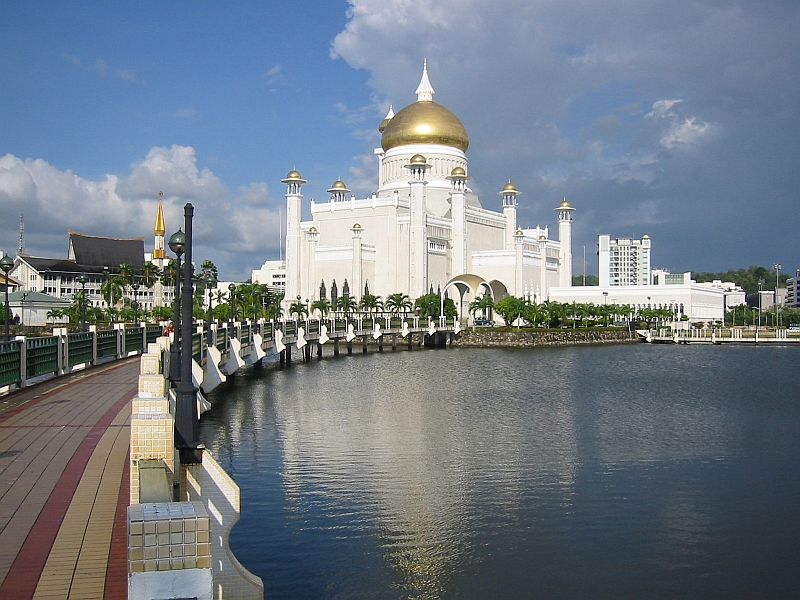
Omar Ali Saifuddien Mosque
4.8896° N · 114.9391° E · Mosque
Photo: Daniel Weiss · CC BY-SA 3.0 · Wikimedia Commons
Omar Ali Saifuddien Mosque is an architectural structure. It is near Bandar Seri Begawan, Brunei. Completed in 1958 in central Bandar Seri Begawan. The free Lokali audio guide runs 7 minutes.
✓ Published October 2026 · how we write these guides
Visitor facts
| Lokali audio guide | 7 min · free |
|---|---|
| Type | Mosque |
| Location | Bandar Seri Begawan, Brunei |
| Coordinates | 4.8896, 114.9391 |
| Languages | 50+, in the Lokali app |
The story
Listen first. Water laps softly against stone. Somewhere across the river, a small boat engine coughs, then hums away into the distance. The air is warm and heavy, and it smells faintly of river mud and wet timber. Then you lift your eyes, and there it is. A golden dome rises above a white building, and the whole scene appears again in the still lagoon below. This is the Omar Ali Saifuddien Mosque, at the heart of Bandar Seri Begawan, the capital of Brunei.
The mosque carries the name of Sultan Omar Ali Saifuddien the Third. He was the twenty-eighth Sultan of Brunei, and he is often called the architect of modern Brunei. He was the father of the current Sultan. Under his rule, oil wealth began to change this small country on the island of Borneo. This mosque became one of the clearest public signs of that change. It was completed in 1958, and it quickly became the visual centre of the capital.
Before the mosque, much of life here happened on the water. Look across the river and you will see Kampong Ayer, which simply means water village. It is a large settlement of houses raised on stilts above the Brunei River. People have lived on this water for centuries. Wooden walkways link the homes, schools, and small shops. Water taxis move between them all day. The mosque was placed deliberately at the edge of this old world, facing it.
Now look at the setting more closely. The mosque does not simply stand beside the river. It stands beside an artificial lagoon, built so that the building would appear to float. On a calm day, the white walls and the gold dome repeat perfectly in the water. This is not an accident of nature. The designers planned this reflection as part of the architecture. The water is a second façade, one that changes with every cloud and every breeze.
Here is the first detail many visitors miss. Out in the lagoon sits a large stone boat. It is a replica of a royal barge, a ceremonial vessel of the kind used by Brunei's sultans in the sixteenth century, a period often remembered as Brunei's golden age of power across Borneo. The replica was added in the 1960s to mark a religious anniversary connected to the Quran. For many years, it was used for official ceremonies and events. Today it rests quietly in the water, a reminder that this was always a river kingdom.
Let your eyes travel up to the dome. It is the feature everyone remembers. The surface is covered in a mosaic, and the gold you see comes from gold within that covering. In strong sunlight it does not simply shine. It glows, almost like a lamp. When clouds pass, it turns softer, closer to honey. Watch it for a minute or two and you will see the colour shift as the light moves.
The style of the mosque mixes several traditions. Many observers point to Mughal influence, the architecture of the Muslim empire that ruled much of India and built monuments such as the Taj Mahal. You can see this in the onion-shaped dome and the slender, decorated towers. There are also Italian touches in the arches and the details. Brunei did not copy one model. It combined ideas from across the Islamic world and beyond, and shaped them into something its own.
The tall minaret deserves a moment too. A minaret is the tower from which the call to prayer traditionally sounds. This one rises well above the surrounding rooftops. For a long time, it was one of the tallest structures in the city. There was a reason for that. People in Bandar Seri Begawan often say that no building in the old centre should stand higher than the mosque. Whether this is a formal rule or a long custom, the effect is clear. The skyline still bows to it.
Here is the second surprise. Much of what you see was gathered from far away. Accounts of the building commonly mention marble from Italy, chandeliers from England, and carpets from the Middle East. A small country, at a moment of new wealth, reached across the world for its finest materials. Yet the mosque never feels like a museum of imports. The pieces sit together calmly, and the result feels unified and peaceful rather than showy.
The mosque is, above all, a working place of worship. Five times a day, the call to prayer rises over the lagoon and the water village. If you hear it while you stand here, pause. Notice how the city seems to slow. People walk with more purpose toward the doors, and the traffic noise fades into the background. Visitors are welcome at many times, but prayer comes first, so non-Muslim visitors should step back during prayer hours.
If you do go inside, a few customs matter. Shoes come off at the entrance. Shoulders and legs should be covered, and robes are often available for visitors who need them. Speak softly. Photography rules inside can change, so follow the guidance of the staff at the door. Inside, the space feels cool and quiet after the heat of the street. The light falls softly through tall windows onto the carpets.
As evening comes, the mosque changes character again. Lights come on across the building, and the dome begins to glow against the darkening sky. The lagoon turns from green to deep blue, and the reflection becomes even sharper. Across the river, the houses of Kampong Ayer light up one by one. Small boats leave thin lines of silver behind them on the water. Many people say this is the best hour to see the mosque.
Take one last look before you move on. Notice the gold above, the white walls, and the stone barge resting in the lagoon. Listen again for the water, and for the boats crossing to the village on stilts. This mosque was built to show a new Brunei to the world. Yet it still faces the old river life that came long before it. As you walk away, turn back once. The reflection will still be there, waiting in the water.
Key facts
What to look for
Practical tips
Common questions
Is there a free audio guide to Omar Ali Saifuddien Mosque?
Yes — the Lokali app narrates Omar Ali Saifuddien Mosque free of charge in 50+ languages. The guide runs about 7 minutes, covers the history, what to look for on site and practical tips, and works offline once downloaded.
Where is Omar Ali Saifuddien Mosque?
Omar Ali Saifuddien Mosque is near Bandar Seri Begawan, Brunei, at 4.8896, 114.9391. Tap the map link on this page for directions from where you are.
What is Omar Ali Saifuddien Mosque known for?
Completed in 1958 in central Bandar Seri Begawan. Named after Sultan Omar Ali Saifuddien the Third.
What should you look for at Omar Ali Saifuddien Mosque?
The golden dome mirrored in the still lagoon. The stone royal barge resting in the water. The tall minaret rising above the old town.
What should you know before visiting Omar Ali Saifuddien Mosque?
Dress modestly with shoulders and legs covered. Avoid visiting during the five daily prayer times.
When is the best time to visit Omar Ali Saifuddien Mosque?
Come at dusk to see the dome illuminated.
On the map
Opens directions to Omar Ali Saifuddien Mosque from your location.
More to see in Bandar Seri Begawan


Hear Omar Ali Saifuddien Mosque in your language
The full story, narrated, in 50+ languages. Download it before you go and it plays offline, at your own pace, with no ticket and no tour group.