
Gran Teatre del Liceu
41.3803° N · 2.1736° E · Opera House
Photo: Chabe01 · CC BY-SA 4.0 · Wikimedia Commons
Gran Teatre del Liceu is an opera house in Barcelona, Spain. The Liceu first opened on La Rambla in 1847. The free Lokali audio guide runs 6 minutes.
✓ Published October 2026 · how we write these guides
Visitor facts
| Lokali audio guide | 6 min · free |
|---|---|
| Type | Opera House |
| Location | Barcelona, Spain |
| Coordinates | 41.3803, 2.1736 |
| Languages | 50+, in the Lokali app |
The story
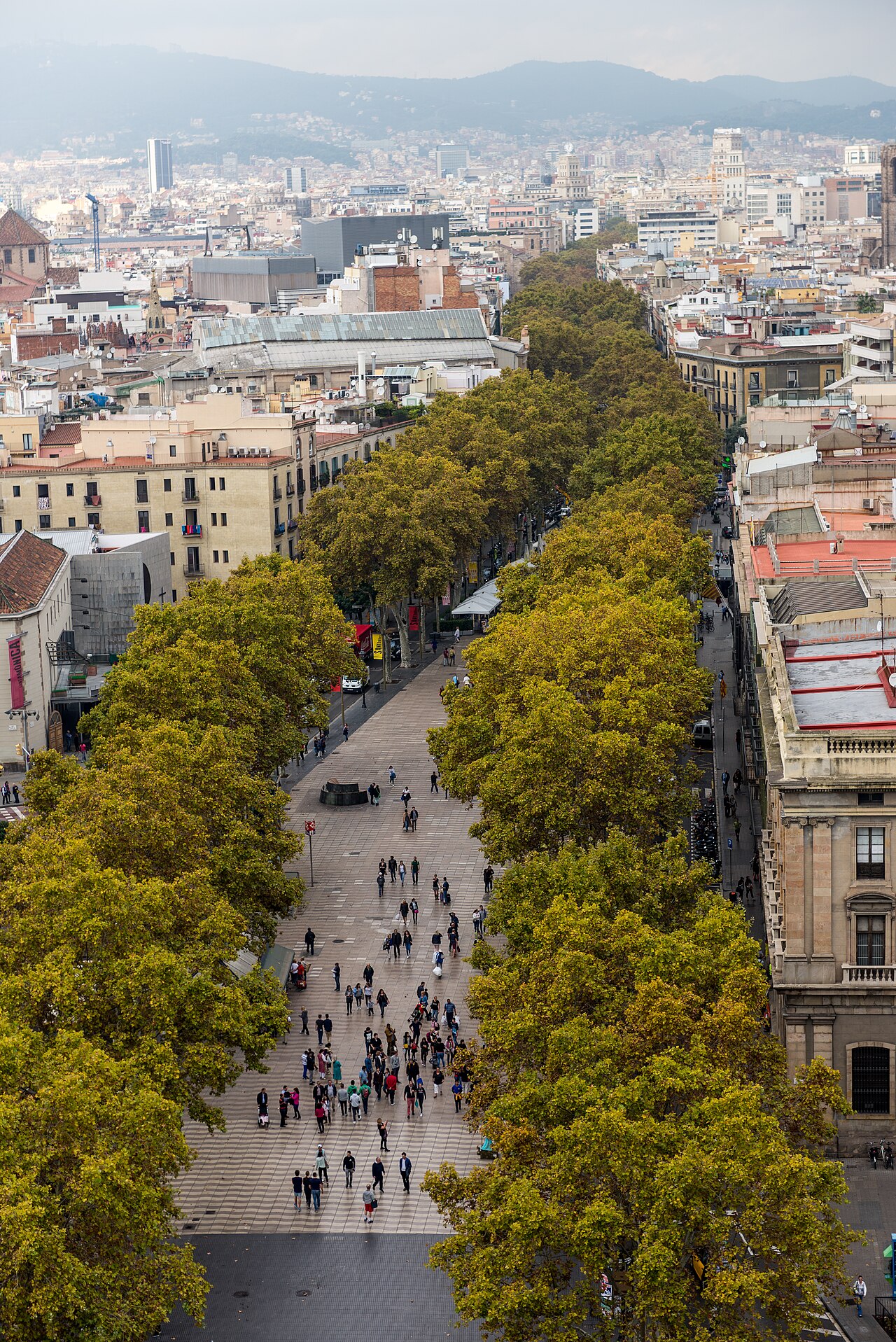
Stand still for a moment on La Rambla. Feel the broad stone pavement under your feet, worn smooth by millions of footsteps. Around you there is the noise of the street: suitcase wheels, café chatter, a busker somewhere down the hill. And here, set into the row of buildings, is a façade that is surprisingly modest. Many people walk right past it. Behind these doors is one of the great opera houses of Europe.
This is the Gran Teatre del Liceu, which most people in Barcelona simply call the Liceu. It opened in 1847. In its day, its horseshoe auditorium was among the largest theatres in Europe. But the first surprise is this. The Liceu was not built by a king or a royal court, as so many European opera houses were. It was paid for by private citizens, a society of shareholders from the city's growing middle class.
That detail matters. In the nineteenth century, Barcelona was becoming an industrial city. Textile mills and trade were making new families rich. These families wanted a stage that matched their ambitions. They wanted somewhere to see and be seen. The shareholders owned their boxes almost like private property. They passed them down through generations, like an apartment or a family jewel.
The theatre took its name from an earlier institution, a music and drama school known as a lyceum. That school needed a larger home. The site it found here on La Rambla had once belonged to a religious convent. So the ground under the opera house has held prayer, then music, for a very long time. The original design came from the architect Miquel Garriga i Roca.
The Liceu has a dramatic history, and not only on stage. In 1861, only fourteen years after opening, a fire destroyed much of the building. The shareholders did not give up. They rebuilt quickly, and the theatre reopened the following year. This pattern of disaster and recovery would return. Again and again, the people of Barcelona decided that their opera house must survive.
The darkest night came in 1893. During a performance of Rossini's William Tell, an anarchist named Santiago Salvador threw two bombs from the upper gallery down into the expensive seats below. Around twenty people died. One bomb did not explode. It was a time of deep social conflict in Barcelona, between wealthy factory owners and poor workers. To many radicals, the Liceu represented the privileged class. The audience inside became the target of that anger.
According to a popular local story, some of the seats where victims died were left empty for years afterwards, out of respect or superstition. It is hard to confirm, so treat it as legend. But the story shows how deeply that night stayed in the city's memory. Even today, the attack appears in Barcelona novels and history books. It reminds us that this elegant theatre stood at the centre of the city's tensions.
Now for a second surprise. Barcelona became one of Europe's great Wagner cities. Audiences here loved the German composer with real passion. When the rights to his final opera, Parsifal, expired at the start of 1914, the Liceu staged it almost immediately. The first performance began just after midnight on New Year's Day. It was among the very first productions of that work outside Wagner's own festival theatre in Bayreuth, Germany.
Over the twentieth century, great voices filled this hall. Two of the most famous singers from Barcelona, Montserrat Caballé and Josep Carreras, are closely connected to the Liceu. For local opera lovers, they are not just stars. They are neighbours who grew up in this city and became famous on the world's biggest stages. For many people here, the Liceu was where those careers felt most personal.
Then, in January 1994, disaster returned. A fire started during repair work, and it spread fast. Within hours, the auditorium and the stage were destroyed. People gathered on La Rambla and watched the flames in shock. Many of them cried in the street. For Barcelona, it felt like losing a member of the family. But some parts survived, including the entrance and the elegant Hall of Mirrors, a grand reception room.
The fire changed the Liceu completely. Before 1994, it belonged to private shareholders. After the fire, public institutions took over, and the theatre became a public opera house. The rebuilding took several years. The architects recreated the classic red and gold horseshoe auditorium, but they also added modern stage technology and new spaces behind and around it. The theatre reopened in 1999. Many visitors who sit inside today do not realise that the old-looking hall is actually younger than they are.
If you go inside on a guided tour or for a performance, look up and around. The auditorium rises in tiers of boxes, gold against deep red. The Hall of Mirrors is all reflections, gilded frames and painted ceilings. There is also a private club connected to the theatre, the Cercle del Liceu, known for its decoration in the Catalan Modernist style, the local form of Art Nouveau. Its rooms are not always open to visitors, so check before you plan around them.
Before you walk on, look down at the pavement nearby on La Rambla. Close to the theatre, there is a large circular mosaic by the Catalan artist Joan Miró, in bright red, yellow and blue. Thousands of people step on it every day without noticing. Then look back at the quiet façade of the Liceu. It has survived two great fires and a bombing, and it is still a working opera house. Somewhere inside, right now, someone may be rehearsing. Listen for a moment... and then let the street carry you on.
Key facts
What to look for
Practical tips
Common questions
Is there a free audio guide to Gran Teatre del Liceu?
Yes — the Lokali app narrates Gran Teatre del Liceu free of charge in 50+ languages. The guide runs about 6 minutes, covers the history, what to look for on site and practical tips, and works offline once downloaded.
Where is Gran Teatre del Liceu?
Gran Teatre del Liceu is in Barcelona, Spain, at 41.3803, 2.1736. Tap the map link on this page for directions from where you are.
What is Gran Teatre del Liceu known for?
The Liceu first opened on La Rambla in 1847. Private shareholders, not royalty, funded the original theatre.
What should you look for at Gran Teatre del Liceu?
The modest stone façade facing directly onto La Rambla. The red and gold tiers of the horseshoe auditorium. Gilded frames and reflections inside the Hall of Mirrors.
What should you know before visiting Gran Teatre del Liceu?
Book a guided tour to see the auditorium by day. Check the season calendar early for popular opera nights.
When is the best time to visit Gran Teatre del Liceu?
Check the season calendar early for popular opera nights.
On the map
Opens directions to Gran Teatre del Liceu from your location.
More to see in Barcelona


Hear Gran Teatre del Liceu in your language
The full story, narrated, in 50+ languages. Download it before you go and it plays offline, at your own pace, with no ticket and no tour group.